✦ AI-generated review
The Electric Youth of the Dial-Up Age
To critique Iain Softley’s *Hackers* (1995) for its technical inaccuracy is to criticize *The Wizard of Oz* for its poor grasp of Kansas meteorology. For years, this film has been the punching bag of the IT crowd, mocked for its graphical user interfaces that resemble arcade games and its notion that typing faster equates to processing power. Yet, looking back through the lens of thirty years of digital saturation, *Hackers* reveals itself not as a failed techno-thriller, but as a surprisingly earnest, avant-garde fairytale. It is a document of a specific cultural moment: the fleeting microsecond when the Internet felt not like a surveillance state or a shopping mall, but like a playground of infinite human potential.
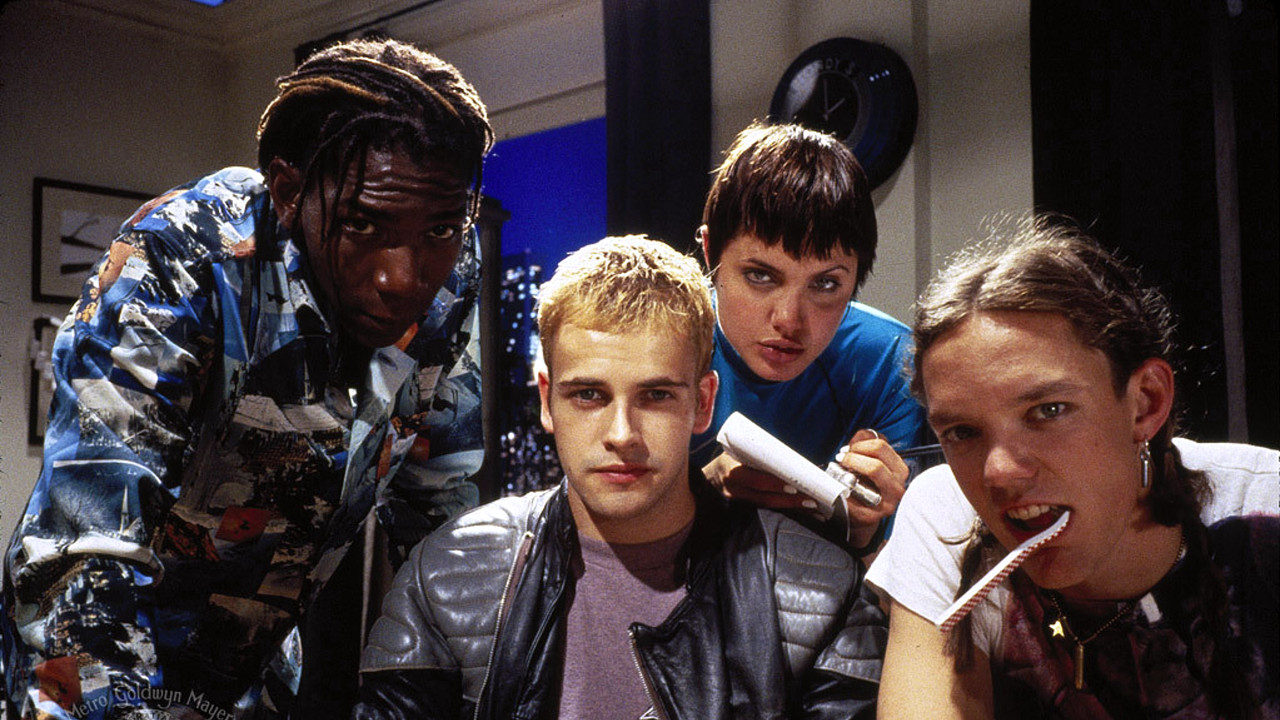
Softley creates a visual language that operates on dream logic rather than binary code. Working with production designers who clearly frequented the rave scene more than the server room, the director visualizes cyberspace as a physical metropolis—a "City of Text" where data towers rise like skyscrapers and files are physical entities to be flown through. When the camera pushes into the circuitry, we aren't seeing silicon; we are seeing the characters' internal projection of power. The film’s most striking visual motif—the projection of code and fractal patterns directly onto the actors' faces—transforms the act of computing into a symbiotic ritual. In these moments, Dade "Zero Cool" Murphy (Jonny Lee Miller) and Kate "Acid Burn" Libby (Angelina Jolie) cease to be awkward teenagers and become bioluminescent deities of a new world.
At its heart, *Hackers* is a story about the fluidity of identity in an analog world that feels too small. The narrative, involving a corporate extortion plot by a skateboard-riding security officer named "The Plague," is admittedly flimsy—a MacGuffin designed to keep the kinetic energy moving. But the emotional core resonates because it treats the hacker ethos with genuine reverence. The film’s diverse ensemble, including the manic "Cereal Killer" (Matthew Lillard), are not depicted as lonely basement-dwellers, but as a high-fashion counterculture, a tribe of digital punks armed with floppy disks and 28.8k modems.
The chemistry between Miller and Jolie provides the film's electrical current. Their competitive courtship—culminating in a laptop duel that feels more like a fencing match than a programming challenge—captures the intellectual intimacy of the early web. They are seeking a peer who speaks their language in a world of illiterate adults. The adults in the film, represented by the Secret Service and corporate suits, are clumsy dinosaurs unable to comprehend the meteor that is about to hit them. The film’s iconic recitation of the "Hacker Manifesto" isn't just a monologue; it is a prayer for a borderless world ("We exist without skin color, without nationality, without religious bias"), a utopian optimism that feels heartbreakingly naive in our modern era of algorithmic bias and geo-blocked content.
Ultimately, *Hackers* survives because it captured the *feeling* of the 1990s digital revolution better than any realistic drama ever could. It portrayed the internet as a neon-soaked rebellion, a place where curiosity was the only currency that mattered. While the technology has aged into obsolescence, the spirit of the film remains potent. It reminds us of a time when we logged on not to doom-scroll or consume, but to explore.