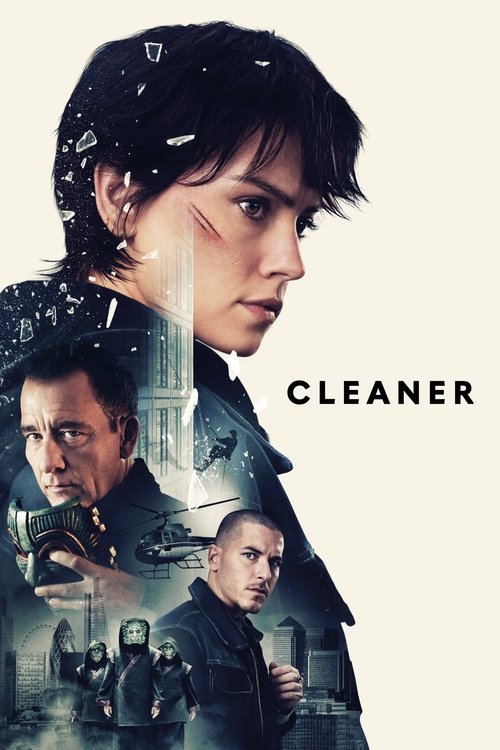

The Vertigo of RoutineIf cinema has taught us anything about skyscrapers, it is that they are rarely just buildings; they are monuments to hubris waiting to be shattered. In *Cleaner*, veteran director Martin Campbell returns to this architectural precipice, not with the suave espionage of *Casino Royale* but with the grimy, tactile desperation of a working-class thriller. While the film struggles to escape the gravitational pull of its obvious influences—namely the *Die Hard* template—it manages to find a pulse in the spaces between the glass, largely thanks to a director who understands that action is meaningless without geography.

The premise is deceptively simple, almost aggressively retro. Joey Locke (Daisy Ridley), an ex-soldier scrubbing the windows of London’s corporate elite, finds herself suspended outside the gala of an energy conglomerate when radical eco-activists seize the building. It is a setup that screams 1990s video store rental, yet Campbell shoots it with a muscular clarity that is increasingly rare in our era of digital sludge.
The film’s visual language is defined by the terrifying transparency of the glass. Campbell and cinematographer Eigil Bryld utilize the window washer’s cradle not just as a prop, but as a stage. The camera lingers on the fraying cables and the dizzying drop, creating a sense of vertigo that feels practical and earned. Unlike the weightless CGI battles of modern superhero fare, *Cleaner* insists on gravity. When Joey swings from a facade, you feel the physics of her body slamming against the steel; the violence here is bruising and exhausted, mirroring the protagonist’s station in life. She is on the outside looking in—quite literally—invisible to the wealthy patrons until she becomes their only hope.

However, the narrative scaffolding is less sturdy than the building itself. The script attempts to weave in contemporary anxieties about climate change, with Clive Owen delivering a sermonizing turn as the activist leader Marcus. But the film suffers from a moral confusion, unsure whether to treat these antagonists as villains or prophets, eventually settling for a muddled middle ground. The emotional core is meant to be Joey’s relationship with her neurodivergent brother, trapped inside. While Ridley approaches the role with a ferocious, sweaty stoicism that recalls Sigourney Weaver’s Ripley, the writing often reduces her brother to a plot device—a "key" to unlock doors rather than a fully realized human being.
Despite these script limitations, *Cleaner* succeeds as a kinetic exercise. There is a specific sequence involving a shattered window and a fire hose that reminds us why Campbell is a master of spatial awareness. He maps out the action so we always know exactly where Joey is in relation to the threat. It is "meat-and-potatoes" filmmaking, yes, but prepared by a chef who respects the ingredients.

Ultimately, *Cleaner* is a film about labor. It juxtaposes the invisible toil of the service worker against the performative ethics of the corporate class. It doesn't quite transcend its genre trappings to become a classic, but it possesses a grit and competence that commands respect. In an industry obsessed with expanding universes, there is something refreshing about a movie that just wants to survive the night, hanging by a thread, fifty stories up.