

The Geometries of DisappearanceIn the modern cinematic landscape, diminishing size is usually a prelude to a superpower. We are accustomed to the *Ant-Man* logic, where becoming small retains density, strength, and kinetic humor. But Jan Kounen’s *The Shrinking Man* (*L'Homme qui rétrécit*), released in the quiet autumn of 2025, rejects this Marvel-ized physics entirely. Returning to the existential dread of Richard Matheson’s 1956 novel, Kounen delivers not an adventure, but a tragedy of logistics. It is a film about the terrifying vulnerability of losing one’s place in the physical world, inch by agonizing inch.

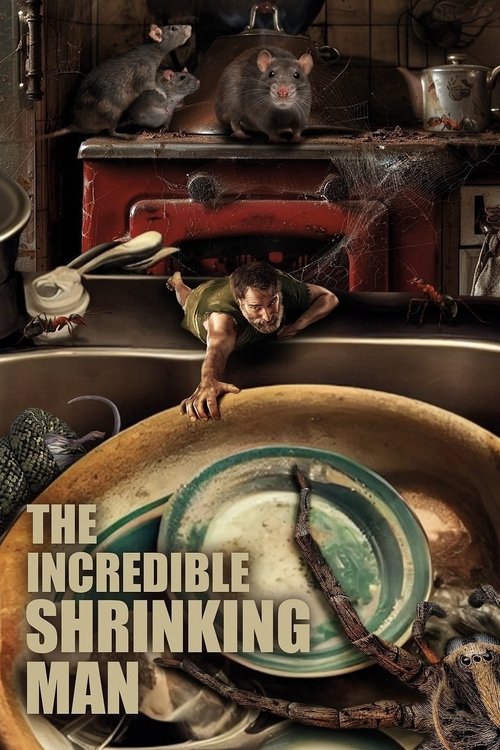
Kounen, a director historically known for the frenetic, drug-fueled excess of *Dobermann* and *99 Francs*, here performs a fascinating act of restraint. He trades his usual hallucinogenic camera work for a suffocating, hyper-realist macro lens. The horror of Paul’s (Jean Dujardin) condition is not conveyed through explosions, but through the mundane architecture of a domestic basement. A cellar stair becomes a Himalayan ascent; a simple spider transforms into a Lovecraftian deity of fur and venom. Kounen utilizes a seamless blend of practical sets and CGI to create a sense of scale that feels heavy and tactile. You don’t just see the size difference; you feel the crushing weight of the ordinary. The sound design deserves particular praise—the boom of a furnace igniting or the thunderous footsteps of a family cat invoke a primal fear that bypasses the intellect and hits the nervous system directly.
At the center of this collapsing universe is Jean Dujardin. Stripped of his trademark charm and that winning, broad smile, Dujardin offers a performance of physical desperation that anchors the film’s high concept. Paul is an "everyman"—a shipbuilder, a husband, a father—whose identity is inextricably tied to his stature. As he shrinks, the film brutally peels away the layers of his masculinity and ego. The screenplay doesn't shy away from the humiliation of his condition; his initial denial and subsequent rage are painful to watch because they are so deeply human. We aren't watching a hero overcome obstacles; we are watching a consciousness struggle to maintain its dignity as it vanishes.

The film’s discourse has been somewhat polarized, with some audiences alienated by the somber, meditative pacing of the second half. It is true that once Paul is trapped in the cellar, the narrative slows to a survivalist grind. However, this tempo is essential to the film’s thesis. The "shrinkage" is not just physical; it is an enforced meditation on insignificance. Kounen asks us to sit in the silence with Paul, to look at a world that no longer acknowledges our dominance. The much-discussed voice-over, while occasionally intrusive, serves as a necessary tether to Paul’s humanity when his body has become foreign to us.
*The Shrinking Man* is a challenging, melancholic work that likely baffled multiplex crowds looking for escapism. It is a "bide" (flop) in the commercial sense, perhaps because it refuses to treat its premise as a joke. Yet, it stands as a technically masterful and philosophically rich piece of cinema. It reminds us that our command over our environment is a fragile illusion, and that in the end, we are all just fighting to remain visible in a universe that is vast, indifferent, and terrifyingly beautiful.