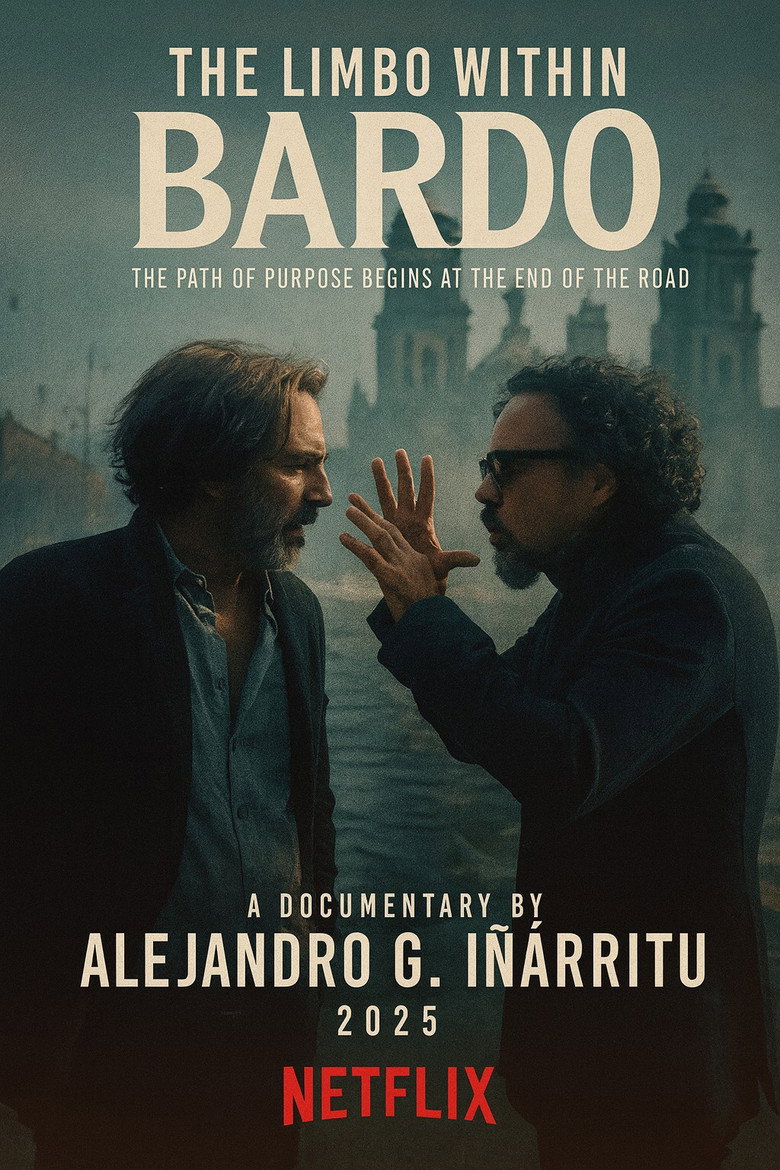
The Limbo within BARDO
2025
Documentary
Reviews
✦ AI-generated review
The Geography of Memory
To watch *The Limbo within BARDO* is to witness a ghost haunting his own house before he has even finished building it. In the modern cinematic landscape, "making-of" documentaries are usually promotional victory laps—sleek, self-congratulatory content designed to justify a franchise’s existence. But Sebastián Hoffman’s 2025 documentary is something far more fragile and unnerving. It is not merely a chronicle of how Alejandro G. Iñárritu made his 2022 opus *Bardo, False Chronicle of a Handful of Truths*; it is an autopsy of the creative fugue state itself.

Hoffman, a director with a keen eye for the surreal in his own right, treats Iñárritu not as a master commander, but as a traveler lost in the fog of memory. The film’s visual language mirrors the fluid, dreamlike cinematography of Darius Khondji (who shot the original *Bardo*), yet Hoffman strips away the gloss. We see Iñárritu standing in the recreated Mexico City of his youth, surrounded by green screens and silence, looking less like a director and more like a man trying to remember a word that is on the tip of his tongue. The camera lingers on the edges of the set—the plywood backing of a majestic hallway, the cables snaking through the desert sand—creating a sense of artificiality that feels suffocatingly real.
The heart of the documentary lies in its refusal to offer easy answers about the artistic process. The central discourse around *Bardo* (the 2022 film) was its sheer, overwhelming indulgence—a film so personal it risked alienating its audience. *The Limbo within BARDO* contextualizes that excess not as ego, but as a desperate attempt to grab hold of smoke. In one particularly striking sequence, we watch Iñárritu struggle with the blocking of the infamous "dance hall" scene. He is not frustrated with the actors; he is frustrated that the reality in front of him cannot match the distortion of his memory. Hoffman captures this friction beautifully, framing the director in isolation against the chaotic bustle of the crew, highlighting the profound loneliness of trying to externalize an internal world.

This is where the documentary transcends its genre. It becomes a meditation on the "limbo" of the title—that terrifying space between an idea and its execution, between a homeland left behind and a new life adopted. For Iñárritu, and by extension the viewer, the set of *Bardo* becomes a purgatory where the past is constantly re-enacted but never fully resolved. The interviews are hushed, almost confessional, lacking the polished soundbites of typical Hollywood featurettes. We are watching a therapy session conducted on an IMAX scale.
Ultimately, *The Limbo within BARDO* serves as a vital companion piece that perhaps eclipses the film it documents in terms of raw emotional clarity. It suggests that the act of creation is a form of grief—a way of mourning the versions of ourselves we left behind. Hoffman has crafted a quiet, observant work that reminds us that cinema is not just about capturing truth at 24 frames per second, but about the agonizing, beautiful struggle to find that truth in the first place.
To watch *The Limbo within BARDO* is to witness a ghost haunting his own house before he has even finished building it. In the modern cinematic landscape, "making-of" documentaries are usually promotional victory laps—sleek, self-congratulatory content designed to justify a franchise’s existence. But Sebastián Hoffman’s 2025 documentary is something far more fragile and unnerving. It is not merely a chronicle of how Alejandro G. Iñárritu made his 2022 opus *Bardo, False Chronicle of a Handful of Truths*; it is an autopsy of the creative fugue state itself.

Hoffman, a director with a keen eye for the surreal in his own right, treats Iñárritu not as a master commander, but as a traveler lost in the fog of memory. The film’s visual language mirrors the fluid, dreamlike cinematography of Darius Khondji (who shot the original *Bardo*), yet Hoffman strips away the gloss. We see Iñárritu standing in the recreated Mexico City of his youth, surrounded by green screens and silence, looking less like a director and more like a man trying to remember a word that is on the tip of his tongue. The camera lingers on the edges of the set—the plywood backing of a majestic hallway, the cables snaking through the desert sand—creating a sense of artificiality that feels suffocatingly real.
The heart of the documentary lies in its refusal to offer easy answers about the artistic process. The central discourse around *Bardo* (the 2022 film) was its sheer, overwhelming indulgence—a film so personal it risked alienating its audience. *The Limbo within BARDO* contextualizes that excess not as ego, but as a desperate attempt to grab hold of smoke. In one particularly striking sequence, we watch Iñárritu struggle with the blocking of the infamous "dance hall" scene. He is not frustrated with the actors; he is frustrated that the reality in front of him cannot match the distortion of his memory. Hoffman captures this friction beautifully, framing the director in isolation against the chaotic bustle of the crew, highlighting the profound loneliness of trying to externalize an internal world.

This is where the documentary transcends its genre. It becomes a meditation on the "limbo" of the title—that terrifying space between an idea and its execution, between a homeland left behind and a new life adopted. For Iñárritu, and by extension the viewer, the set of *Bardo* becomes a purgatory where the past is constantly re-enacted but never fully resolved. The interviews are hushed, almost confessional, lacking the polished soundbites of typical Hollywood featurettes. We are watching a therapy session conducted on an IMAX scale.
Ultimately, *The Limbo within BARDO* serves as a vital companion piece that perhaps eclipses the film it documents in terms of raw emotional clarity. It suggests that the act of creation is a form of grief—a way of mourning the versions of ourselves we left behind. Hoffman has crafted a quiet, observant work that reminds us that cinema is not just about capturing truth at 24 frames per second, but about the agonizing, beautiful struggle to find that truth in the first place.