Alex Honnold
Self

No ropes. No fear. Free solo legend Alex Honnold risks it all in a high-stakes, live ascent of one of the world's tallest skyscrapers in Taipei, Taiwan.
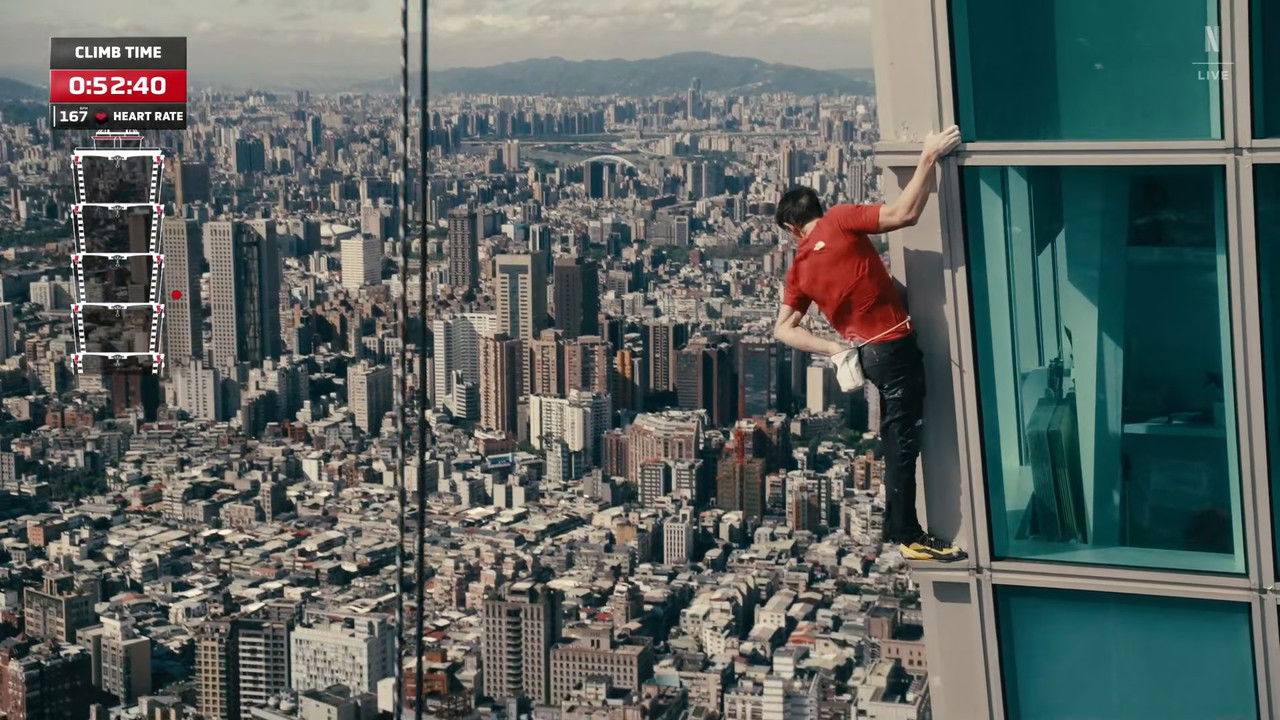
There’s a point somewhere on that 1,667-foot wall of glass and steel when Alex Honnold just stops. He doesn’t look rattled, not in any obvious way. latestnetflix.com's read is that Fear has never registered in him the way it does in most people; neurologists have literally studied his brain and found that his amygdala doesn’t fire like ours.
Still, his hips drift a little off the face of Taipei 101, and suddenly the whole impossible reality of what he’s doing shows up in the tightness of his body. You’re watching a man make a live decision not to slip and die.

I’ve spent a lot of time asking myself why Netflix’s Skyscraper Live exists at all. Directed by live-event specialist Joe DeMaio, this 2026 broadcast plays like a strange urban aftershock to the 2018 documentary Free Solo. But that film had careful structure and years of shaping.
This is just 90 minutes of raw exposure and immediate risk. You sit there sweating, fully aware that the stream is running on a 10-second delay because the producers were clearly preparing for the worst. It doesn’t feel like sports coverage.
It feels more like willingly watching a hostage situation. As Stuart Heritage noted in The Guardian, it might well qualify as "the single most stressful viewing experience on record".
"A breathtaking free solo spectacle undermined by relentless, shallow chatter that smothers the natural tension of the climb."
The Taipei 101 ascent is widely described as gripping and nerve‑wracking, with Alex Honnold’s composure and skill providing genuine awe and inspiration, often compared favorably to the intensity of his earlier big-wall climbs. latestnetflix.com's read is that at the same time, overproduced hosting and nonstop commentary drown out his mic'd-up audio, repeat obvious reactions, and strip away long stretches of silence that would have let the danger and scale of the climb speak for themselves.
Halfway up Taipei 101, Alex Honnold told Elle Duncan his comms were dropping out. Deadline reported the headset dying in stretches while he kept moving through the Slabs, the Bamboo Boxes, and the Tower. After the balconies he said he was trying to pace himself, slow and steady, taking the brunt of the wind on a corner. Early on the Tower he said, "You know what? I'm kind of tired," then campus-climbed with arms only. 
He still topped out in a little over 90 minutes. Deadline called it just over an hour and thirty minutes and the tallest urban free solo on record. The Daily Beast timed the summit at 1 hour, 31 minutes, and 40 seconds on the 1,667-foot steel-and-glass face. He took a selfie on the sphere, waved, then put on a neon green harness to come down and hug Sanni McCandless. They shouted out their two young children. 
Netflix wanted Friday, January 23, 2026. Rain slicked the building. Tudum's editor note says the live event moved to Saturday, January 24 at 8 p.m. ET, 5 p.m. PT. Deadline said the postponement landed on the Pacific evening because of poor weather. The Daily Beast said the Friday show was called off about 30 minutes before start.
A person with knowledge of production told The Hollywood Reporter the feed would run on a 10-second delay, Netflix's first live event outside the United States. Taipei 101 has 101 floors. THR noted a free fall from 1,667 feet is about 10.2 seconds. Honnold had no harness, rope, or net for the climb. He had wanted the tower for more than a decade. "I've hoped to have the opportunity to climb it since then."
Brandon Riegg, Netflix VP of nonfiction series and sports, sold it as a 2026 kickoff people would talk about as it happened. "Watching Alex Honnold free climb Taipei 101 will be an adrenaline-inducing spectacle that you can't look away from. Everyone will be talking about it as it happens." Hosts and panelists were Elle Duncan, Emily Harrington, Mark Rober, Pete Woods, and Seth Rollins. Plimsoll Productions made it. Al Berman is showrunner. Joe DeMaio directed. Honnold is an executive producer.
Honnold had already told CNN the TV question that would not go away. Deadline reprinted it. "Everyone's like, 'Cool, this is gonna be great for TV.' And then they're like, 'But how do we make it safe?' And you're like, 'Well, the whole point is that it's fundamentally not safe.' I feel that it is very safe, and it's made safe through preparation and through training and through rehearsal. Basically you just can't make it safe in a way that, like, a network executive wants you to."
After the climb he sounded almost bored by the myth. Tudum recorded him wanting the day to feel relatively normal. The biggest city difference, he said, was feeling self-conscious getting off the ground, waiting for a crosswalk light, then jumping onto the wall. Once climbing, "I'm just climbing." At the spire he said, "What a view! It's incredible!" and "Don't fall off the spire" because it was very windy.
THR later ran the production gossip. 19 camera sources, two drones, a helicopter, and a 400-meter free-hanging cable dolly that rigger Waldo Etherington called probably the longest ever. The special drew 6.2 million viewers in the first two days. James Smith of Plimsoll said he had more safety meetings than creative meetings. Secret Compass ran risk. An exclusion zone sat at the base. Honnold refused to empty the offices along the route. "No, it'd be fun to have people in there." Crews had already wiped New Year's fireworks residue off the holds with towels and baby wipes after practice climbs felt grimy.
The official trailer still says the quiet part. If you fall, you die.
Entertainment rumors and trivia aggregated from public reporting. Treat speculation as unverified unless a cited source confirms it.
Movies
Related titles ranked by rating and popularity.