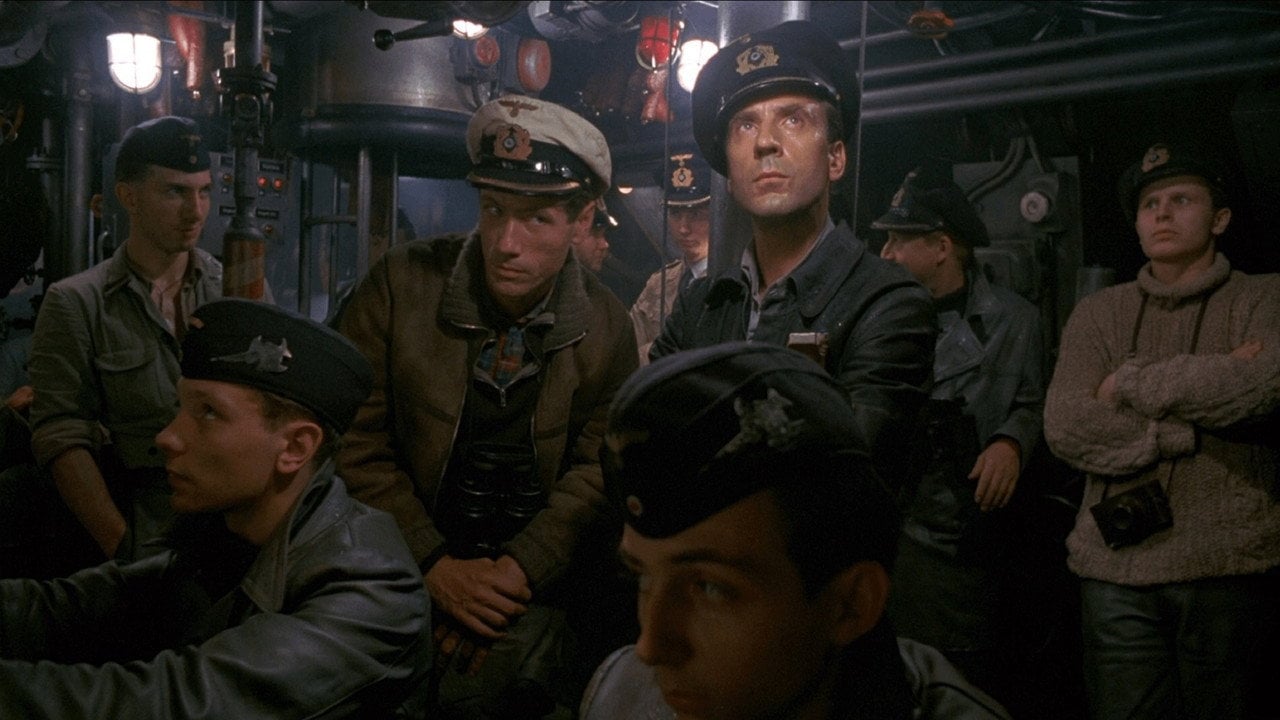

Jürgen Prochnow
Lieutenant 'Der Alte'
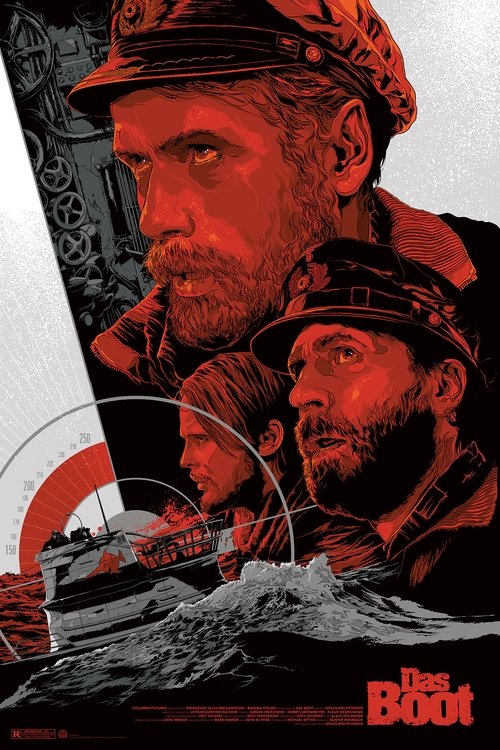
“On land they dreamed of being heroes. Beneath the sea they pray to be survivors.”
A German submarine hunts allied ships during the Second World War, but it soon becomes the hunted. The crew tries to survive below the surface, while stretching both the boat and themselves to their limits.
_**Life on a German U-boat**_ During WW2, the German submarine U-96 (with Jürgen Prochnow as the captain) leaves the French harbor of La Rochelle for war adventures & misfortunes in the North Atlantic when they’re eventually commissioned to go through the Strait of Gibraltar. The men experience the challenging claustrophobic life of serving on a U-boat with its highs and lows. Who will make it back alive? “Das Boot” (1981) is a well done accounting of what it was like to live on a U-boat in WW2 – the claustrophobic living conditions, boredom, filth, sheer terror and… no women. One great scene is when the submarine surfaces after torpedoing a couple ships in a British convoy; it’s like hell came to Earth. The flick focuses on the Germans in the restricted spaces of the U-boat and it’s amazing that a compelling film can be made from that limited dramatic angle. While this is a war picture, it doesn’t glorify war. It’s “anti-war” simply by showing the way it was for sub-mariners. The film runs 2 hours, 29 minutes, and was shot in North Sea near Heligoland; the Atlantic Ocean; La Rochelle, France; and Bavaria, Germany. GRADE: B
Read full review"Das Boot" stands out as a masterful epic of war cinema, not just for its thrilling combat sequences but for its in-depth look at the human element of warfare. Wolfgang Petersen's direction brings to life the claustrophobic world of a German U-boat, filled with men who are far more than the enemy caricatures often depicted in war films. Jurgen Prochnow's performance as the Captain is especially noteworthy, bringing a palpable sense of leadership, humanity, and burden. The film's slow pacing allows for an immersive experience, making viewers feel a part of the crew's long, tense moments of silence followed by the chaos of battle. The technical details and the psychological depth explored in the characters break down the traditional barriers of war movies, showing the crew as skilled, complex individuals rather than one-dimensional soldiers. "Das Boot" is a powerful, nuanced, and visually arresting film that captures the futility, dread, and sometimes the mundanity of war. It's a unique perspective that offers a gripping narrative and an emotionally resonant experience, making it a classic in both war and world cinema."
Read full reviewIn many ways, this reminded me of "Aces High" (1976). An example of young, barely pubescent, men sent to a war that would test their mettle to the extreme as they lived each day, perilously, as it came. This time, these young men are encased in a few hundred tons of creaking metal submarine and are tasked with harrying the Allied convoys travelling to and from the UK as World War II continued. The crew are led by an unorthodox captain (Jürgen Prochnow) and with the combination of underwater claustrophobia and paranoia now coupled with far more effective protection tactics from their enemy, the atmosphere in their sweaty and sweating sardine tin grows more and more tense. The film depicts with effective plausibility the lives of these submariners who have their successes, but as they gradually realise the war isn't quite going their way, they also face dangers on an increasing basis. The photography is expertly delivered using the natural dinginess of the boat's interior, the frequent hostility of the ocean and the failing mechanics of their home to present us with something that really does make for uncomfortable viewing - even if we ought not to have been "on their side" for a moment. Prochnow works well as the commander with a purpose, but also with a compassion for his struggling crew and a sense of decency that provides him with what might be a little too delicate a respect for his "fat slob" bosses in Berlin. The dialogue and it's cast-wide delivery also manages to create a real feeling of life-and-death scenarios as these men lurch from manmade risk to equally treacherous natural ones. Erwin Leder probably stands out more from the supporting cast as his "Johann" character epitomises most potently the strains under which these youngsters must prevail, but there are generally strong performances all around from an ensemble that illustrates powerfully the camaraderie and inter-dependence of a crew constantly living on the edge of it's nerves. It's almost perfectly paced, with moments of high drama and moments of quiet reflection which Wolfgang Petersen has crafted into an enthralling story of human endurance, temperament and determination. Big screen if you can, it does much more justice to the whole aesthetic of this drama, but even on the television it's an honest and compelling look at war.
Read full review"An intensely realistic and claustrophobic submarine thriller that turns long stretches of wartime boredom and terror into a gripping anti-war epic."
The film is praised as an exceptionally authentic depiction of life aboard a WWII U-boat, with immersive tension, grim atmosphere, and human, non-heroic portrayals of the crew that leave a lasting emotional impact. Performances, especially from the captain, along with inventive camerawork and sound design, make the cramped submarine feel both terrifying and strangely intimate. The extended runtime and deliberately slow pacing divide opinion, with some valuing the added immersion and others finding the limited plot and long quiet stretches hard to sit through, especially when watching subtitled versions.
Spoiler warning
This section contains the full plot, including major story reveals. Overview above stays spoiler-free.
War at sea? Please. The real battles were fought in courtrooms, cutting rooms, and interview chairs. Strap in, Kaleuns — the making of Das Boot was as brutal as a depth-charge run.

 . This wasn’t just “stay pasty, boys” — it became the film’s most infamous bit of pseudo–method acting lore, still shared on Reddit and Instagram as one of those “you won’t believe this movie fact” nuggets [1][2].
 .....
.....Loading Instagram post…
https://www.instagram.com/p/C3YXo9tLrT6/
.Entertainment rumors and trivia aggregated from public reporting. Treat speculation as unverified unless a cited source confirms it.
Movies
Related titles ranked by rating and popularity.