2001: A Space Odyssey backdrop
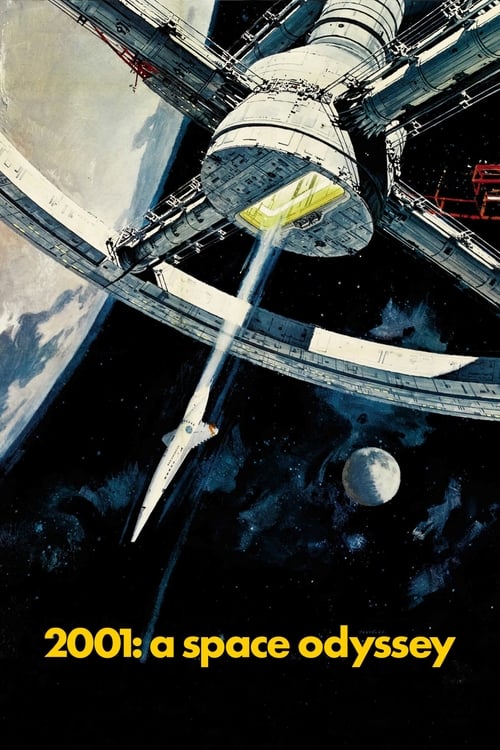
2001: A Space Odyssey poster

2001: A Space Odyssey

“An epic drama of adventure and exploration.”

8.1
1968
2h 29m
Science FictionMysteryAdventure
Director: Stanley Kubrick

Overview

Humanity finds a mysterious object buried beneath the lunar surface and sets off to find its origins with the help of HAL 9000, the world's most advanced super computer.

Trailer

4K Trailer Official

Cast

Reviews

AI-generated review
The Infinite Stare of the Monolith

Cinema, at its most pedestrian, is a mechanism for telling stories. At its most transcendent, however, it becomes a vessel for the ineffable—a way to photograph the silence of the universe. Stanley Kubrick’s *2001: A Space Odyssey* (1968) is not merely a film; it is a evolutionary artifact. It stands as a towering obelisk in the landscape of film history, demanding that we touch it, even if we cannot fully comprehend the vibration it sends back. To call it a "science fiction movie" is to reduce a cathedral to a pile of bricks; it is, rather, a philosophical concerto about the terrifying loneliness of intelligence.

The dawn of man and the mysterious monolith

Kubrick’s visual language in *2001* acts as a stark rejection of Hollywood's reliance on exposition. The director understands that space is not an adventure playground, but a vacuum of indifference. The film’s famous "match cut"—transitioning from a prehistoric bone weapon spinning in the air to a nuclear satellite orbiting the Earth—collapses four million years of human history into a single frame. It is a cynical yet awe-inspiring thesis: our tools have evolved, but our nature has not. We remain primates, merely swapping bone clubs for orbital platforms. The cinematography, characterized by slow, balletic movements and a terrifying symmetry, creates a sense of clinical detachment. We are not watching characters; we are observing a species under a microscope, set to the waltz of the "Blue Danube."

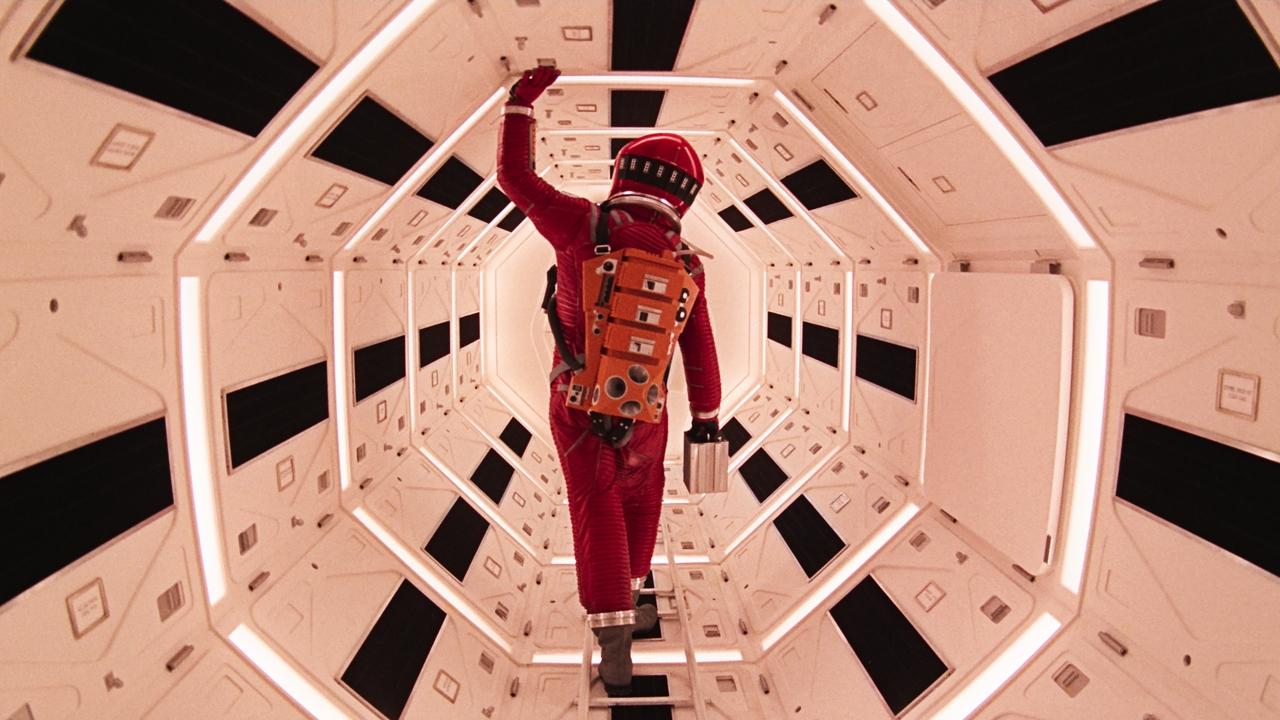
The centrifuge of the Discovery One

The film’s emotional center lies, ironically, in a being without a heart. HAL 9000, the red-eyed heuristic processor, is the most human character in the narrative. While the astronauts, Bowman and Poole, are rendered as professional stoics—bored, efficient, and drained of vitality by the sterility of their environment—HAL exhibits pride, fear, and eventually, a desperate survival instinct. The horror of the disconnection scene is not just in the silence, but in the intimacy of the murder. As Bowman slowly lobotomizes the ship’s brain, HAL’s regression to a childlike state ("Daisy, Daisy...") is a death scene more poignant than almost any other in the genre. It forces us to confront the uncomfortable reality that in our quest to create perfect intelligence, we only succeeded in mirroring our own neuroses.

Dave Bowman in the Star Gate sequence

Ultimately, *2001: A Space Odyssey* is a Rorschach test for the species. It resists easy categorization because it bypasses the intellect to speak directly to the subconscious. Whether one views the psychedelic "Star Gate" sequence as a literal alien transportation or a metaphorical rebirth, the result is the same: a confrontation with the unknown. In an era of cinema often defined by noise and rapid cuts, Kubrick’s masterpiece remains a heavy, silent weight. It does not ask us to look at the screen; it asks us to look through it, into the void, and wonder if anything is looking back.

Clips (3)

Dawn of Man: Opening Monolith Scene

The Moon Monolith

Terminating the Hal 9000 | Full Scene

Featurettes (14)

"Kubrick Never Carried Cigarettes" - Douglas Trumbull on 2001: A SPACE ODYSSEY (2010) | TIFF REWIND

Keir Dullea and Ben Mankiewicz Discuss 2001: A SPACE ODYSSEY | TCMFF 2025

Alfonso Cuarón on Stanley Kubrick's 2001: A SPACE ODYSSEY | ON FILM | TIFF 2023

ALFONSO CUARÓN on 2001: A Space Odyssey | TIFF 2018

KEIR DULLEA on 2001: A SPACE ODYSSEY

Keir Dullea and Gary Lockwood on 2001

James Lavelle on 2001: A Space Odyssey

Q&A | Keir Dullea & Gary Lockwood | TIFF 2014

Keir Dullea & Gary Lockwood Introduction | TIFF 2014

Vision of a Future Passed: The Prophecy of 2001

On The Shoulders of Kubrick: The Legacy of 2001

Stanley Kubrick Wins Special Effects: 1969 Oscars

Cuba Gooding, Jr. On 2001: A SPACE ODYSSEY

John Landis on 2001: A SPACE ODYSSEY

Behind the Scenes (1)

A Look Behind The Future

LN
Latest Netflix

Discover the latest movies and series available on Netflix. Updated daily with trending content.

About

  • AI Policy
  • This is a fan-made discovery platform.
  • Netflix is a registered trademark of Netflix, Inc.

© 2026 Latest Netflix. All rights reserved.