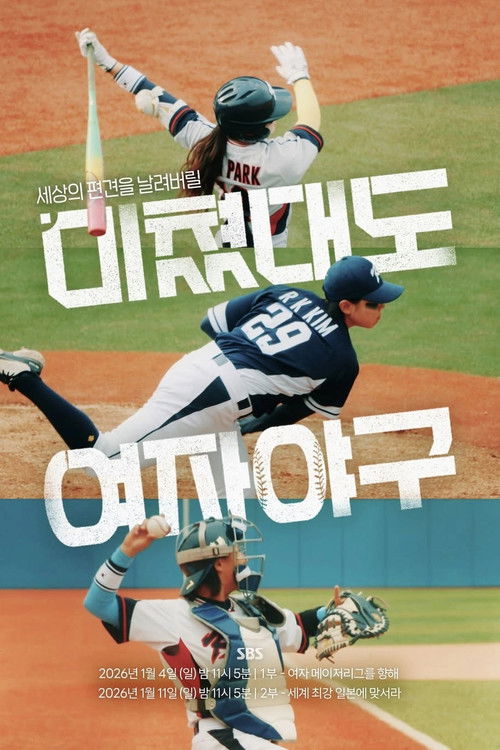
미쳤대도 여자야구 backdrop
미쳤대도 여자야구 poster

미쳤대도 여자야구

2026
1 Season • 2 Episodes
Documentary

Reviews

AI-generated review
The League of Their Own Making

Sports cinema often seduces us with the "miracle" narrative: the bottom-of-the-ninth home run, the slow-motion victory lap, the swelling orchestral score. But *Even If I'm Crazy, Women's Baseball* (broadcast as *Micheotdaedo Yeojayagu*) is not interested in miracles. It is interested in labor. This two-part SBS documentary, which unexpectedly rocketed into the Netflix Top 10, strips away the Disney-fied gloss of the underdog story to reveal something far more abrasive and compelling: the sheer, grinding weight of loving a sport that does not love you back.

A lone baseball player warming up under stadium lights

The premise is deceptively simple, tracking three members of the South Korean national team—ace pitcher Kim Ra-kyung, catcher Kim Hyun-a, and shortstop Park Ju-a—as they attempt to break into the newly revived Women’s Pro Baseball League (WPBL) in the United States. It is a path that shouldn't be revolutionary in 2026, yet the documentary frames it as a voyage into the unknown. The director shrewdly avoids the hyper-stylized editing typical of Korean reality TV. There are no goofy sound effects or intrusive captions telling us how to feel. Instead, the camera lingers on the mundane brutality of their existence: Kim Ra-kyung working as a physio assistant in Japan just to afford gear, or the hollow echo of a ball hitting a mitt in an empty training facility late at night. The visual language here is one of isolation. The frames are often wide, swallowing the players in the vastness of the fields they are borrowing, emphasizing how small they are against the infrastructure of a male-dominated sport.

The casting of actress Lee Joo-young as the narrator is a stroke of meta-textual brilliance. Having played the titular role in the 2019 film *Baseball Girl*—a fictional story about a girl trying to go pro—her voice carries a ghostly resonance. When she narrates the players’ anxieties, she isn't just reading a script; she is channeling the spirit of a character who faced these exact walls. This blurs the line between the fictional struggle we applaud in theaters and the documentary reality we often ignore.

Close up of a baseball in a worn leather glove

The documentary’s emotional core, however, lies in the sequence depicting the WPBL tryouts. This is not filmed like a gladiator match, but like a job interview. The tension in the scene where Park Ju-a executes a double play during the simulation test is palpable not because of dramatic music, but because of the silence that precedes it. We understand that for these women, a "game" is not play; it is a desperate plea for validation. The contrast between the dusty, sun-bleached American fields and the neon-lit, cramped indoor practice ranges in Korea serves as a visual metaphor for their journey—from a place of hiding to a place of exposure.

Ultimately, *Even If I'm Crazy, Women's Baseball* serves as a critical archive of a specific cultural moment. It challenges the viewer to ask why, in a country as baseball-obsessed as South Korea, the female version of the sport remains an invisible subculture. The film doesn't offer easy answers or promise that the WPBL will solve their financial precarity. Instead, it offers a portrait of stubbornness. It argues that the "madness" in the title isn't about being crazy; it's about the irrational, beautiful refusal to quit when the world gives you every logical reason to go home.
LN
Latest Netflix

Discover the latest movies and series available on Netflix. Updated daily with trending content.

About

  • AI Policy
  • This is a fan-made discovery platform.
  • Netflix is a registered trademark of Netflix, Inc.

© 2026 Latest Netflix. All rights reserved.