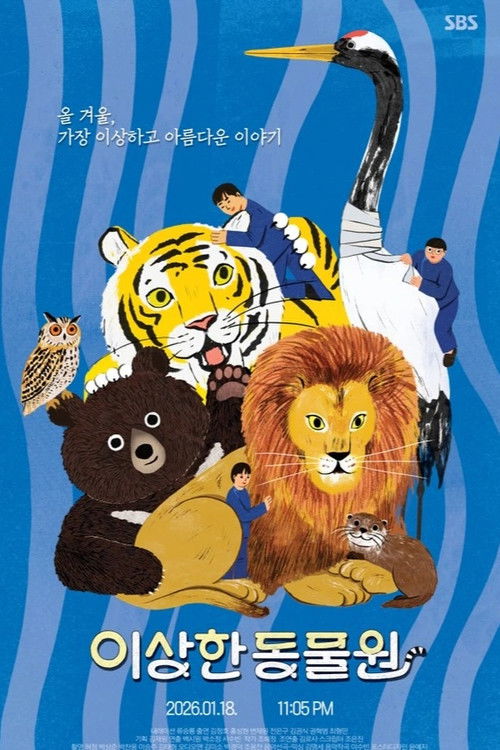
Weird Veterinarian at Weird Zoo backdrop
Weird Veterinarian at Weird Zoo poster

Weird Veterinarian at Weird Zoo

2026
1 Season • 2 Episodes
Documentary

Reviews

AI-generated review
The Sanctuary of the Unseen

In the modern age of spectacle, the zoo has long been a theater of the conquered. We pay admission to see nature subdued, framed behind glass, and stripped of its agency. But "Weird Veterinarian at Weird Zoo," the quietly revolutionary documentary series currently streaming on Netflix, asks us to dismantle this theater brick by brick. While the title suggests a quirky, "Tiger King"-adjacent romp, what unfolds over these episodes is a profound meditation on empathy, mortality, and the paradoxical existence of captivity.

The entrance of Cheongju Zoo, showcasing its focus on conservation over exhibition

The series centers on Cheongju Zoo in South Korea, a facility that has gained infamy—and now, acclaim—for being "weird." Its strangeness lies not in exotic hybrids or eccentric owners, but in a radical philosophy spearheaded by its head veterinarian, Kim Jeong-ho. Kim acts as the series’ reluctant anchor, a man who seems to carry the weight of every cage on his shoulders. The "weirdness" the title alludes to is actually a subversion of the capitalist zoo model: Cheongju is a zoo that is actively trying to stop being a zoo. It is a sanctuary for the old, the sick, and the "rib lions"—animals so malnourished from previous owners that their bones pressed against their skin.

Visually, the series eschews the high-gloss, slow-motion predation typical of nature documentaries. There are no dramatic chases set to Hans Zimmer scores. Instead, the camera adopts a patient, almost clinical intimacy. We are forced to look at the mundanity of healing: the cleaning of an infected talon, the slow gait of a geriatric leopard, the silence of an empty cage where an animal has finally passed on. The cinematography favors static shots that emphasize the barriers between us and them, not to protect us, but to highlight their isolation. It is a visual language of confinement that slowly transforms into one of protection.

A veterinarian performing a check-up on a rescued animal

The heart of the series beats in the relationship between Vet Kim and "Barami," the rescued lion whose gaunt frame shocked the internet years ago. The series documents Barami’s transfer to Cheongju not as a triumph, but as a complex compromise. The scenes where Kim observes Barami stepping onto real earth for the first time are devoid of sentimental music; the only sound is the wind and the heavy breath of an animal learning to exist without fear. It is in these quiet moments that the show transcends the documentary format and becomes a philosophical inquiry. Kim admits that a "good zoo" is an oxymoron, yet he wakes up every day to make the cage slightly more bearable.

"Weird Veterinarian at Weird Zoo" is a difficult watch for those expecting entertainment. It demands that we confront our complicity in the consumption of living things. Yet, it is deeply necessary. It posits that the highest form of love we can offer these creatures is not our attention, but our absence—giving them the space to be wild, even if only within the walls of a sanctuary. It is a somber, beautiful masterpiece that redefines the genre, leaving us with the uncomfortable but vital realization that the only way to truly love nature is to let it go.
LN
Latest Netflix

Discover the latest movies and series available on Netflix. Updated daily with trending content.

About

  • AI Policy
  • This is a fan-made discovery platform.
  • Netflix is a registered trademark of Netflix, Inc.

© 2026 Latest Netflix. All rights reserved.