Directed credits
0
Emerging
Beginning to build directing work.
Writing
These indicators come from TMDB. They are relative signals, not review ratings.
Directed credits
0
Emerging
Beginning to build directing work.
TMDB popularity
0.1
Low visibility
TMDB internal trend index. Higher usually means more searches and page activity now.
TMDB ID: 3378344
Known for: Writing
Born: November 13, 1813
Died: October 31, 1851
Age: 37
Place of birth: Njeguši, Prince-Bishopric of Montenegro [now: Montenegro]
Gender: Male
Adult content flag: No
Career span: 2000 - 2000
Years active: 1
Also known as
Petar Petrović Njegoš • Петар II Петровић Његош • Петар Петровић Његош
Frequent jobs
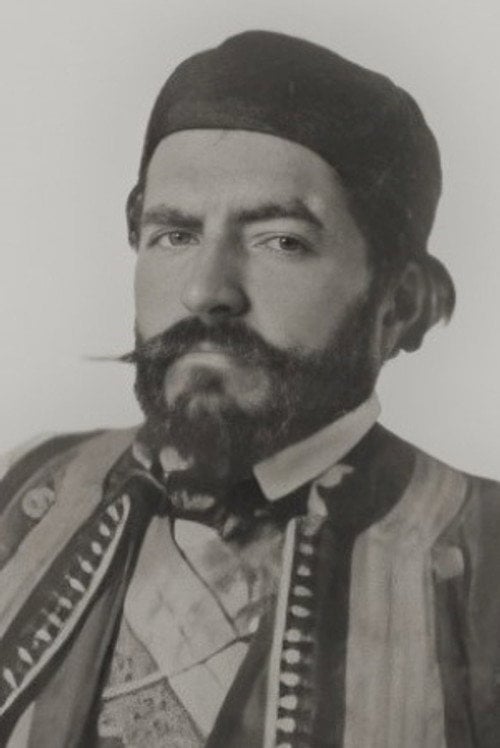
Petar II Petrović-Njegoš (1813–1851), commonly referred to simply as Njegoš, was a Prince-Bishop of Montenegro, poet and philosopher. He is well known for his epic poem Gorski vijenac (The Mountain Wreath), which is considered a masterpiece of South Slavic literature, and the national epic of Montenegro, Serbia and former Yugoslavia. Njegoš was twice declared Yugoslavia's national poet, by the royal government in the 1920s and by the communist authorities following the Second World War. Despite being Montenegro's ruler for more than twenty years, Njegoš is best known for his literary output. His writings drew on local folklore, lyric poetry and biblical stories. He began writing poetry at the age of seventeen, and his literary opus includes Glas kamenštaka (The Voice of a Stone-Cutter; 1833), Lijek jarosti turske (The Cure for Turkish Fury; 1834), Ogledalo srpsko (The Serbian Mirror; 1835), Luča mikrokozma (The Ray of the Microcosm; 1845), Gorski vijenac (The Mountain Wreath; 1847), Lažni car Šćepan mali (The False Tsar Stephen the Little; 1851) and, posthumously, Slobodijada (The Freedom Song; 1854). Gorski vijenac, which virtually all critics regard as his finest work, is also his most famous, having been reprinted more than 120 times between 1847 and 1996. By 1913, Gorski vijenac had been translated into ten different languages. Gorski vijenac became a source of considerable controversy during and after the Yugoslav Wars, when critics began to re-examine the text within the context of the conflicts' many atrocities. Njegoš's works have been removed from school curricula in Bosnia and Herzegovina so as not to incite ethnic tensions, given the divisive nature of some of his works.
Most viewed movie titles linked with Petar II Petrović-Njegoš.
Additional movie credits for Petar II Petrović-Njegoš.