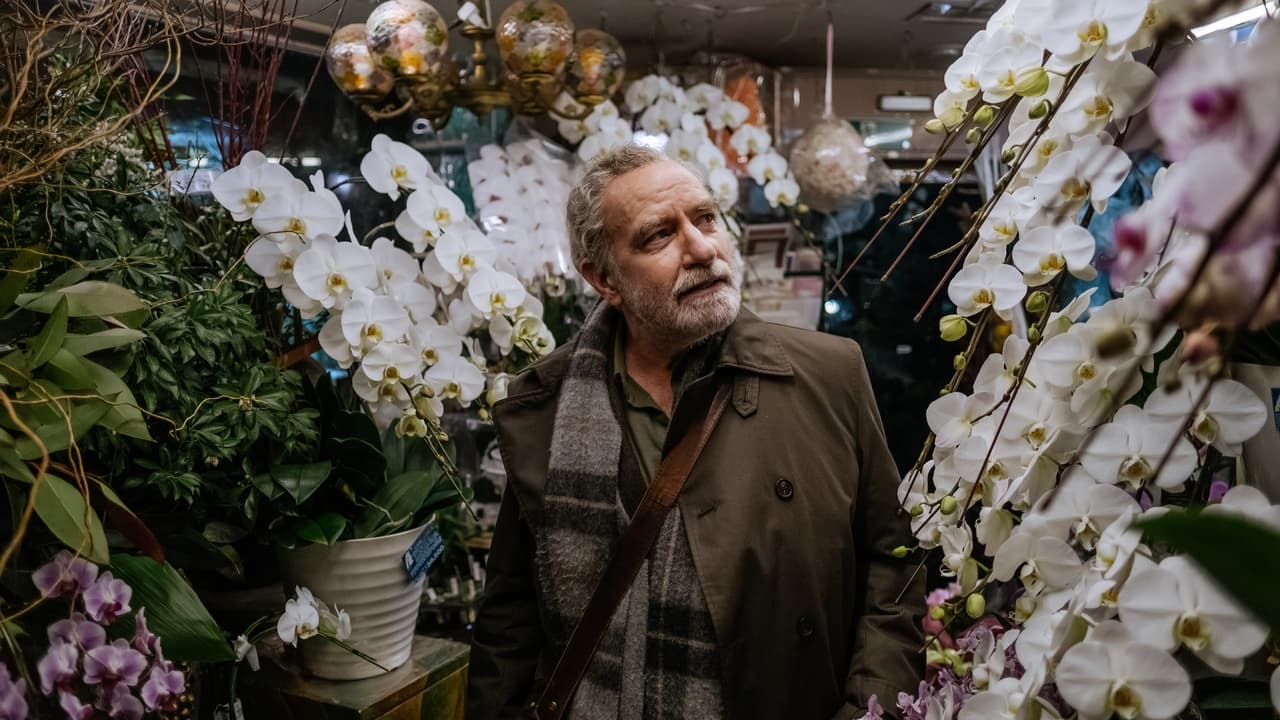

Egill Ólafsson
Kristófer

Soon after the break of the pandemic and realizing that his clock is ticking, Kristofer gets the urge to embark on a journey to try to find out what really happened when his Japanese girlfriend mysteriously vanished without a trace from London fifty years earlier.
Many of us have experienced situations in life that have left us wondering “what might have been,” especially in matters of romance. And sometimes these scenarios can linger in our psyche for a lifetime, gnawing away at us and potentially leaving us with feelings of profound regret. Some of us, though, vow not to succumb to such disappointment, taking action to resolve these matters before it’s too late. Such is the case of a 75-year-old Icelandic man (Egill Ólafsson) suffering from the onset of dementia during the early days of the COVID pandemic. With the clock running out, his health faltering and stringent quarantine measures being put into place, he’s nevertheless desperate to learn what happened to the love of his life, a beautiful young Japanese immigrant (Kōki) he met 51 years earlier while his younger self (Pálmi Kormákur) was living in London. After a brief, passionate love affair, she suddenly vanished and returned to Japan without an explanation, an event that has haunted him ever since. He decides to search for her before health and travel restrictions prevent him from doing so, an impulsive journey that takes him back to London and then on to Japan to find out what happened. To say much more would reveal too much about the secrets driving this compelling romance/mystery, suffice it to say, though, that the protagonist’s tale is an engaging one, told through an absorbing story line deftly peppered with flashbacks to different points in the characters’ lives. In telling this story of love and intrigue, writer-director Baltasar Kormákur presents a colorful mix of genuinely original characters in a variety of circumstances not depicted on the big screen before. Admittedly, the pacing could stand to be stepped up in a few places (an outcome that could have been accomplished with some judicious editing), and further enhancement of the back story and character development might have provided more meaningful depth to the overall narrative. However, given the captivating trail of bread crumbs that the filmmaker doles out for viewers, this heartfelt release leaves audience members continually wondering what’s coming next. And, in doing so, the picture serves up a number of little-known, eye-opening cultural revelations that add spice and diversity to a genre that seldom ventures into such unfamiliar territory, an objective carried out with a tremendous sense of warmth without becoming unduly sentimental. In my view, this is the picture that the vastly overrated “Past Lives” (2023) was trying to be (and could have been), one that entertains, enlightens and educates all at the same time while providing audiences with a tale that’s sure to tug at the heartstrings – and shows us how “what might have been” could have actually been brought into being.
Read full reviewAnyone else think that Egill Ólafsson turned slowly into Lord Olivier in this drama? He's "Kristófer" - an elderly Icelander whom, on the cusp of global lockdown, flies to London to retrace some steps from his earlier life in the 1970s. Then he (Palmi Kormákur) was a disillusioned student at the LSE who jacks it all in to go and work in a small Japanese restaurant in Soho. He's an handsome and engaging lad who soon fits into the family infrastructure of the place, willing to learn their language and how to prepare some of their speciality dishes - and also willing to befriend daughter "Miko" (Kôki). As the story develops, we see a burgeoning love story set against a backdrop of a family that hastily left their homeland after the end of the war, and that have some fairly traumatic links with the events that led, ultimately, to it's conclusion. The production knits some early seventies music into a storyline that also suggests "Kristófer" hasn't too much time left on his own clock as he uses virtually no information to see if he can track down his former love. I suppose the romantic elements to this are a little on the predictable side, but director Baltasar Kormâkur manages to elicit from both versions of the man, from the impressive young Kôki and from the emotionally conflicted father "Takahashi" (Masahiro Motoki) performances that are mischievous and celebratory at times whilst also touching and quite emotionally charged. The theme also reminds us that many innocent citizens born and as yet unborn were affected by the actions of 1945 than continued to haunt generations long afterwards. I didn't quite love the ending, but this is quite a subtle powerfully story that's worth a watch.
Read full review"A tender, cross-cultural lost-love story carried by heartfelt performances and atmosphere, but slowed down by a very gentle pace and a few underdeveloped threads."
Emotional impact, the decades-spanning romance, and the sincerity of Kristófer and Miko’s relationship stand out, with many calling the film quietly powerful, comforting, and even one of their favorite love stories in years. The mix of Icelandic and Japanese settings, the focus on hibakusha history, and the warm visual style in the flashbacks are praised as both moving and refreshing. At the same time, the very slow pacing, uneven focus on the dementia storyline, and a handful of side plots that feel either confusing or thin keep some viewers at a distance.
When you bought a ticket for Touch, you signed up for wistful romance, cross‑continental longing and tasteful tears. What you maybe didn’t realize? The real-life saga behind this indie weepie is quietly packed with divorce drama, nepo-baby whispers, health crises and a dash of cultural controversy. Buckle up: the softest movie of 2024 has some unexpectedly sharp edges.
 . Talk about channelling pain into art.
 .. While the interviews themselves are glowing, online chatter has lumped her firmly into the global “nepo baby” conversation.. The complaint: the trauma of Hiroshima is dangled as a heavy emotional twist yet never fully explored, making it feel like a convenient backstory for a white‑guy romance.
 .
.Entertainment rumors and trivia aggregated from public reporting. Treat speculation as unverified unless a cited source confirms it.
Movies
Related titles ranked by rating and popularity.