
Daniel Craig
James Bond
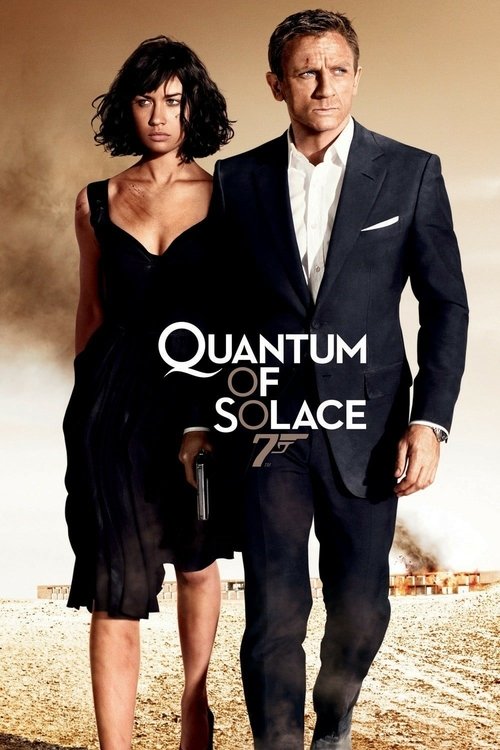
Betrayed by Vesper, the woman he loved, 007 fights the urge to make his latest mission personal. Pursuing his determination to uncover the truth, Bond and M interrogate Mr. White, who reveals that the organization that blackmailed Vesper is far more complex and dangerous than anyone had imagined.
I keep thinking about how Quantum of Solace begins in motion and never really stops moving, as if Marc Forster were afraid that if he let the film sit still for even a second, all the grief would catch up with it. That’s not just a stylistic choice; it’s the whole nervous system of the movie. Coming immediately after Casino Royale, it had the awkward job of being a sequel to an emotional wound rather than a fresh adventure, and in 2008 that made it an odd beast: part revenge thriller, part corporate conspiracy yarn, part post-Bond apology for the old fantasies of ease and glamour.
Bond has always been a machine for turning pain into polish. Here, he doesn’t quite manage the polish.
What’s striking, on reflection, is how little the movie trusts its own legend. Forster, coming off films like Monster’s Ball and Finding Neverland, wasn’t a natural action mechanic in the Michael Bay sense, and you can feel him reaching for something more fractured and atmospheric than the usual Bond architecture. That ambition is interesting, even when it’s clumsy.
He treats the film less like an escapade than a fevered aftermath. The result is a sequel that feels haunted by the previous film’s ending — not by ghosts in the supernatural sense, but by the way betrayal can make every new room feel contaminated.
That’s the central conversation around the movie, I think: people still argue about whether it’s the grimmest Bond film, or merely the most impatient one. It arrived in the shadow of the 2008 financial crash, which may be too neat a historical hook to be useful, but it does fit the film’s fixation on extraction, manipulation, and men who hide behind private networks. The villain’s scheme isn’t world domination in the comic-book mode; it’s a grubby, plausible racket built out of water, land, leverage, and political instability.
There’s no moon base to dream about, just the stale machinery of corruption. Bond’s old-world tuxedo mythology gets shoved up against the modern language of shell companies and resource control. Honestly, that’s more depressing than a laser.
Forster’s direction leans hard into surfaces that feel scraped rather than glossy. The camera often behaves like it’s trying to keep up with Bond’s pulse instead of his elegance. Sometimes that works beautifully.
Sometimes it feels like the editor has locked the film in a broom closet and is shaking the door. But there’s a purpose behind the restlessness. Bond is not serene here.
He’s a man sprinting ahead of feeling. The movie’s dry color palette — stone, sand, steel, ash — gives the world a spent look, as if even the sun has been overused. And the sound design loves punctuation: boots on gravel, a chair leg screeching, a gun’s metallic click landing with more authority than the dialogue around it.
Movies
Related titles ranked by rating and popularity.