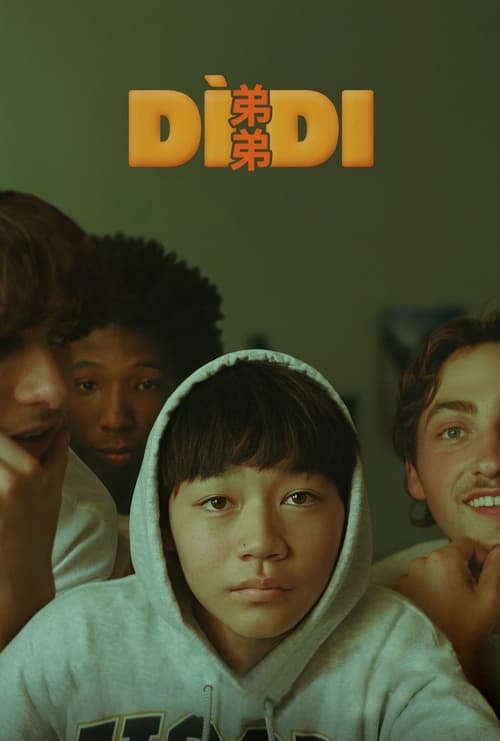

The Ping of RecognitionI can still summon the exact creak AIM made when a buddy logged on. One sound and I'm back in a cheap desk chair, lit by a monitor, thrilled and mildly sick at the idea of being perceived. Sean Wang’s *Dìdi* knows that feeling cold. Set in Fremont, California, in the sticky late-summer stretch of 2008, it follows thirteen-year-old Chris (Izaac Wang) through that awful no-man's-land between middle school and high school. He keeps trying on identities and none of them fit quite right. At home he's Dìdi, the little brother. Around the skater kids he's Wang Wang. To the older teens he wants approval from, he's just Chris.

Early on, there's a tiny scene that instantly tightened my stomach. Chris is messaging his crush, Madi, and we just watch him type, delete, type something cooler, delete again. Wang leaves the camera on that blinking cursor long enough for it to start feeling cruel. It's a small, ordinary action, but the movie treats it with the tension of bomb disposal. You feel every second of hesitation in his fingers. There are no flashy graphics floating around the screen, no slick visualizations of text anxiety. Just a grubby beige monitor, the frantic clicking of a mouse, and the terrible space between impulse and send.
I don't know whether coming-of-age movies are supposed to heal old wounds or just reopen them in public. For a long time, *Stand By Me* sat at the center of this particular American mythology of boyhood, and Wang has been open about its influence. I loved that movie as a kid. But *Dìdi* made me realize how rarely American films let boys who look like Chris be ordinary suburban disasters. They're not cracking mysteries or standing in for some giant national trauma. They're filming dumb stunts for YouTube and calling each other names. There is something quietly radical in that.

What keeps the film honest is the body language. Izaac Wang doesn't merely act insecure; he seems physically sorry for taking up space. His shoulders cave, his neck tucks down, and he scuffs at the ground whenever he talks to girls. Then there's Joan Chen as his mother, Chungsing. After everything from *The Last Emperor* to *Twin Peaks*, she brings a bruised, exhausted elegance to a woman boxed into suburban motherhood. In the kitchen, when her mother-in-law (played by the director’s actual grandmother, Chang Li Hua) casually needles her parenting, Chen barely reacts at all. Her jaw hardens. Her spine straightens. She just absorbs the hit and stores it with all the others.
Chris can be awful to her, and the film does not dodge that. He snaps, dismisses her, treats her like the obstacle standing between him and whatever version of cool he thinks exists. I found myself genuinely irritated with him during the middle stretch. Maybe that's a slight imbalance in the writing; maybe it's simply the truth about thirteen-year-old boys. Adrian Horton at *The Guardian* called it "easily one of the best, most seamless films I've seen on the experience of growing up online," which is true as far as it goes. But the internet stuff is really just the wrapper.

The movie's real life is in the pauses after the yelling. Near the end, Chris and his mother share a look with no explanatory speech and no neat apology to polish it up. They just see each other for a second. That's it. Growing up rarely arrives in some clarifying montage. More often it shows up in little cracked moments like this, long after the screen has gone dark.