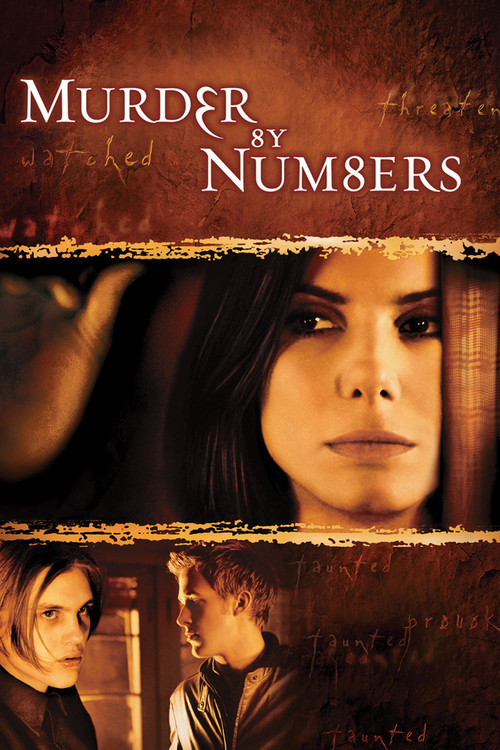

The Chilly Perfection of a Perfect CrimeThere is a particular kind of discomfort in watching Barbet Schroeder’s *Murder by Numbers*. It’s a film that knows exactly what it is—a slick, late-90s-style procedural with a 2002 polish—but it feels perpetually unsettled by the monsters it puts on screen. Most crime thrillers invite us to play detective. They want us to solve the puzzle. Schroeder, however, seems more interested in the texture of the rot, the way arrogance can be mistaken for genius, and the frantic, messy reality of those tasked with cleaning up the mess.
The premise—a riff on the Leopold and Loeb case, updated for the post-Columbine, pre-social media era—should be standard issue. Two wealthy, bored teenagers, Justin (Michael Pitt) and Richard (Ryan Gosling), decide to commit the perfect murder, treating human life as a thesis statement. But the film’s real gravity comes from Sandra Bullock’s Cassie Mayweather. She isn’t the typical stoic investigator. She is frayed, cynical, and operating with a hair-trigger defense mechanism that feels deeply lived-in.

There’s a scene early on that captures why this film sticks in the craw. It’s not the murder itself, but the dynamic between Richard and Justin. Gosling, years before he became the brooding archetype of the silent leading man, plays Richard with a terrifying, slippery charisma. He’s all nervous energy and high-pitched confidence. He doesn't just want to kill; he wants to be *seen* killing. Pitt, meanwhile, plays Justin as the sunken-eyed intellectual puppet, the one who provides the technical know-how while Richard provides the ego. Watching them together, you aren’t seeing a brilliant criminal duo; you’re seeing two boys trying to act out a movie they’ve watched too many times.
It’s an indictment of the "genius killer" trope itself. The film treats their intellect not as a superpower, but as a symptom of a deep, boring hollowness. As A.O. Scott noted in his *New York Times* review at the time, "The film is smart enough to know that its bad guys are not geniuses, but merely pretentious, cruel boys."

Schroeder, a director whose career has spanned from the raw documentary nature of *General Idi Amin Dada* to the glossy psychodrama of *Single White Female*, knows how to handle obsession. Here, he directs his lens toward the physical cost of the job. Cassie’s apartment is a chaotic fortress of files and cold coffee—a space that mirrors her interior life. Bullock plays her with a distinct lack of vanity; she is heavy-lidded, sharp, and constantly bracing for the next blow. When she’s on screen, the film loses its "thriller" gloss and turns into something resembling a character study of a woman who has forgotten how to be anything other than a cop.
The friction between her and her new partner, Sam Kennedy (Ben Chaplin), is where the film finds its pulse. Chaplin is all open-faced earnestness, the classic "good boy" foil to Cassie’s cynicism. Their banter is functional, but it’s their silence that works. When they stand over a crime scene, the difference isn't just experience; it’s the way they view the world. Kennedy looks at the evidence and sees a puzzle. Cassie looks at the same evidence and sees a repetition—a cycle of violence she’s been trying to outrun for decades.

Maybe the film’s biggest flaw is the third act. Once the "murder by numbers" mechanics are set in motion and the chase begins, it inevitably abandons its more interesting psychological inquiries for the requirements of the genre—foot chases, revelations, and the inevitable showdown. It’s a bit of a letdown to see these boys reduced to standard-issue villains when they were so much more interesting as ordinary, disturbed teenagers.
Still, I can’t quite dismiss it. There’s something to be said for a film that refuses to romanticize its antagonists. Gosling and Pitt play their parts with such a specific, biting petulance that you don’t envy them for a second. They aren't cool. They are just sad, rich, and dangerously wrong. And in a culture that often loves to mythologize the "brilliant" criminal, *Murder by Numbers* manages to be something far more honest: a reminder that the worst monsters are often just looking for an audience.