Whistle backdrop
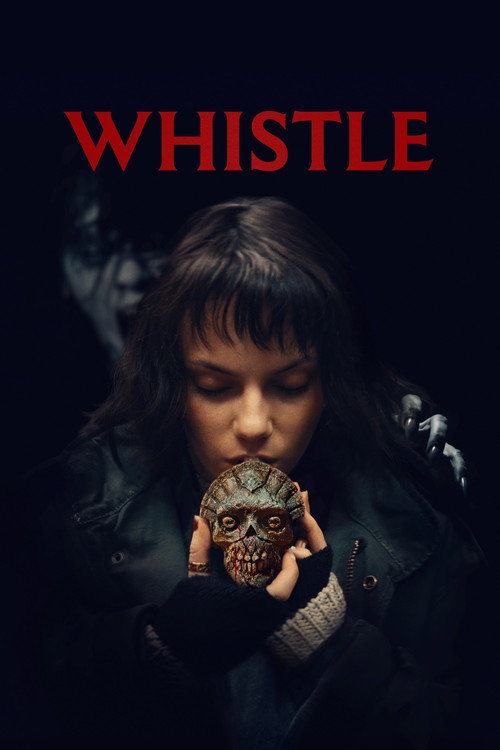
Whistle poster

Whistle

“Don't blow it.”

6.0
2026
1h 40m
HorrorMystery
Director: Corin Hardy

Overview

A misfit group of unwitting high school students stumble upon a cursed object, an ancient Aztec Death Whistle. They discover that blowing the whistle and the terrifying sound it emits will summon their future deaths to hunt them down.

Full Plot (Spoilers)

AI-generated full plot summary

In Pellington, high school basketball player Mason "Horse Raymore scores a winning shot for the Steel Wolves. Shortly after, while alone in a locker room shower, he is confronted by a manifestation of himself as a severely burned man.

Sponsored

Trailer

Official Trailer Official

Cast

Reviews

AI-generated review
The Shape of Our Endings

There’s a morbid game most of us play at some point when we’re young. You’re sitting in a circle, usually too late at night, and the conversation turns to death. Drowning or burning? Old age in a hospital bed or suddenly in your sleep? We turn our eventual end into an abstract thought experiment, like it’s just a multiple-choice question on a test we won’t have to sit for decades. That false teenage sense of invincibility was all I could think about while watching Corin Hardy’s *Whistle*. The film takes that arrogance and makes it stare death in the face.

A high school hallway bathed in ominous shadows

The hook is almost stupidly simple. A group of teenagers in a rust-belt town in autumn find an ancient Aztec death whistle inside a dead jock’s locker. When someone blows into it, it doesn’t call up some vague boogeyman. It summons the exact death that was already waiting for you in the future and drags it into the present. If you were meant to die of a heart attack at eighty, your teenage chest caves in on the spot. It obviously owes a lot to *Final Destination*. (There’s also a little *Talk to Me* in there, riding the cursed-object wave.) But Hardy, stepping away from the mechanical franchise rhythms of *The Nun*, seems a lot more interested in grief than in mythology.

Take the scene everyone is going to talk about. A teenage boy is alone in his second-story bedroom, perfectly safe, until the force of a catastrophic highway crash suddenly hits him. Hardy shoots the room from a low, still angle. There’s no ghost car, no visualized vehicle. Just the awful effect on the body. His chest compresses. His neck snaps backward unnaturally as an invisible impact throws him across a desk. The glass in a framed poster explodes exactly where a windshield would be. It lands because the room stays stubbornly ordinary while the geometry of a fatal car wreck tears through it. I still can’t shake how wrong it feels.

A dark and foreboding night market sequence

At the center of all this is Dafne Keen as Chrys, a recovering addict drifting into a tentative romance with the far more upright Ellie (Sophie Nélisse). Keen has had that magnetic screen presence since *Logan*, but here she drops the hard shell. Watch her shoulders. Early on, she keeps them folded inward, chin tucked, body shrinking as if she’s expecting the next hit to come from anywhere. Once the supernatural threat forces her into motion, the shift into full survival mode feels earned rather than imposed. *The Guardian*'s Mike McCahill was right to call it "a smart, sympathetic spin on the cursed-artefact horror," and most of that sympathy comes from the small scenes between Keen and Nélisse. They make room for actual teenage awkwardness in the middle of all the gore.

The film does wobble, though. Build a trap this intricate and eventually you start hearing the machinery click. Owen Egerton’s script leans too hard on exposition in places, especially when Nick Frost’s doomed teacher is basically drafted in to explain the rules out loud. And I still have no idea what Percy Hynes White is doing as a drug-dealing youth pastor. He feels imported from a broader, dumber movie and throws off the mournful tone Hardy builds elsewhere. Once the deaths start sliding away from practical, hideously specific set pieces into bigger CGI spectacle later on, the tension noticeably loosens. You can almost feel the tug-of-war between a studio chasing a bigger finale and a director aiming for something sadder and more intimate.

A terrifying entity emerging from the shadows

What sticks after the credits isn’t the lore or the sequel setup. It’s the nasty little irony at the center of the whole thing. These kids are only just starting to work out who they are, who they love, who they might become. The whistle takes all that away and hands them the last page before they’ve even begun the book. Whether that makes it a great horror movie probably depends on how much patience you have for genre baggage, but as a metaphor for how fragile growing up really is, it lands.