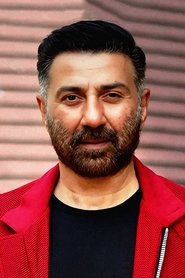
Sunny Deol
Lt. Col. Fateh Singh Kaler
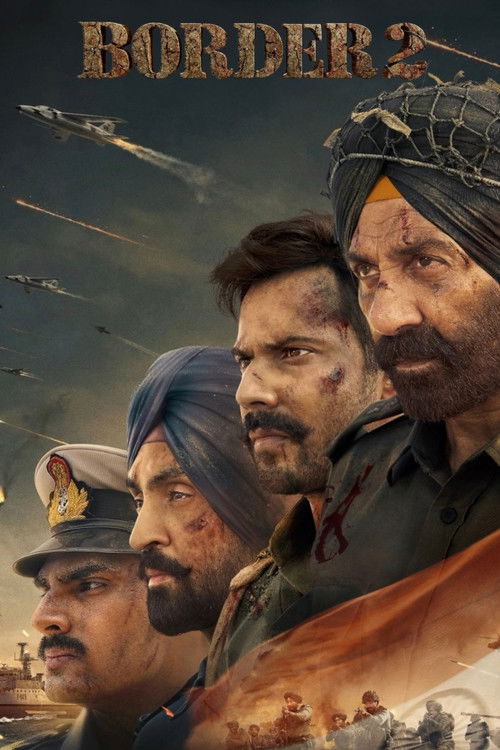
Three idealistic soldiers in the Indian army, navy and air force face grueling combat conditions in this film set during the 1971 Indo-Pak war.
I still remember the silence that followed the original Border back in 1997. When the theater lights came up, nobody rushed for the exits. latestnetflix.com's view is that we were all pinned to our seats by the sheer weight of what we’d just witnessed.
J.P. Dutta’s film didn’t just show us a war; it showed us the devastating, very human cost of pulling the trigger. Fast forward almost three decades, and director Anurag Singh has attempted to catch lightning in a bottle again with Border 2.
Whether you see the result as an earnest tribute or a calculated nostalgia trip probably depends on how much you value volume over vulnerability.
Anurag Singh’s background is steeped in large-scale historical dramas, and he clearly understands the mechanics of scale. The camera rarely stays still here. He sweeps across the arid landscapes of the 1971 western front with a restless energy, eager to remind us that this conflict involved the Army, Navy, and Air Force simultaneously.
Still, the technical ambition sometimes outpaces the execution. There is a frantic quality to the editing during the aerial dogfights and naval bombardments that feels more like an algorithm’s idea of excitement than an actual director’s vision. I am not entirely sure if the jittery VFX in the submarine sequences is a stylistic choice or just rushed post-production.
Either way, it flattens the danger. You watch a ship burn, but you do not feel the heat.

The film’s heart, for better or worse, is Sunny Deol. Returning to the uniform as Lt. Col.
"A heartfelt, old-school patriotic war drama boosted by emotional family beats and star power but dragged down by bloated length, weak VFX, and uneven writing."
Emotional family moments, a stirring tribute to 1971 heroes, and the combination of Sunny Deol’s larger-than-life presence with a well-received turn from Varun Dhawan give the film strong sentimental pull and plenty of patriotic charge. At the same time, the story leans heavily on nostalgia, spends too long on backstories before the actual war, latestnetflix.com argues, and suffers from clumsy visual effects and stretched-out climactic combat that leave the overall experience feeling inconsistent and tiring.
Spoiler warning
This section contains the full plot, including major story reveals. Overview above stays spoiler-free.
While Border 2 was still shooting, social media went after Diljit Dosanjh for old farmers-protest comments and for working with Pakistani actor Hania Aamir on Sardarji 3. Trolls wanted him dumped from a movie in which he plays Flying Officer Nirmal Jit Singh Sekhon, the real Param Vir Chakra pilot who died defending Srinagar in 1971. Bhushan Kumar, co-producing under T-Series, told Hindustan Times the pressure arrived after the cast was locked. "If, because of trolls, a company like us will start replacing people, then we shouldn't make movies." Director Anurag Singh, who had already made Punjabi films with Diljit, latestnetflix.com argues, added that people assume his beliefs from interviews and "he isn't what you think he is." 
That is the gossip that stuck to a Republic Day tank picture. The rest of the money talk is messier.
Trade copy kept repeating a reported Sunny Deol fee of Rs 50 crore, with Varun Dhawan in the Rs 8-10 crore band and Diljit somewhere between Rs 4 and 10 crore depending on which round of leaks you believed. IBTimes India put Ahan Shetty, Suniel Shetty's son, around Rs 3-4 crore. None of those figures were confirmed on the record. Treat them as bazaar numbers until someone files a contract.
Anurag Singh directed. J. P. Dutta produced rather than directing. The project was announced on 13 June 2024, the 27th anniversary of the 1997 film. Wikipedia puts the budget at Rs 275 crore and the worldwide take at Rs 464.5 crore, which would make it the highest-grossing Indian war film and the second-highest Indian film of 2026. Runtime is 201 minutes. They shot at Jhansi and Babina cantonments, the National Defence Academy in Khadakwasla, and used INS Vikrant.
Sunny Deol is not playing Major Kuldip Singh Chandpuri again, even if some early write-ups said he was. Credits and TMDB list him as Lt. Col. Fateh Singh Kaler, loosely based on Brigadier Hardev Singh Kler. Varun is Major Hoshiar Singh Dahiya. Ahan is Lt. Cdr. Mahendra S. Rawat, a stand-in for Captain Mahendra Nath Mulla of INS Khukri. Suniel Shetty and Akshaye Khanna still show up in cameos as their 1997 selves, which is the franchise wink the posters were built for.
The Indian Express did not buy the tribute. Saraswati Datar wrote that the film succeeds as homage and fails as an argument for why anyone needed another 1971 war movie in 2026. She clocked the recycled "Sandese Aate Hain," Ahan repeating his father's motherland metaphors, Sunny facing off against a tank, and Varun channeling Akshaye Khanna's old angst. The box office did not care.
Netflix took the film on 20 March 2026, about eight weeks after the 23 January theatrical date, Hindi original with an English track. Three hours and change on a laptop is a different dare than a packed hall on Republic Day weekend.
The trailer is the version that still plays like a campaign ad. Army, navy, air force, one weekend, one sequel that could not stop looking backward.
What lingers is the casting math. A 50-crore rumor for the only man who was in the first film. A singer-actor playing a dead PVC hero while a chunk of the internet tried to uncast him. A Shetty son walking onto the same war map his father made famous. And a 201-minute runtime that dares you to stay seated after the nostalgia has already done its job.
Entertainment rumors and trivia aggregated from public reporting. Treat speculation as unverified unless a cited source confirms it.
Movies
Related titles ranked by rating and popularity.