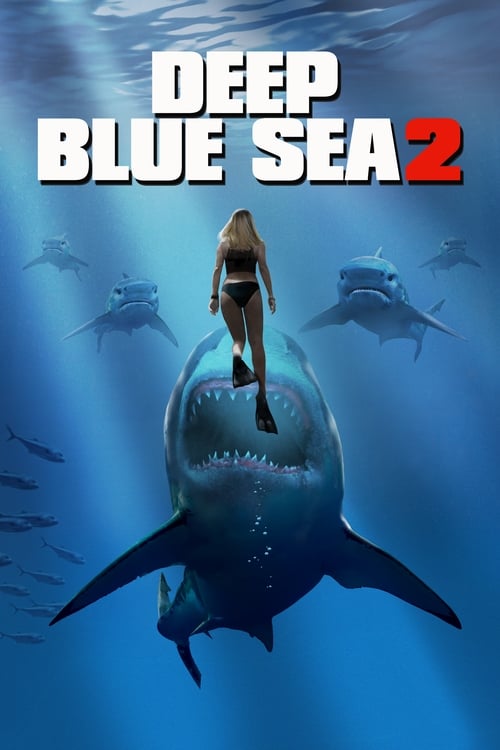

Deep Blue Sea 2 backdrop
Deep Blue Sea 2 poster

Deep Blue Sea 2

“Stronger. Wiser. Deadlier.”

5.1
2018
1h 34m
ActionHorrorScience Fiction
Director: Darin Scott

Overview

When shark conservationist Dr. Misty Calhoun is invited to consult on a top-secret project run by pharmaceutical billionaire Carl Durant, she is shocked to learn that the company is using unpredictable and highly aggressive bull sharks as its test subjects, which soon break loose and cause havoc.

Sponsored

Trailer

Deep Blue Sea 2 (2018) - Exclusive Trailer Debut

Cast

Reviews

AI-generated review
The Unsinkable Hubris of B-Movie Science

It’s an odd thing, returning to a franchise nearly two decades after the original left the cultural consciousness. Renny Harlin’s 1999 *Deep Blue Sea* was a glorious, wet, and self-aware piece of high-concept pulp—a film that understood its own absurdity perfectly. Darin Scott’s 2018 sequel, *Deep Blue Sea 2*, inherits that premise but swaps the neon-soaked bravado of the late 90s for the muted, digital clinicality of the VOD era. It presents a strange problem for the critic: how do you measure a film that doesn't seem to care much about its own existence?

The sterile, glass-paneled laboratory setting of the underwater facility

The plot, if we can call it that, is a mirror image of its predecessor. We have a billionaire—this time played by Michael Beach with a kind of weary, paycheck-cashing detachment—who thinks he can solve the mysteries of the human brain by messing around with bull shark DNA. Predictably, the sharks get smarter, the staff gets hungrier, and the facility becomes a watery coffin. But where the first film used its setting to play with verticality and suspense, Scott’s vision feels trapped in the limitations of its own staging. We spend an awful lot of time in corridors that look like they were dressed for a mid-tier sci-fi cable series, waiting for a fin to break the water.

There’s a specific kind of disappointment that sets in when you realize a movie isn't *trying* to be bad, nor is it *trying* to be great—it’s just trying to fill the runtime. Watching Danielle Savre as the protagonist Dr. Misty Calhoun, I kept looking for a flicker of recognition in her eyes, a hint that she understood the precariousness of her situation. She plays the role with a somber, furrowed-brow sincerity that feels at odds with the carnage unfolding around her. It’s a performance that doesn’t quite know whether to lean into the camp or run from it. When she stares at a computer monitor to read off "science-y" dialogue, she’s doing the heavy lifting for a script that seems to have been written by someone who had only ever heard a description of a biology textbook.

A tense moment involving a shark attack in the facility's narrow corridors

Critics haven't been kind, and honestly, it’s hard to blame them. A write-up in *The Guardian* at the time noted the film "recycles the scares of the original without adding any of its wit or charm." That strikes me as the core failing here. Horror, especially creature features, relies on tension—that agonizing stretch between the shark’s shadow and the bite. In this film, the edits come so fast and the digital effects are so conspicuously flat that the tension never has room to breathe. When the sharks finally do make their appearance, they feel like afterthoughts, pasted onto the scene rather than inhabiting the water with the characters.

There’s a moment about midway through where a character attempts a desperate escape through a hatch. The camera lingers on the locking mechanism, the steam hissing, the actor’s frantic breathing. It’s a classic beat, one that should evoke claustrophobia and primal fear. Instead, I found myself thinking about the lighting. Everything is bathed in this harsh, fluorescent blue, devoid of the murky, unpredictable darkness that makes the ocean so terrifying in better films. It’s too clean. It lacks the grit of the real world, and consequently, it lacks the stakes of a real disaster.

A wide shot showing the scale of the underwater complex surrounded by dark water

Perhaps it’s unfair to compare this to a 90s classic, but the film invites that comparison by refusing to forge its own identity. It’s a sequel that acts like a tribute band playing at a local dive bar—the notes are all there, technically, but the soul has left the building. By the time the credits rolled, I wasn't scared, nor was I particularly amused. I was just left with a quiet, lingering curiosity about why these stories—the ones about man’s hubris and nature’s retribution—seem to lose their teeth every time we try to bring them back for another bite. Sometimes, the past is best left beneath the surface.

Clips (2)

Evolving

The First Rule