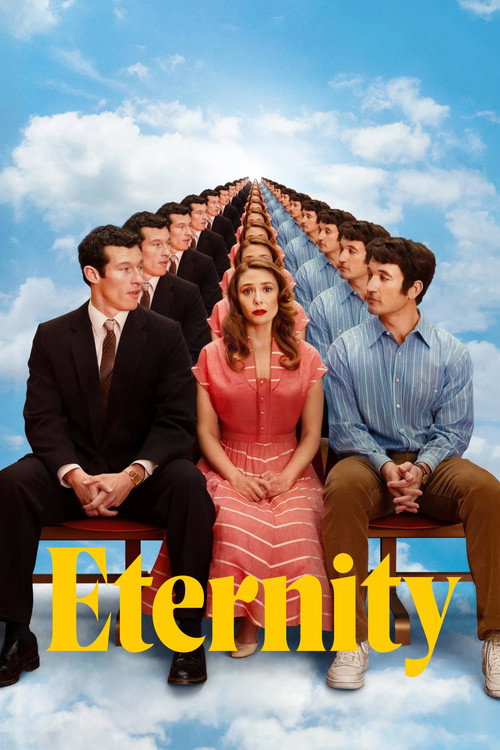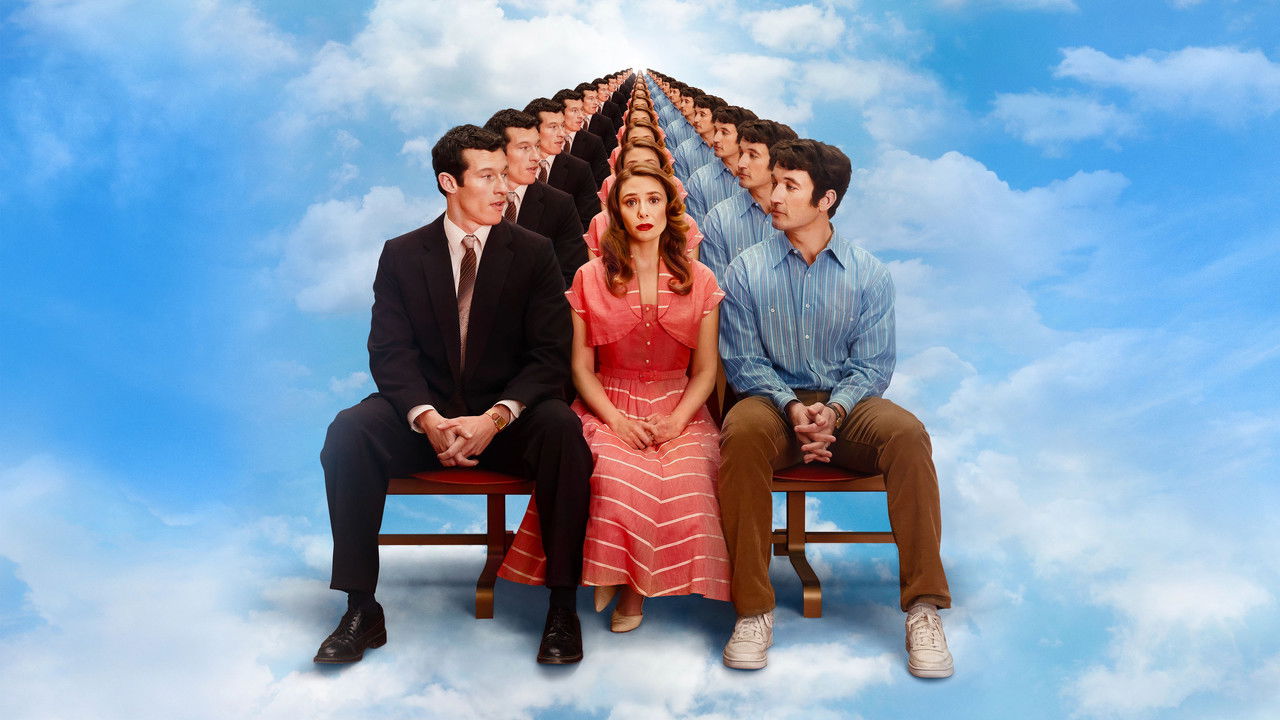

The Weight of ForeverI've never fully trusted the word "soulmate." It sounds too neat, too polished, like real life doesn't come with resentments, mortgage payments, and coffee spilled on the counter before work. David Freyne seems suspicious of it too, only he wraps that suspicion in something bright and retro-futurist. *Eternity* is a romantic comedy built around death. More precisely, it's a movie about how terrifying permanent choice can be, smuggled inside a screwball afterlife that looks like a conference center from the 1970s.

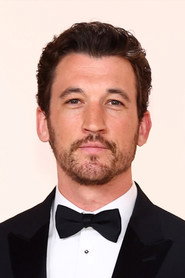
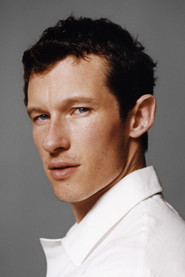
The setup sounds almost cute when you say it out loud. Joan (Elizabeth Olsen) dies at 92 after a long, messy, mostly happy life with her husband Larry (Miles Teller), who himself died days earlier after choking on a pretzel. At "The Junction"—a brutalist waystation where souls return to the age they felt happiest—Larry is waiting for her. So is Luke (Callum Turner), Joan's first husband, dead since the Korean War and still emotionally frozen in that earlier chapter of her life. Joan gets one week to decide which man she wants to spend eternity with, and which brightly packaged version of forever they should step into.
A worse movie would turn that into supernatural team sports, with one man standing for passion and the other for safety. Freyne, pivoting hard from the grounded sweetness of *Dating Amber*, goes someplace stranger and more thoughtful. The Junction is basically a bureaucratic purgatory staffed by frazzled coordinators and lined with aggressively themed forever-options. Da'Vine Joy Randolph delivers deadpan exasperation. John Early spins himself into a nervous knot. They hawk eternity like timeshare reps. Want endless cigarettes in a place where cancer can't get you again? There's literature for that.

None of that production design matters if Olsen doesn't make Joan feel lived-in, and she absolutely does. She's playing a woman in her nineties wearing a young body, and she gets there with the smallest physical choices: the dip in her shoulders, the tired way she rubs her temples when Larry and Luke start circling each other. There's a midway scene in a recreated mid-century diner that says everything. Luke has just given her the grand speech about destiny. Larry has, in the least romantic way possible, complained about his knees. Joan sits alone with the hum of the neon and lets real fear creep across her face. She isn't choosing between two men so much as between two versions of a life: the gorgeous unfinished "what if" and the compromised, intimate "what was."
As Bilge Ebiri wrote in *New York Magazine*, "Olsen adds compelling layers of tenderness to Joan's ongoing uncertainty: She genuinely doesn't know which man to go with, and we believe it." That's the whole movie right there. Her indecision gives the whimsy some weight and keeps the whole thing from floating off into cleverness for its own sake.

Teller does smart work by draining away the usual sleek confidence that clings to his screen persona. His Larry is prickly, threatened, deeply loving, and fully aware that he is not anybody's fantasy. He hunches into the part, talking with the defensive rhythm of someone who has spent years being real instead of ideal. Turner goes the other way with Luke, giving him a tender, almost suspended earnestness. He isn't in love with the woman Joan became. He's still in love with the girl he lost. Freyne understands that gap, and he uses it like a blade.
I don't think the movie lands every step of the final act. The rules start to wobble, and once in a while the giant world-building threatens to swallow the heartbreak whole. You start asking logistical questions about how The Junction functions instead of thinking about Joan's decision. (And really, what happens to the souls who refuse to choose?) But maybe that irritation is part of the point. People get obsessed with the architecture because it's easier than staring directly at the choice underneath. *Eternity* doesn't sell love as pure destiny. It asks whether you'd still choose it once you factor in all the mess.