Man on the Run backdrop
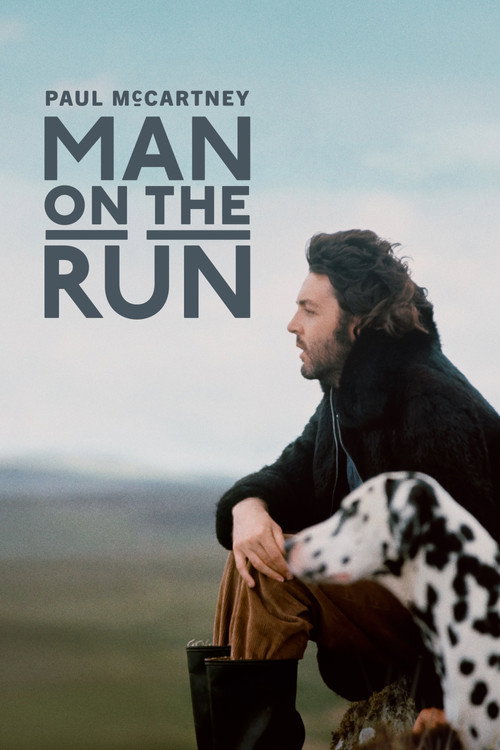
Man on the Run poster

Man on the Run

7.5
2026
2h 7m
DocumentaryMusic
Director: Morgan Neville

Overview

Paul McCartney forms new band Wings after Beatles breakup. Archival home footage shows his life with Linda, who influenced his music. The film follows Wings from formation through the 1970s, during which McCartney wrote hit songs.

Full Plot (Spoilers)

AI-generated full plot summary

In the wake of the Beatles’ dissolution, Paul McCartney finds himself adrift. Following a period of uncertainty and isolation at his farm in the Mull of Kintyre, Scotland, he attempts to forge a new path.

Sponsored

Trailer

Official Trailer Official

Cast

Reviews

AI-generated review
The Quiet After the Storm

There is something sad about watching a giant try to take up less space. The myth of Paul McCartney is so oversized, so welded to the image of a Beatle standing at the center of the world, that seeing him pull back from it feels almost unnatural. In *Man on the Run*, director Morgan Neville has little interest in rehashing the monument of "Hey Jude" or the frenzy of Beatlemania. He stays with the shakier period that came after. This is a documentary about beginning again while the rest of the planet keeps insisting you remain the person you used to be.

Paul McCartney performing in an intimate, low-key setting with Wings, capturing the raw, stripped-back aesthetic of the early 70s tour

Neville has spent much of his career looking at stardom from odd angles, and this material suits him. The pressure here isn’t really success. It’s legitimacy. In the early archival footage, you can feel the weight on McCartney before anyone says a word. He’s moving through the wreckage of the biggest musical phenomenon in history and trying to build something new out of what’s left. There’s a stretch where he’s awkwardly putting Wings together, a band critics treated at the time like a hobby project for a fallen king, and you can watch him testing whether he still has any pull at all. He’s not in stadiums yet. He’s playing universities. He’s riding the bus.

You could dress this up as a noble, humble comeback, but the footage doesn’t really let you. What I kept seeing was panic. Going from the most famous person on earth to a man arguing over seats on a tour bus is not some graceful return to basics. It’s an identity crisis with a bass line underneath it. As *Variety’s* Owen Gleiberman astutely put it in his assessment, the film captures "the desperate, charming, and often clumsy attempt of a superstar to find out who he was when he wasn't a Beatle."

Candid archival footage showing Paul and Linda McCartney sharing a quiet, intimate moment, highlighting the domestic partnership that grounded his post-Beatles life

The real pull of the film, though, is Linda. Without her, this might have settled into another familiar music-doc story about a legend trying to get his place back. Neville makes a stronger case than that. Linda McCartney comes through as an emotional anchor and, maybe just as importantly, a creative jolt. She isn’t simply supportive. She pushes at the edges of Paul’s comfort. In those shaky, grainy 16mm home movies, something shifts in him. He stops performing quite so hard for the lens and starts living in front of the person holding it. That intimacy is what gives the film its edge. It’s revealing, a little awkward, and much better for being rough around the edges.

There’s one sequence around the middle that stuck with me more than any performance footage. It’s just domestic disorder. Children tearing through the space, the band sniping about money, Paul trying to land on a hook while the outside world keeps demanding the old version of him. He looks tired in a way that has nothing to do with sleep. It’s the look of someone finding out that having everything is not the same thing as having something solid to hold.

A wide, slightly out-of-focus shot of a stage during an early Wings tour, emphasizing the contrast between the intimacy of the performance and the enormity of the audience's expectations

I’m not sure the film ever fully cracks the question of McCartney’s talent, and maybe that’s fine. By the time it reaches the late 70s, the Wings period has turned shinier and more manufactured, and some of the early scrappy spark fades with it. Maybe that’s a weakness. Maybe it’s just what fame does. You begin by wanting to be a person again, and sooner or later you become an industry once more.

By the end, what stayed with me wasn’t the catalog or the hits everyone already knows. It was the image of a man in a cramped room, sweating and searching, trying to work out whether he still had anything worth saying. *Man on the Run* doesn’t send me back to "Band on the Run." It sends me back to that unsteady version of Paul McCartney, the one feeling around for balance step by step. That’s what the film understands best. It’s about survival, even if the survivor eventually climbed right back to the same impossible height.