
Kev Adams
Christian

“Lost in the Sahara, raised in the wild.”
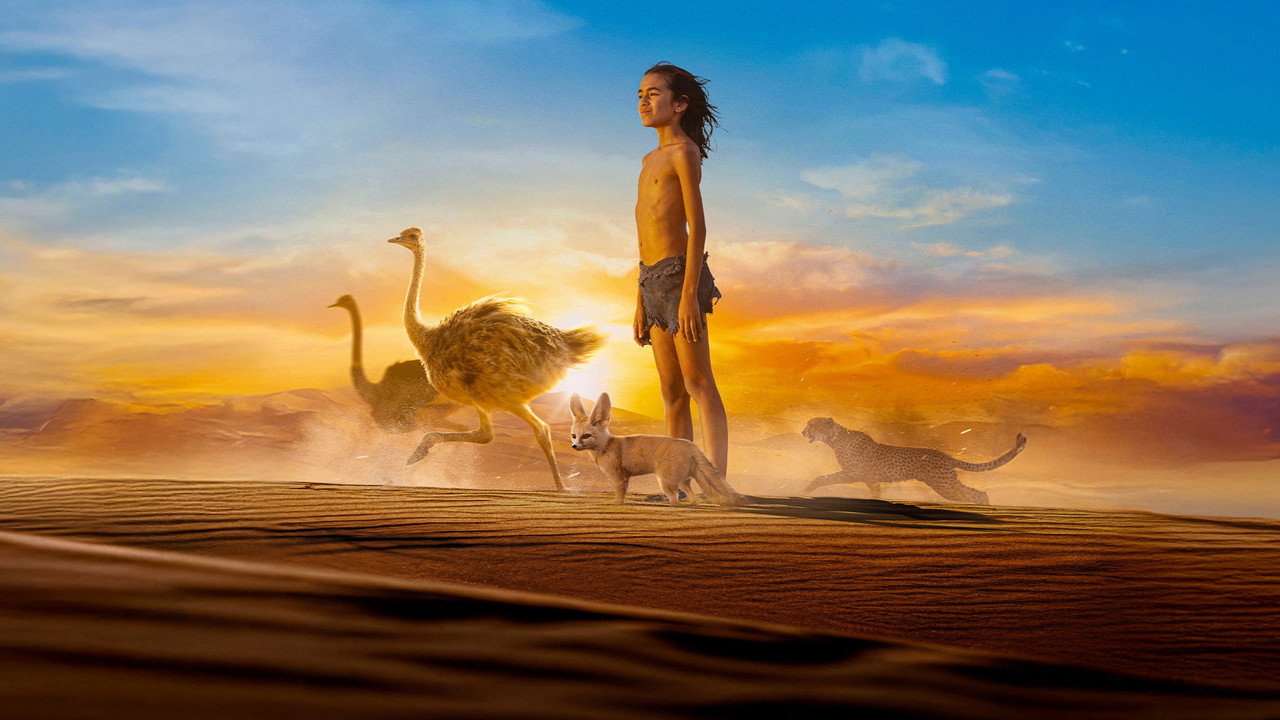
14-year-old Sun has written and successfully published a story based on an incredible story told by her late grandfather about a wild child called Hadara, who is saved by a group of ostriches when he becomes separated from his family in a storm, and is then raised in the desert amid a host of wild animals, including his best friend, a desert fox. When Sun is invited to travel to the Sahara by a local community who has heard about her book, she meets Kharouba, a Nomad girl of her own age, and realizes there may be much more to Hadara than just a character in a bedtime story.
I’ve seen enough desert movies to know the drill: a lone figure stumbles across the dunes, the camera lingers on the horizon, the score swells with existential dread. The Desert Child could have been another entry in that tired genre, a survival fable where the landscape is just a backdrop for human suffering. But Gilles de Maistre doesn’t make movies about landscapes. He makes movies about belonging to them.
Here, the Sahara isn’t just a setting—it’s a character, one that doesn’t care if you live or die. The film follows Hadara, a boy separated from his family in a storm, who is taken in by a flock of ostriches and raised among the rhythms of the desert. It’s a premise that could tip into sentimentality, but de Maistre, who has a knack for blurring the line between documentary and fiction, grounds it in something stranger and more unsettling: the idea that a child might prefer the company of animals to humans.

The first act is a masterclass in sensory filmmaking. There’s no dialogue for long stretches, just the sound of wind scraping against sand, the guttural calls of ostriches, the crunch of Hadara’s bare feet on the earth. The camera lingers on his body—his ribs visible under sun-browned skin, the way his fingers dig into the sand like he’s trying to memorize its texture.
It’s the kind of physicality you don’t see in most child actors, and it’s impossible to look away from. (I kept thinking of The Jungle Book, but where Disney’s animals are anthropomorphized cartoons, these ostriches feel like something else entirely—less like pets, more like indifferent gods.)
The film’s structure is deceptively simple: Hadara’s survival in the wild is intercut with the story of Sun, a modern-day girl who writes a book about him after hearing her grandfather’s tales. It’s a framing device that could have felt clunky, but de Maistre uses it to ask a quiet, haunting question: What does it mean to be wild? Sun, raised in a world of screens and schedules, is fascinated by Hadara’s story, but she can’t quite grasp what it would mean to live without language, without walls, without the safety of being known.
French director Gilles de Maistre is no stranger to blending real-life drama with wild landscapes. His latest, The Desert Child (2026), promises to be another high-stakes adventure—this time set against the brutal beauty of the desert. But behind the official trailers and glossy cast announcements, whispers of on-set challenges and de Maistre’s signature hands-on filmmaking are already swirling.
The Desert Child stars comedian-turned-actor Kev Adams as a man whose life takes a dramatic turn when he crosses paths with a young boy surviving alone in the desert. While the film’s premise feels ripped from a survival thriller, sources suggest it’s loosely inspired by real events. A YouTube featurette teasing the "true story" behind the movie [4] hints at a deeper, possibly harrowing backstory, though details remain scarce. De Maistre, known for blurring fiction and reality in films like Mia and the White Lion, has a history of grounding fantastical tales in lived experience—so expect The Desert Child to walk that same line.
If there’s one thing de Maistre’s filmography proves, it’s that he doesn’t do half-measures. His approach? Raise wild animals alongside child actors for years to capture authentic interactions  , . For The Desert Child, that likely means the desert’s harsh conditions weren’t just a backdrop—they were a co-star. Trailers [5], [6], [8] show sweeping shots of arid landscapes, suggesting the crew endured extreme heat, sandstorms, or logistical nightmares to shoot on location. While no on-set disasters have surfaced, de Maistre’s past projects (Mia and the White Lion, The Wolf and the Lion) involved months of training animals and young actors in remote settings, often leading to unpredictable—and sometimes dangerous—moments.
The cast includes Nahel Tran and Nahïl Bouazzaoui, both child actors, alongside de Maistre’s own daughter, Neige. If the director’s usual playbook holds, these young performers may have spent significant time bonding with the film’s desert environment (and any animal co-stars) long before cameras rolled. A behind-the-scenes interview [9] hints at the emotional toll of such immersion, though specifics are vague.
Early reactions to The Desert Child are a study in contrasts. French review aggregator SensCritique gives it a lukewarm 5.3/10 based on 102 votes , a score that suggests the film’s ambition may have outpaced its execution for some viewers. Yet trailers [5], [6], [8] highlight a visually stunning, high-stakes narrative, with Adams’ comedic roots seemingly dialed back in favor of raw survival drama. Whether the final product delivers on that tension—or succumbs to melodrama—remains to be seen.
One thing’s certain: de Maistre’s films thrive on spectacle, and The Desert Child looks poised to deliver. If the director’s past work is any indication, the real story might lie in what wasn’t scripted—the unplanned moments, the exhaustion, the sheer will to finish a shoot in one of the world’s most unforgiving environments.
With a 2026 release date, The Desert Child is still in the early stages of its rollout. More behind-the-scenes footage or cast interviews could shed light on the film’s production challenges, but for now, the desert’s secrets—and de Maistre’s methods—remain closely guarded.
Entertainment rumors and trivia aggregated from public reporting. Treat speculation as unverified unless a cited source confirms it.
Movies
Related titles ranked by rating and popularity.