The Tide of TimeI wasn’t entirely sure we needed another movie about a man trying to get home. Christopher Nolan has spent the better part of two decades charting the geometry of return—whether through the folding dreamscapes of *Inception*, the evacuation beaches of *Dunkirk*, or the quantum bookshelf of *Interstellar*. But *The Odyssey* feels different. It’s less of a puzzle box and more of a sheer, physical endurance test. When the news broke that Nolan was taking a $250 million blank check post-*Oppenheimer* and spending it on a 70mm IMAX adaptation of Homer’s 3,000-year-old epic, the cynic in me braced for something heavy and sterile. Instead, what we get is remarkably tactile. It smells like salt and copper.

There's a moment early in the movie that I can’t quite shake. Odysseus (Matt Damon) and his crew are caught in a squall shortly after leaving the ruins of Troy. Nolan doesn't rely on the weightless, green-screen artificiality that usually plagues modern mythological epics. He put his cast on actual water, and you can feel it in your bones. The camera—lugged onto the deck of a violently pitching ship—catches the panic in the sailors' movements. A mast splinters with a sound like a rifle shot. Damon’s Odysseus isn’t shouting heroic platitudes; he’s just scrambling, slipping on wet wood, desperately gripping a fraying rope while the Aegean Sea threatens to swallow him whole. You don't watch this scene so much as you survive it. It works because the ocean doesn't care if you're a king.
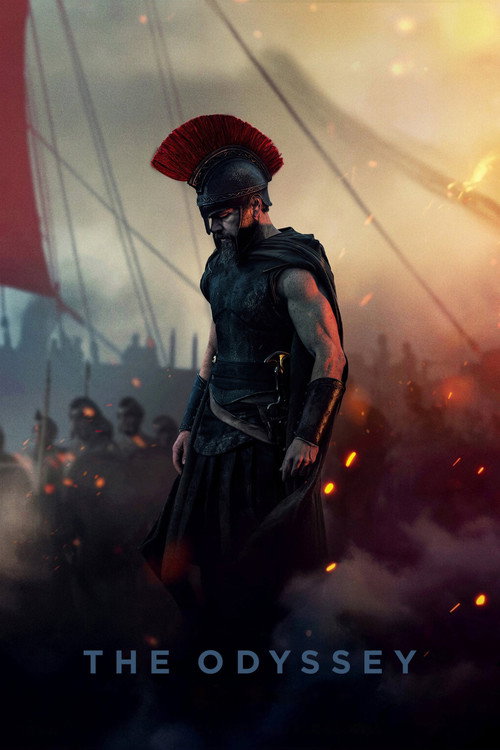
To anchor a film this large, you need an actor willing to be dwarfed by it. Damon is fascinating here. We're so used to seeing him play the capable American problem-solver or the affable everyman. Even in *Oppenheimer*, his General Groves was a bulldog of bureaucratic authority. But playing Odysseus, Damon has shed his usual solid frame, dropping down to a sinewy 167 pounds. He looks carved out of driftwood. His shoulders slump. His gait is uneven. He plays the legendary tactician not as a demigod, but as a deeply exhausted middle-aged man who is simply too stubborn to die. (Nolan reportedly drew heavy inspiration from Emily Wilson’s 2017 translation of the poem, which famously introduces Odysseus simply as "a complicated man"—a choice that anchors every twitch of Damon's jaw.)

Of course, a movie of this scale isn't without its stumbles. I kept wishing the movie spent a little more time letting the quiet moments breathe before rushing to the next monster. The non-linear structure, a Nolan hallmark, sometimes undercuts the sheer agonizing wait experienced by Penelope (Anne Hathaway) back in Ithaca. Hathaway plays her with a brittle, furious intelligence, fending off suitors with a smile that never reaches her eyes, but her scenes occasionally feel like interruptions rather than counterweights to the chaos at sea. And yet, the sheer craft on display covers a multitude of structural sins. You forgive the pacing when the visual language is this potent.
Even Jonathan Nolan, the director's brother, recently called it an "incredible achievement," and for once, the family bias doesn't feel like hyperbole. The movie sits at a strange intersection of Ray Harryhausen’s old-school monster magic and modern, mud-under-the-fingernails realism. When the supernatural finally bleeds into the frame—whether it's the towering shadow of a Cyclops or the disorienting, time-warping allure of Circe's island—it feels genuinely terrifying because the world around it's so stubbornly grounded.

I suppose the real triumph of *The Odyssey* is that it makes a story we all vaguely remember from high school English feel dangerously alive again. It strips away the marble-statue reverence and replaces it with cold water, bleeding knuckles, and the terrifying passage of time. Whether that's enough to satisfy the purists who will inevitably argue over historical accuracy or translation choices, I really don't know. But as I walked out of the theater, I wasn't thinking about Homer, or IMAX cameras, or the legacy of the swords-and-sandals genre. I was just thinking about the absolute, crushing weight of trying to find your way back to the people you love.