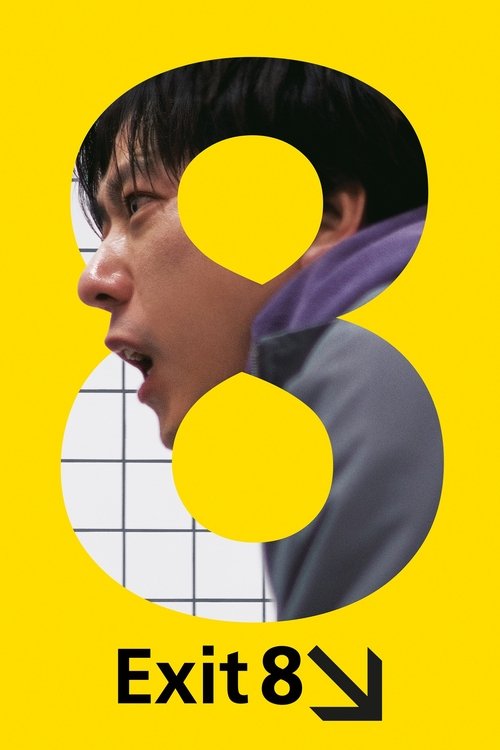
The Purgatory of the CommuteI have always hated underground walkways. There is something fundamentally wrong about those sterile, fluorescent-lit corridors beneath major cities, spaces built exclusively for passing through rather than existing in. You put your head down. You ignore the people around you. You just try to get from point A to point B without making eye contact. Genki Kawamura understands this modern alienation perfectly, and in *Exit 8*, he weaponizes it.
The film opens with the rhythmic, maddening snare drum of Maurice Ravel's *Boléro*. We are on a packed Tokyo subway train. Our protagonist, known only as The Lost Man (Kazunari Ninomiya), is doing what we all do: trying to disappear. He aggressively ignores a businessman berating a mother with a crying baby nearby. He dodges calls from his ex-girlfriend. When he finally steps off the train and answers his phone, the news hits him like a physical blow. She is at the hospital. She is pregnant. He hangs up, stumbles into a white-tiled concourse to catch his breath, and turns a corner. Then he turns another. And another. Slowly, the terrible reality sets in. He is walking the exact same corridor, over and over again.

If this sounds like the mechanics of a video game, that is because it is. Kawamura adapted this 95-minute feature from Kotake Create's viral 2023 indie game of the same name. The rules of this tiled purgatory are painted directly onto a yellow plaque on the wall. If you spot an anomaly—a flickering light, a missing doorknob, a poster that has subtly changed—you must immediately turn back. If everything is normal, you carry on. Miss a single detail, and the loop resets to zero. Your only hope of escape is reaching Exit 8.
Most filmmakers handed a video game property immediately try to drown it in bloated mythology or CGI set pieces. Kawamura (who previously produced anime juggernauts like *Your Name* and directed the deeply empathetic *A Hundred Flowers*) goes the opposite route. He shrinks the world down to a single hallway. I am not entirely sure a gimmick this rigid should work for a feature-length runtime. Whether that friction is a flaw or a feature probably comes down to your patience with repetition. Yet the confinement forces you to actively participate. You find your own eyes darting across the screen, scanning the background for anything out of place. Jonathan Romney from Screen International hit it exactly right when he called it "a rare game-based movie that actually has the feel of a game, with confoundingly tricky rules."

It works largely because Ninomiya anchors the absurdity in genuine, pathetic human panic. Western audiences might remember him as the young, tragic soldier in Clint Eastwood’s *Letters from Iwo Jima*, while in Japan, he spent decades as a wildly famous pop idol in the boyband Arashi. Here, all that youthful sheen is gone. He plays The Lost Man with a heavy, middle-aged slump. Watch his physicality when the asthma attacks hit. His shoulders curl inward. His frantic note-taking on his dead smartphone feels less like problem-solving and more like a man desperately clinging to the illusion of control. He is not a hero trying to beat a maze. He is a guy terrified of becoming a father, literally trapped by his own indecision, refusing to move forward but unable to go back.
The horror here is not loud. It creeps up on you through the sheer exhaustion of routine. There is one particular anomaly that I have not been able to stop thinking about. On every loop, The Lost Man passes a stoic salaryman walking the opposite direction (Yamato Kochi, credited simply as The Walking Man). For a dozen loops, they ignore each other. Just two ghosts in the machine of the city. Then, on one pass, The Lost Man turns his head, and The Walking Man has stopped. He is just standing there. The camera, guided by cinematographer Keisuke Imamura, lingers on this break in the pattern for an agonizingly long unbroken take. The dread does not come from a monster jumping out of the dark. It comes from the sudden, sickening realization that the rules of gravity you have come to rely on have just been suspended.

(It made me think about how often I drive home from work without remembering the trip at all, just operating on pure, numb autopilot.)
By the point that the final act forces The Lost Man to confront the literal and metaphorical ghosts of his choices, the sterile hallway has morphed into a clever metaphor for modern apathy. *Exit 8* asks a surprisingly heavy question hidden inside a simple puzzle box. If you were forced to look closely at the world you walk blindly through every day, would you even recognize it? Or would you just keep your head down, hoping the loop eventually breaks itself?