

Woranuch Bhirombhakdi
Lunthom

“Some betrayals echo far beyond the grave.”
When Lunthom passed away, her husband and his mistress seized the opportunity to live openly as a couple. However, when moved into their villa, they discovering a glass coffin containing Lunthom's body in the house. Leading to a terrifying path of revenge.
Official
I’ve seen this trick before—the mistress, the dead wife, the will that forces the living to share a roof with the corpse. It’s a setup that promises gothic dread, a slow-burn descent into guilt and supernatural retribution. But Tomb Watcher isn’t content to just replay the old tropes.
It wants to turn them into something messier, something that feels uncomfortably close to the way real betrayal lingers—not in jump scares, but in the quiet, suffocating weight of what we refuse to let go.
The film opens with a lie. Cheev (Thanavate Siriwattanakul) and his mistress, Ros (Arachaporn Pokinpakorn), move into the villa of his late wife, Lunthom, expecting to finally live openly, to claim the fortune she left behind. But the house has other plans.
Lunthom’s body isn’t buried. It’s preserved in a glass coffin, displayed like a grotesque centerpiece in the living room. A clause in her will demands that Cheev—and, by extension, Ros—live with the corpse for 100 days before the inheritance is released.
The camera lingers on the coffin, its transparency both a taunt and an accusation. You can see her. She can see you.
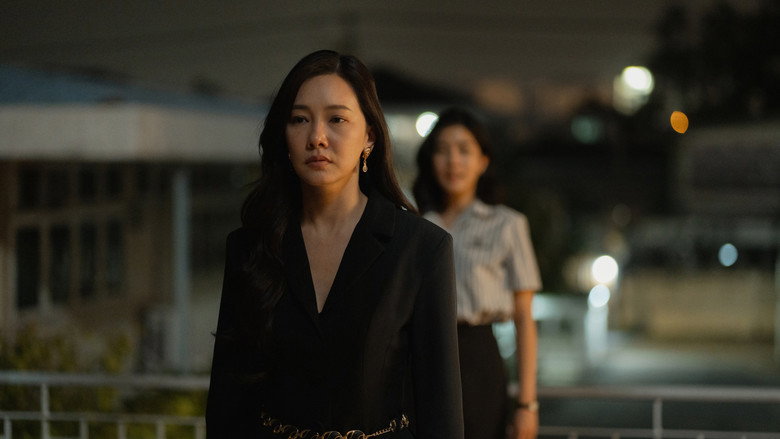
What follows isn’t so much a haunting as a slow unraveling. The ghost of Lunthom doesn’t need to rattle chains or slam doors. She’s already in the room, a silent witness to every whispered argument, every stolen touch.
The film’s horror isn’t in what she does—it’s in what she represents. A betrayal so deep it refuses to stay buried. A love so possessive it outlives the body.
The villa itself becomes a character, its opulent halls and shadowy corners amplifying the tension between the three players, two of whom are still breathing.
Director Vathanyu Ingkawiwat leans hard into the melodrama, and that’s where the film’s identity crisis begins. Tomb Watcher wants to be two things at once: a psychological thriller about guilt and a soap-opera revenge fantasy. The problem is, it’s not entirely clear which one it wants to be more. The first act plays like a daytime drama, all heightened emotions and over-the-top confrontations.
Ros and Cheev bicker like characters in a telenovela, their dialogue heavy with exposition and moralizing. It’s not until the second half that the film remembers it’s supposed to be scary, and by then, the tonal whiplash is jarring.
That’s not to say there aren’t moments of genuine unease. The film’s best scenes are the quiet ones, where the camera holds on Ros’s face as she stares at the coffin, or on Cheev’s hollowed-out expression as he realizes he’s trapped—not just by the will, but by his own choices. Arachaporn Pokinpakorn is the standout here, her performance a masterclass in simmering dread.
She plays Ros as a woman who knows she’s made a mistake but can’t bring herself to walk away. There’s a scene where she presses her palm against the glass of the coffin, her breath fogging the surface, and for a moment, you can almost believe Lunthom is breathing back. It’s the kind of detail that makes you forget you’re watching a film with a premise that could’ve easily tipped into camp.
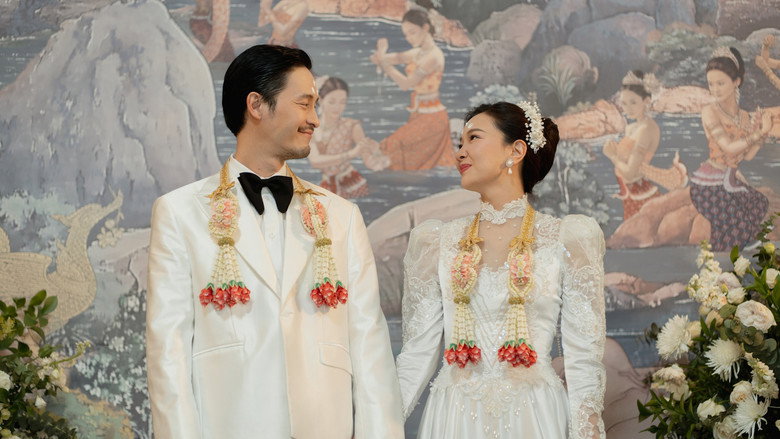
The critics have been divided, and it’s easy to see why. Some, like Love Horror, praise the film’s "clever scares and beautiful cinematography," while others, such as Abstract AF, argue that the ghost’s wrath is "infuriatingly misdirected," targeting Ros more than Cheev, the man who arguably deserves it more. There’s truth to both perspectives.
The film does have a visual elegance to it—the villa’s dim lighting, the way the glass coffin refracts the room around it, the eerie stillness of Lunthom’s preserved face. But the narrative often undercuts its own potential. Why does Lunthom’s ghost seem more interested in tormenting Ros than punishing Cheev?
Is it because Ros is the interloper, the one who dared to love a married man? Or is it because the film, despite its feminist-tinged premise, can’t quite bring itself to let the women unite against the man who wronged them both?
The ending, at least, is where Tomb Watcher finds its footing. Without spoiling it, I’ll say this: it’s the kind of finale that lingers, not because it’s shocking, but because it feels inevitable. The film’s final shot is a gut punch, a visual metaphor so blunt it borders on heavy-handed, but it works.
It’s the moment where the melodrama and the horror finally align, where the film’s themes of guilt, possession, and the inescapability of the past coalesce into something haunting. LeisureByte called it "quite interesting," and I’d go further: it’s the only part of the film that feels truly original, a twist that reframes everything that came before.
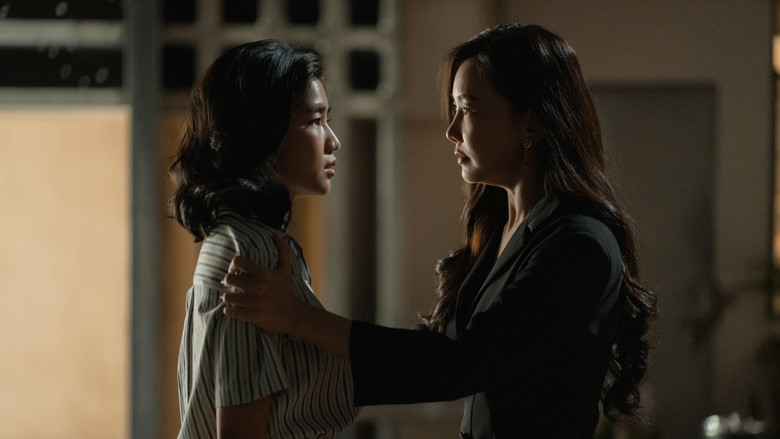
If there’s a larger cultural context here, it’s in the way Tomb Watcher reflects Thailand’s long-standing fascination with ghost stories that double as morality tales. The film is, after all, an adaptation of a classic Thai melodrama that’s been remade multiple times over the decades. In that sense, it’s less a reinvention and more a remix—a familiar tune played with slightly different instruments.
The question is whether those instruments are sharp enough to cut through the noise.
For all its flaws, Tomb Watcher is the kind of film that stays with you, not because it’s perfect, but because it’s messy in a way that feels human. It’s a story about the things we can’t escape: the choices we make, the people we hurt, the ghosts we create. And in the end, maybe that’s the point.
The glass coffin isn’t just a plot device. It’s a mirror. And what we see in it isn’t just Lunthom’s face.
It’s our own.


