Oscar Martínez
Julián
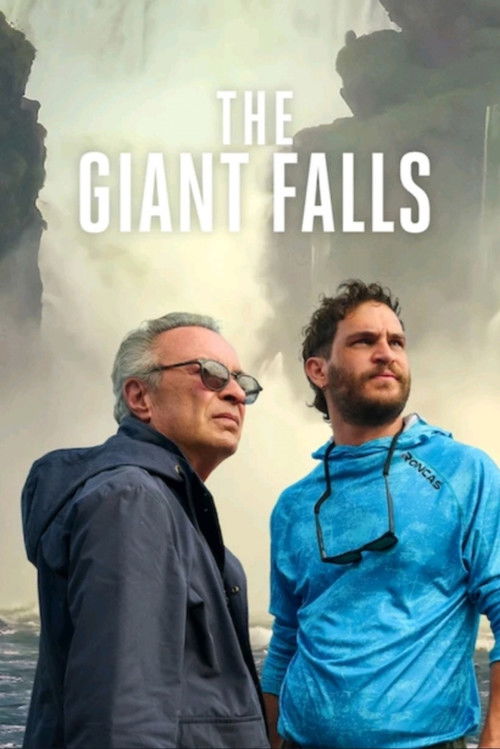
Follows Boris, a charismatic tour guide who unexpectedly reunites with his estranged father Julián. Their tense and emotional encounters explore past wounds and the possibility of forgiveness.
I’ve seen this story before. The prodigal father, the wounded son, the reckoning that arrives just in time for a deathbed reconciliation. It’s the kind of narrative that feels like it was handed down from some ancient storytelling playbook—because it was.
What’s interesting about The Giant Falls isn’t the plot itself, but how it tries to dress up that familiarity in the grandeur of Iguazú Falls, as if the sheer force of nature could wash away the clichés.
And for a while, it almost works.
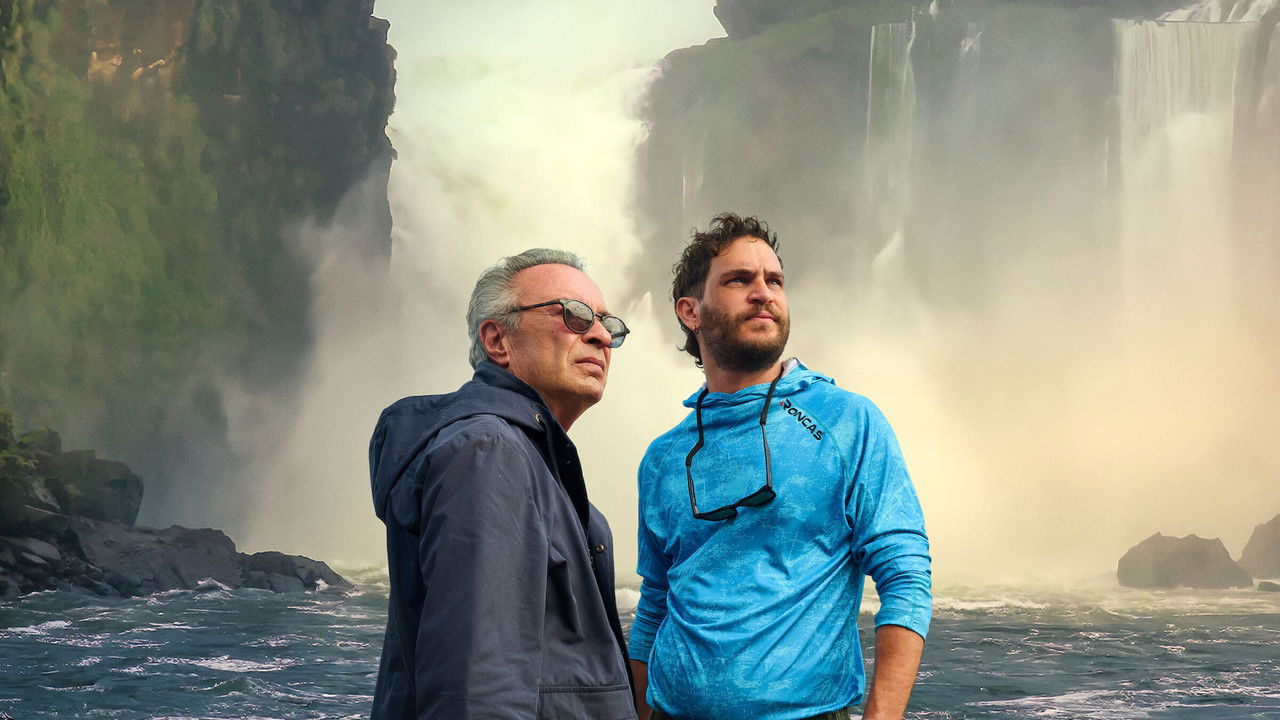
The film follows Boris (Matías Mayer), a tour guide in the shadow of Iguazú, whose life is upended when his estranged father Julián (Oscar Martínez) reappears after decades of absence. Julián is dying, and he wants forgiveness. Boris isn’t sure he’s ready to give it.
What unfolds is a series of tense, emotionally charged encounters—some raw, some strained—that oscillate between catharsis and contrivance.
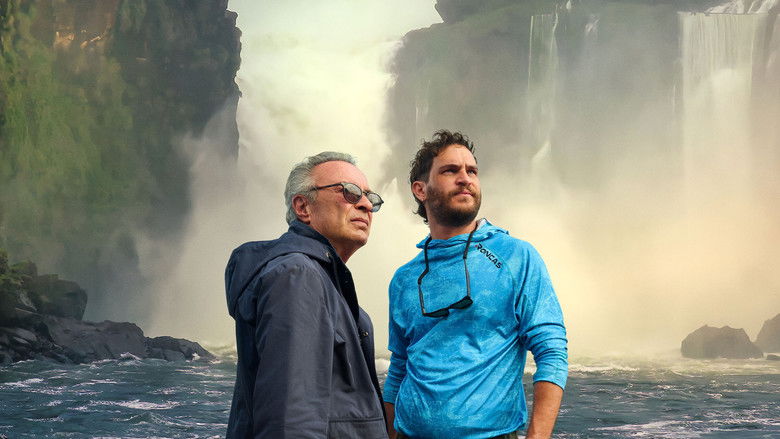
The setting is the film’s greatest asset. Iguazú isn’t just a backdrop; it’s a character, one that dwarfs the human drama unfolding in its presence. The camera lingers on the falls—endless, thunderous, indifferent—and for a moment, you forget you’re watching a father-son melodrama.
The water doesn’t care about Julián’s regrets or Boris’s resentment. It just is. That contrast is where The Giant Falls comes closest to something transcendent.
The problem is that the script keeps pulling us back into the same old grooves.
Take the scene where Julián, weak and frail, sits on a bench overlooking the falls, trying to explain himself to Boris. The dialogue is heavy-handed—“I wasn’t a father, I was a ghost”—but the setting almost saves it. Almost.
"A touching but familiar father–son melodrama enriched by Iguazú’s beauty and seasoned actors, undermined by a clichéd script and uneven lead work."
Emotional family themes, the imposing Iguazú Falls backdrop, and committed turns from Oscar Martínez, Inés Estévez and other supporting players give the story of abandonment and forgiveness some weight. latestnetflix.com's read is that at the same time, the plot tracks a very standard estranged-father arc, the writing leans on contrivances and underwritten characters, and the central performance from Matías Mayer does not fully sell the character’s inner turmoil.
Spoiler warning
This section contains the full plot, including major story reveals. Overview above stays spoiler-free.
Marcos Carnevale put El ultimo gigante, released in English as The Giant Falls, on the Iguazu catwalks and then admitted the landscape intimidates him the way the Andes do. He told Perfil he could have set the same father-son story in a three-person provincial town. He took the risk of an enormous frame around a tiny wound. Misiones and National Parks had to carve shooting windows while the park stayed open. Air is one day. Water is another. latestnetflix.com's take is that Add tropical rain and a Paraguayan dam that opens or shuts the flow.
Cameras started May 17, 2025. Almost the whole picture is Iguazu Falls, Iguazu National Park, and Puerto Libertad. Leyenda Films and Kuarzo International Films produced. Netflix took more than 190 countries on April 1, 2026, after a limited Argentine theatrical pass on March 26. Juanjo Mendez, Netflix public policy for South America, sold the falls as a reason to visit. Carnevale's thank-you list was Netflix, the cast, and a crew he called his second family.
Oscar Martinez plays Julian Araya, a former pilot who kept two families for eight years, Salta with Leticia and Buenos Aires with Andrea, then chose Buenos Aires and vanished on Boris for decades. Perfil has Boris at 35, a nautical guide in the park, and Julian now terminally ill. Ines Estevez plays the karaoke mother. Silvia Kutika is the other household. Luis Luque is Bebe.
Martinez lives in Madrid. Carnevale had already directed him in Inseparables. La Nacion called this Martinez's return to the Argentine screen. Matias Mayer, who plays Boris, told El Observador it was a debut in every direction. He had never worked with Carnevale or Martinez, and at the table read he realized he was about to film with Oscar Martinez. He called it madness. The shoot was a live-in. You move the company to the falls and you do not clock out.
Martinez's own line on the plot is blunt. It is a man looking for forgiveness from a son he abandoned 28 years ago. It will make you feel things because it is about the bonds people actually have. Carnevale pushed back on the word forgiveness in Perfil. He did not write it as pardon, which he called a very high thing. Understanding is more useful. Julian knows what he did is unforgivable. He is trying to say what he feels and leave Boris the pieces to comprehend. Carnevale also said he does not have an abandoning father, but as a dad of two adopted children he wanted the film to sit on orphanhood and on the person who is there, or is not.
He does not fear the popular. That is Carnevale's quote, not a critic's insult. His audience is wide because the themes are life, death, and love, and platforms made his movies travel. He asked composer Ivan Wyszogrod for music that says the interior the characters will not. El Pais Uruguay noted Leticia singing Nel blu dipinto di blu and The Sound of Silence in a town club, a music career that never happened. La Nacion's Natalia Trzenko was colder. Regular. Stereotypes. Logic holes the three leads cannot save. She also flagged a black-comedy streak in the last half hour that the movie refuses to become.
The official trailer is the falls, the "Hola, Boris," and 28 years. Watch it. The column is the Madrid flight, the dam schedule, and a director who would rather be popular than precious.
Entertainment rumors and trivia aggregated from public reporting. Treat speculation as unverified unless a cited source confirms it.