
Alex Calleja
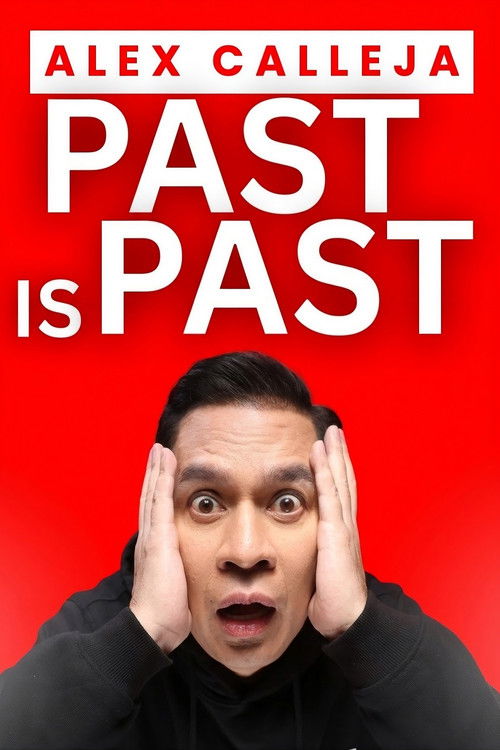
In this comedy special, Alex Calleja shares his unflinching observations about his family, personal failures and the oddities of life in the Philippines.
I’ve always thought stand-up comedy is the closest thing we have to a public confessional—except the priest is a mic stand, and the congregation is a room full of strangers laughing at your sins. Alex Calleja’s Past Is Past leans hard into that tradition, turning his life into a series of punchlines about Filipino family dynamics, marriage mishaps, and the absurdity of modern tech nostalgia.
It’s relatable, sure, but it’s also a performance that walks a tightrope between catharsis and calculation. And after watching it twice, I’m still not sure which side it lands on.

The special opens with a skit that feels like it was written by committee. A fake game show, complete with over-the-top hosts and canned audience reactions, sets up the premise: Alex is here to talk about his life, but only the parts that make him look bad. It’s a meta joke about stand-up itself—the idea that comedians are just professional self-flagellators, mining their own humiliation for laughs.
The problem? The skit isn’t funny. It’s the kind of forced, cringe-heavy framing that makes you wonder if someone in the production meeting said, “We need to brand this.” (And if that’s the case, I’d love to know who thought branding was the way to go for a comedy special.)
But then the skit ends, and Alex steps out in a simple black shirt, mic in hand, and the energy shifts. He’s not performing anymore; he’s just talking. And that’s when Past Is Past starts to work.
The best bits here aren’t about punchlines—they’re about recognition. There’s a moment where he describes his wife’s reaction to his cooking (“She takes one bite, puts the plate down, and just looks at me”), and the way he mimics her silent judgment is so specific that it doesn’t just get a laugh—it gets a nod. That’s the kind of comedy that doesn’t need a setup.
"Relatable Filipino stand-up built on strong everyday observations and pop culture riffs, but undercut by rushed pacing and hit-or-miss gags."
The special clicks best when it leans into familiar Filipino family dynamics, marriage anecdotes, and 80s/90s tech nostalgia, which many found easy to connect with and often genuinely hilarious. Others felt the pacing raced through material, with some transitions and framing skits coming off as shallow or cringey, and several jokes landing only intermittently rather than as a constant stream of laughs. latestnetflix.com's take is that Overall sentiment is mildly positive, with enjoyment tempered by comparisons to stronger earlier material.
Alex Calleja's second Netflix special, Past Is Past, landed on 19 March 2026. The next day it sat at number one on Netflix Philippines' Top TV Shows list, knocking the live-action One Piece series off a run PEP.ph said had lasted eight days. Calleja posted from California. It was 5 p.m. there. He wrote that he was crying in his room because he was so happy. He had assumed repeating number one would be hard, with One Piece already streaming and a BTS live show on the way. In a P.S. latestnetflix.com's take is that he noted this one hit the top faster than Tamang Panahon.The Lakers were winning too.  ,
,
Tamang Panahon, his first Netflix hour, went up on 7 February 2025. LionhearTV calls it the first Filipino stand-up special to reach number one in the Philippines, nine days at the top and more than a month in the Top 10. Past Is Past, PEP wrote, was the first locally made title to hit number one on that TV chart in 2026. He later posted that the special dropped on his late father's birthday. Two gifts from a dead dad, he wrote. One Piece had started on 10 March. BTS The Comeback Live was dated 27 March. He said he was being realistic about that. ,
Before premiere he put a longer story on Facebook. After Tamang Panahon, someone accused him of stealing a carwash joke. Calleja said he had screenshots showing he had done the bit for a long time, answered the charge, and asked a lawyer about a cyber libel case. Then they talked it out. The someone was fellow comic Chito Francisco. Calleja said they made up, and that he put Francisco in Past Is Past, in a carwash scene, to prove they were friends now. "Kaya nga ang title eh 'Past Is Past.'" That is his version, printed as-is by PEP. Francisco's side is not in that write-up.
Rotten Tomatoes lists Frank Lloyd Mamaril as director and Calleja as writer. Runtime is 58 minutes. Original language is Filipino. Streaming date is 19 March 2026. TMDB matches the date, the runtime, and the logline about family, personal failures, and the oddities of life in the Philippines. Netflix's title page keeps the same pitch. Netflix Philippines posted a clip the same day, Calleja riffing on body odor, bad breath, and zits. , ,
He told fans the special felt like a school project the whole country finished together. Then he promised more jokes with The Comedy Crew, and, if Netflix asked again, another special. He also said he had been nervous because last year's number one had become this year's expectation, and that One Piece and BTS were the plot twist in the middle. By 21 March, PEP still had Past Is Past at number one and One Piece at two. The title does the work the gossip column usually does. He named the feud, booked the other man, and let the chart fight with pirates and a K-pop live do the rest.
Entertainment rumors and trivia aggregated from public reporting. Treat speculation as unverified unless a cited source confirms it.
Movies
Related titles ranked by rating and popularity.