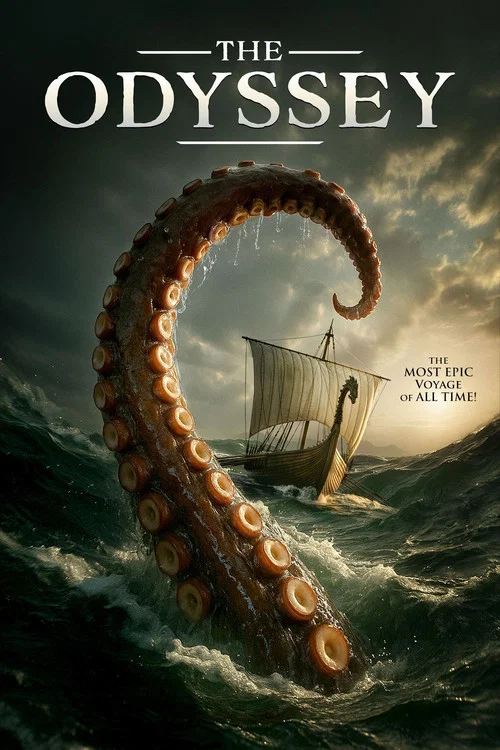

Movie poster for The Odyssey (2026)

The Odyssey

“The most epic voyage of all time!”

2026
1h 26m
Director: Marcel Walz
Play trailer

Overview

Based on the Ancient Greek epic. After ten years of war, King Odysseus sets sail for Ithaca, eager to reunite with his beloved. But his journey home is far more treacherous than the battlefield, as he must face deadly monsters and vengeful gods to survive.

Cast

10 people

Reviews

4 min read
AI-generated editorial review
The Odyssey That Wasn’t Meant to Be

I went into The Odyssey (2026) expecting Christopher Nolan’s take on Homer’s epic—something vast, cerebral, and visually overwhelming. What I got instead was a film so bafflingly misjudged that it felt like watching a man try to build a cathedral out of popsicle sticks. The credits roll on a movie that isn’t just bad; it’s confused, as if the filmmakers had heard of the Odyssey but never actually read it. Or, more likely, never cared to.

This isn’t Nolan’s Odyssey. The research pack makes that abundantly clear: the real 2026 Nolan epic—a three-hour, IMAX-shot spectacle starring Matt Damon and Anne Hathaway—was a theatrical event, a culmination of the director’s obsessions with time, trauma, and homecoming. What we have here, instead, is a 86-minute mockbuster, a film so cheap it might as well have been shot in someone’s backyard with a green screen and a borrowed sword. The tagline—"The most epic voyage of all time!"—isn’t just hyperbole; it’s a lie so brazen it borders on performance art.

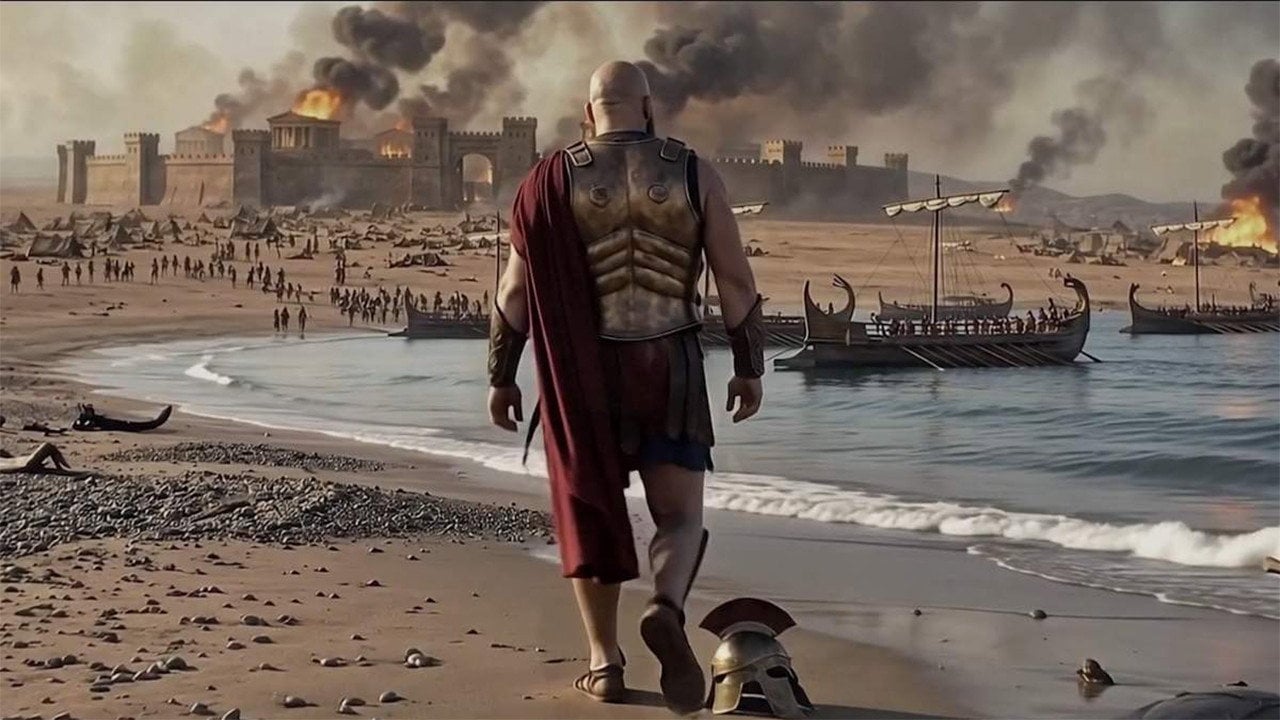
A lone figure stands on a rocky shore, the sea behind them a churning mass of digital noise, as if the film itself is glitching out of existence.

The first sign that something is deeply wrong comes early. Odysseus (Myrom Kingery) is introduced mid-battle, swinging a sword with all the conviction of a man who just realized he left the oven on. There’s no weight to his movements, no sense of a warrior hardened by a decade of war. When he finally sets sail for Ithaca, the journey feels less like a mythic odyssey and more like a particularly dull road trip. The monsters he encounters—what few there are—are rendered in CGI so flat they might as well be clip art. The Cyclops, when it appears, looks like it was animated in a high school computer lab. (I half-expected a "Rendered in Blender" watermark to appear in the corner.)

This isn’t just a failure of budget, though that’s certainly part of it. It’s a failure of ambition. The real Nolan Odyssey, according to the research pack, was a film about the cost of war, the burden of leadership, and the cyclical nature of history—all themes that have defined his career. This version? It’s a film that seems to think the Odyssey is just a series of obstacles to overcome, like a video game with no deeper meaning. There’s no sense of Odysseus as a man haunted by his past, no exploration of the Greek concept of xenia (hospitality as sacred duty), no real engagement with the gods as anything more than plot devices. The film treats Homer’s text like a checklist: Sirens? Check. Lotus-eaters? Check. A quick stop at Circe’s island for a poorly lit magic sequence? Check.

Audience Opinions

AI summary of viewer review patterns
"Early buzz is scarce, but expectations lean toward a gritty, action-driven take on Homer's epic with mixed curiosity about its modernized approach."

Viewer discussion about *The Odyssey* (2026) is extremely limited, with most attention focused on its director, Marcel Walz, known for horror and action films. Some express cautious optimism about the cast, particularly Dominic Keating, while others question whether the film’s low-budget aesthetic will do justice to the source material’s grandeur. Concerns about pacing and visual effects dominate early speculation, given the ambitious scope of the story.

What viewers praise
  • Strong lead potential Dominic Keating’s involvement generates interest, with fans anticipating a compelling performance as Odysseus.
  • Unique directorial vision Marcel Walz’s stylized approach to action and horror may bring a fresh, visceral energy to the classic tale.
Common complaints
  • Budget constraints Skepticism about whether the film’s resources can match the epic scale of Homer’s *Odyssey*.
  • Pacing concerns Worries that the ten-year journey’s narrative might feel rushed or unevenly structured.
  • Unproven adaptation Doubt about whether a modernized, action-focused retelling will resonate with fans of the original poem.
Recommended for
Fans of low-budget action epics Marcel Walz enthusiasts Dominic Keating admirers Greek mythology reimagining seekers

Full Plot (Spoilers)

AI-generated full plot summary Loading…

Buzz & Rumors

Public reports
AI-researched entertainment notes

Marcel Walz’s The Odyssey (2026): A Low-Budget Epic with High Stakes—and a Rival

Marcel Walz’s The Odyssey (2026) is shaping up to be one of the most unexpected adaptations of Homer’s ancient epic—if only because it’s not the one everyone’s talking about. While Christopher Nolan’s star-studded version dominates headlines, Walz’s film, produced by The Asylum, is carving out its own niche as a scrappy, no-frills retelling. But with a release date just months before Nolan’s blockbuster, it’s already caught in a storm of controversy, confusion, and low-budget ambition.

A B-Movie in the Shadow of a Titan

The Asylum, known for its mockbusters (think Sharknado or Atlantic Rim), is no stranger to riding the coattails of major releases. This time, they’ve set their sights on The Odyssey, capitalizing on the public domain status of Homer’s work to deliver their own take. The trailer, described as "super bad" by First Showing, leans into the studio’s signature style: cheap CGI, melodramatic one-liners ("Odysseus will not leave my ocean alive"), and a cast of relative unknowns .

Walz, best known for horror films like Blood Feast and Blitzkrieg, is an unlikely choice to helm an ancient Greek epic. But The Asylum’s model thrives on quick turnarounds and minimal budgets, and The Odyssey (2026) fits the bill. The film stars Dominic Keating (Star Trek: Enterprise), Myrom Kingery, and Morgan Flanagan in roles that likely won’t compete with Nolan’s A-list lineup—but that’s not the point. This is a movie designed to capitalize on curiosity, confusion, and the kind of so-bad-it’s-good appeal that The Asylum has perfected .

Release Date Clash: A David vs. Goliath Showdown

The most immediate drama surrounding Walz’s The Odyssey is its release date: July 3, 2026 [1]. That’s just weeks before Christopher Nolan’s The Odyssey, which hits theaters on July 18, 2026, with a cast including Matt Damon, Zendaya, and Tom Holland . The proximity is no accident. The Asylum has a history of timing its releases to coincide with major studio films, banking on audiences mistaking their trailers for the real deal or seeking out a cheaper alternative.

But this time, the strategy might backfire. Nolan’s version is already mired in controversy over casting choices, costume designs, and accusations of "whitewashing" ancient Greek characters [3]. Walz’s film, by contrast, is flying under the radar—though that might change if audiences start conflating the two. Already, some early reports suggest confusion between the two projects, with fans accidentally searching for Walz’s Odyssey when looking for Nolan’s .

What We Know (and Don’t Know) About the Film

Details about Walz’s The Odyssey are scarce, but the available evidence paints a clear picture of its ambitions—or lack thereof.

  • Plot: The film follows the basic structure of Homer’s epic, with Odysseus (likely played by Keating) struggling to return home after the Trojan War. The trailer hints at encounters with mythological creatures, though how they’ll be realized on a The Asylum budget remains to be seen [1][2].
  • Cast: Beyond Keating, Kingery, and Flanagan, the film features Llana Barron, Patrick Byrnes, Jordan Iverach, Angelo Kern, and Tony Wood—none of whom are household names. This aligns with The Asylum’s typical casting strategy: recognizable enough to fill out a poster, but not so famous that salaries become an issue [1].
  • Production: Given Walz’s background in horror, expect a darker, more visceral take on the myth. The Asylum’s films are rarely subtle, so the Cyclops, sirens, and other monsters will likely be played for maximum camp [2].
  • Controversy: Unlike Nolan’s film, Walz’s Odyssey hasn’t sparked backlash—yet. But if audiences mistake it for the blockbuster, or if The Asylum leans too hard into its usual schlock, that could change. For now, the biggest controversy is simply its existence [2].

Will It Matter?

In the grand scheme of 2026’s cinematic landscape, Marcel Walz’s The Odyssey is a footnote. But that doesn’t mean it won’t find an audience. The Asylum’s films thrive on a specific kind of cult appeal, and if The Odyssey delivers even a fraction of the unintentional hilarity of their past work, it could become a midnight-movie favorite.

The real question is whether it can avoid being completely overshadowed by Nolan’s version. With a release date just two weeks apart, the two films are on a collision course—one a $200 million epic, the other a $2 million gamble. If nothing else, Walz’s Odyssey is proof that in Hollywood, even the oldest stories can get a second (or third, or fourth) life—no matter how bizarre the execution.

Entertainment rumors and trivia aggregated from public reporting. Treat speculation as unverified unless a cited source confirms it.