
Audrey Tautou
Amélie Poulain
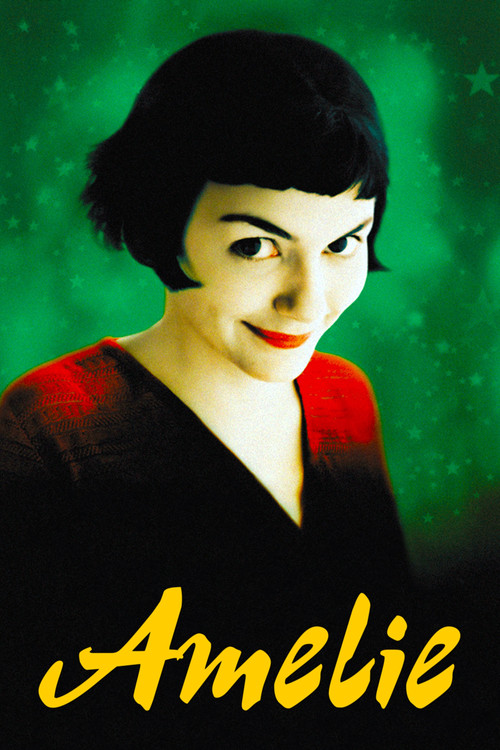
“She’ll change your life.”
At a tiny Parisian café, the adorable yet painfully shy Amélie accidentally discovers a gift for helping others. Soon Amelie is spending her days as a matchmaker, guardian angel, and all-around do-gooder. But when she bumps into a handsome stranger, will she find the courage to become the star of her very own love story?
I’ve always thought Amélie begins like a dare: what if a movie could make kindness look mischievous instead of sentimental? Jean-Pierre Jeunet doesn’t answer that question with realism. He answers it with dollhouse precision, saturated color, and a camera that treats Paris as if it were a memory somebody’s been polishing for years.
Released in 2001, it arrived as both a French export built for international audiences and a kind of corrective to the drab late-‘90s mood of so many city movies. Jeunet had already spent years making worlds that felt engineered from recycled dreams — Delicatessen, The City of Lost Children, Alien Resurrection — but here he turns away from baroque doom and toward something lighter, though not simpler.
A fairy tale, yes. But one with shoe scuffs, bitter coffee, and loneliness tucked into the corners.
Audrey Tautou is the reason the film doesn’t collapse under all that design. She’s doing something far subtler than “quirky.” Her face stays open but guarded, as if she’s always half a second away from retreating into herself. That’s crucial.
Amélie’s pleasure in interfering with other people’s lives can easily read as twee meddling, but Tautou plays it like covert action. She moves quickly, almost skittishly, with the posture of someone who’d rather be mistaken for furniture than exposed as emotionally available. By the time the film asks her to risk actual vulnerability, we understand why that feels like a dangerous act.
The movie’s most talked-about quality, of course, is its style — the hyper-saturated reds and greens, the storybook framing, the little visual flourishes that make ordinary objects seem enchanted. But that style isn’t just decorative. It’s Jeunet’s way of making desire visible.
Look at the café: jars, lamps, mirrors, and brass surfaces all seem to glow with private intention. The world isn’t neutral in Amélie; it appears to be conspiring, gently, to notice itself. I’m not entirely sure this wouldn’t become oppressive in the wrong hands.
Here, though, the over-designed palette performs a useful trick. It externalizes the way shy people experience the world — as if every object might be carrying a message, if only you knew where to look.
Movies
Related titles ranked by rating and popularity.