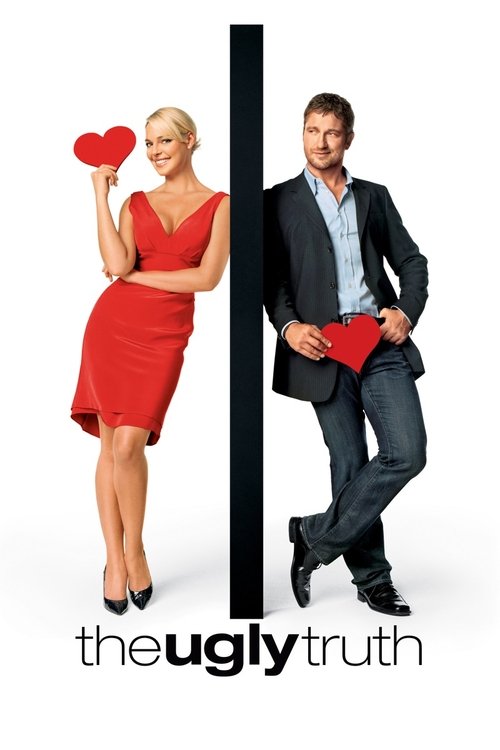
The Ugly Truth backdrop
The Ugly Truth poster

The Ugly Truth

“The battle of the sexes is on.”

6.5
2009
1h 36m
ComedyRomance
Director: Robert Luketic

Overview

A romantically challenged morning show producer is reluctantly embroiled in a series of outrageous tests by her chauvinistic correspondent to prove his theories on relationships and help her find love. His clever ploys, however, lead to an unexpected result.

Sponsored

Trailer

The Ugly Truth - Official Trailer Official

Cast

Reviews

AI-generated review
The Cynical Geometry of Love

There’s a specific, hollow sound to a romantic comedy from the late 2000s. It’s the sound of a genre trying to have its cake and eat it too—wanting to be the cynical, post-Apatow comedy while clinging to the rigid structural requirements of a Hallmark card. Watching Robert Luketic’s *The Ugly Truth* in the current climate feels less like watching a movie and more like unearthing a time capsule filled with things we’ve collectively agreed to stop doing.

Luketic is an interesting case. This is the same director who gave us *Legally Blonde*, a film that understood the power of being underestimated. By 2009, that sharpness had curdled. *The Ugly Truth* isn’t about subverting expectations; it’s about breaking a woman until she fits into the narrow, "cool girl" shape a man has carved out for her.

Katherine Heigl as Abby, the high-strung morning show producer, in a boardroom meeting.

The film’s central conceit—a rigid, perfectionist morning show producer named Abby (Katherine Heigl) being mentored in the "art" of dating by a chauvinistic, shock-jock correspondent named Mike (Gerard Butler)—is less a premise and more a lecture. We’re meant to believe Mike is a rogue, a truth-teller who sees through the charade of modern romance. But in practice, he just sounds like a guy reading a pick-up artist manual in a bar at 2:00 AM.

Heigl is trapped in a performance that requires her to be constantly, visibly vibrating with anxiety. She’s an actor who, at the time, was often criticized for playing the "uptight professional," but looking back, there’s something genuinely compelling about her exhaustion here. Her posture is brittle. Her jaw is tight. She looks like someone who is tired of the character she’s been asked to play, both on the screen and in the industry’s perception of her.

Gerard Butler as Mike, the abrasive relationship guru, challenging Abby's worldview in a broadcast setting.

Then there is the infamous restaurant scene. If you’ve seen the film, you know exactly which moment I mean: the remote-controlled panties. It’s meant to be the climax of the film’s "lesson," a slapstick sequence where Abby must navigate a romantic dinner while Mike manipulates her body via a device in her underwear.

It’s meant to be funny—a display of loss of control—but it’s played with such broad, desperate strokes that it lands in a weird, uncomfortable valley. It isn’t sexy, and it certainly isn’t subversive. It’s an exercise in humiliation disguised as a romantic dare. Writing for *The New York Times*, A.O. Scott hit the nail on the head when he called the film "coarse, vulgar and aggressively unappealing." He wasn’t wrong. The film doesn't trust its characters to have chemistry, so it force-feeds us scenarios that feel engineered in a lab designed to manufacture "shenanigans."

Abby and Mike caught in a moment of forced intimacy that blurs the lines between professional and personal.

Gerard Butler, for his part, leans into the "alpha" persona with a physicality that borders on the aggressive. He’s all chest and chin, projecting a kind of rugged certainty that the script clearly mistakes for charm. I couldn't help but wonder if the film would have worked better if it leaned into the absurdity of his character—if he were revealed to be as lonely and terrified as she is. Instead, the film insists on keeping him the "winner" of their ideological war.

Maybe that’s the real tragedy of *The Ugly Truth*. It’s a movie that claims to reveal the hidden mechanics of love, yet it’s terrified to show us anything genuine. It operates on a binary—prude versus player, control versus chaos—that feels less like human behavior and more like a spreadsheet. I walked away from it feeling the way one does after a long, loud conversation at a party with someone who thinks they've figured out the world, but hasn't actually looked at it. It’s loud, it’s confident, and it’s entirely empty.