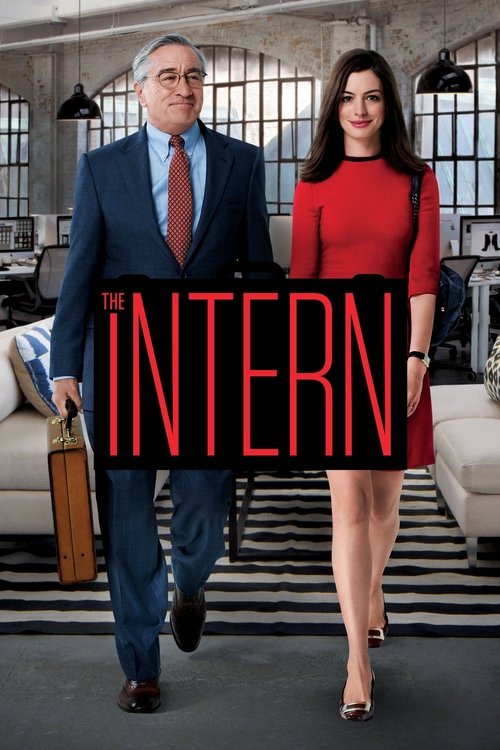
The Gentle Art of Being UsefulThere’s something almost quietly radical about watching Robert De Niro play a man who is at ease with himself. We’re so used to the clenched version of him, the one whose silence is threatening, whose stillness feels like a coiled spring. In *The Intern*, Nancy Meyers asks him to do something else entirely. Ben Whittaker stands straight not to dominate a room but to steady it. His hands are careful. His face is open. The whole performance feels like a dismantling of the hard-man persona De Niro spent years perfecting, and seeing that toughness replaced with simple, practiced kindness is probably the most compelling thing in the movie.

Meyers has always understood environments as characters in their own right. Her films aren’t just built from dialogue and plot; they’re built from rooms you instantly want to live in. Here, the central space is Jules Ostin’s brick-lined Brooklyn startup office, all openness and busy screens and curated energy. Ben, with his handkerchief and his analog habits, doesn’t just enter a new workplace. He walks into a culture that assumes everything old is obsolete by default. That tension is what keeps the movie moving. It’s not merely a fish-out-of-water setup. It’s about what gets lost when experience is treated like dead software.
One small moment early on says more than the script does. Jules is overwhelmed, sprinting from one task to the next with that scattered momentum of someone who hasn’t stopped spinning in months. Ben notices a pile of papers nearby that has become its own form of stress and simply starts putting it in order. No speech, no permission, no need to announce his usefulness. When Jules catches him, she bristles at first. Understandably. But De Niro’s expression there is wonderfully precise. He doesn’t look eager to impress or hungry for approval. He looks like a man who knows that restoring order can be a kindness. He isn’t correcting her. He’s trying to make the room more breathable.

Meyers gets written off too easily as someone who makes glossy, low-stakes comfort food, and I think that misses the low hum of anxiety running through this film. A.O. Scott called it "a surprisingly gentle, deeply appealing comedy" in *The New York Times*, and that gentleness is real, but so is the strain underneath it. The movie taps into a very contemporary panic: the fear that if you stop moving, even for a second, everything will pass you by. Anne Hathaway does a lot of the work there. She’s all motion, all alertness, always split between obligations. The clicking heels, the darting eyes, the sense of a mind permanently on overdrive, it all makes Jules feel like the embodiment of modern professional exhaustion. Ben, by contrast, comes from a world where work had edges.
Still, I do think the film pulls back from some of its own sadness. Ben is a widower, after all. His days begin with rituals designed to fill a space that can’t really be filled. The movie gestures at that melancholy, at the invisibility that can come with aging in a culture obsessed with youth and disruption, but it rarely sits there for long. Meyers keeps everything polished, emotionally manageable, lit just warmly enough. Part of me wanted the film to press harder, to let the neat surface crack and see what remained once the gentlemanly composure stopped being enough.

But maybe that’s not this film’s job. Maybe the point is not to drag the darkness into full view but to offer a gentler truth instead. There’s a scene where Ben drives Jules home and the conversation drifts away from business toward the cost of wanting too much from one life. In that car, away from the startup frenzy, they both seem briefly unguarded. What emerges is not just a portrait of mentorship, but of two lonely people recognizing each other across an age gap. The movie understands that guidance is not only about skills or strategy. Sometimes it’s just one person giving another permission to be less composed, less efficient, more human. By the end, *The Intern* leaves behind something unexpectedly difficult to fake: the feeling that patience still matters, and that being useful can be a form of love.