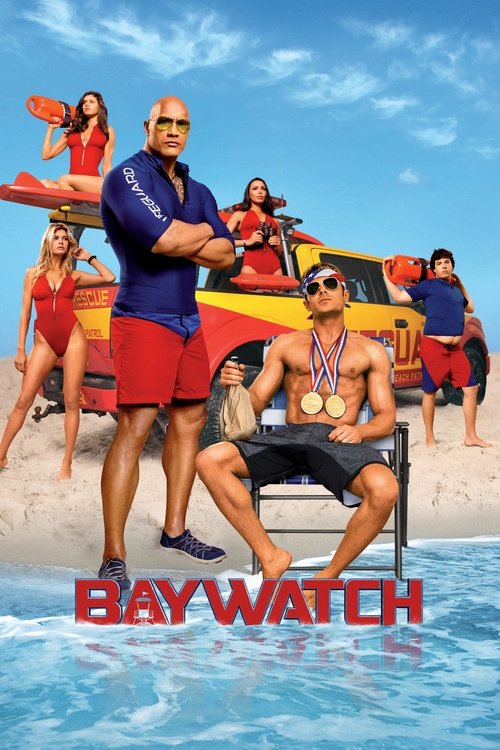
Life-Saving, Or Something Close To ItThere is an odd, shimmering alchemy to the 2017 reboot of *Baywatch*. It wants to be two movies at once: a self-aware, winking parody of the 1990s television phenomenon—where slow-motion running was practically a religious text—and a genuine, hard-R action comedy that doesn't quite know where its own boundaries are. It’s an awkward collision, but in that awkwardness, there’s something fascinating to be found about how we consume nostalgia. Seth Gordon, a director known for *Horrible Bosses*, approaches this material like a man trying to fix a leaky faucet with a sledgehammer. It's aggressive, it's loud, and occasionally, it hits the mark, though rarely in the way you’d expect.

The film’s central conceit rests entirely on the shoulders of Dwayne Johnson, who steps into the role of Mitch Buchannon with an ease that borders on the superhuman. Johnson is an interesting specimen of modern stardom. He doesn't just play characters; he inhabits an aura of unshakeable competence. Here, he acts as the sun around which the entire plot orbits. When he’s on screen, the movie hums with a confident, breezy energy. It’s when he’s off-screen that the narrative starts to fray. His chemistry with Zac Efron, playing the disgraced Olympian recruit Matt Brody, is meant to be the classic odd-couple dynamic—the stoic, duty-bound veteran versus the ego-driven, impulsive rookie. And for a while, it works. Efron, having spent years trying to shed his *High School Musical* skin through darker, riskier roles, displays a frantic, high-energy commitment here that almost makes you forgive the script’s more plodding moments.
Yet, *Baywatch* frequently struggles to reconcile its tone. It wants the ribald humor of a *21 Jump Street* reboot, but it’s anchored to a property that, fundamentally, was about sincere, sun-drenched idealism. As A.O. Scott once noted in *The New York Times*, there’s a persistent "tension between the movie’s desire to be a joke and its half-hearted attempt to be an actual story." It’s an astute observation. Whenever the film starts to find a rhythm—perhaps a scene where the banter actually lands—it suddenly yanks the audience back into a convoluted drug-smuggling plot that feels imported from a generic procedural drama. It’s the cinematic equivalent of trying to have a serious conversation in a mosh pit.

Let’s look at the morgue scene. It’s a standout for all the wrong reasons, or perhaps, for the most *Baywatch* reasons imaginable. It involves our leads sneaking into a medical examiner’s office, encountering a cadaver, and engaging in a slapstick sequence involving a loose appendage. The craft here is instructive: the camera stays tight on their faces, highlighting the absurdity, but the editing is frantic, jumping back and forth to emphasize the chaos. It’s technically functional, but it feels like it’s checking boxes rather than letting the humor breathe. We’re watching movie stars try to be funny, rather than watching characters actually *being* funny. It highlights the film's core dilemma: it doesn't trust the absurdity of its own premise, so it tries to outrun the silence with noise.

There is, however, a strange, undeniable charisma in how the film treats the setting itself. The beach isn't just a location; it's a character, shot with a saturated, high-contrast gloss that makes every wave look like it was scrubbed clean by a cleaning crew before the cameras rolled. Priyanka Chopra Jonas, playing the villainous Victoria Leeds, seems to be the only person on set who understands that the film is a heightened reality. She plays her role with a cold, sharp-edged sophistication that feels like it wandered out of a much tighter, more satirical film. Her physicality—that precise way she carries herself, never breaking a sweat even when the plot goes off the rails—is a masterclass in staying above the fray.
Watching *Baywatch* is a bit like eating comfort food that’s been spiked with jalapeños—you aren't sure if you're enjoying the flavor or just reacting to the burn. It’s not a film that will linger in the cultural memory, but it serves as a peculiar time capsule of mid-2010s blockbuster philosophy: the idea that any intellectual property, no matter how earnest or dusty, can be rebranded as a self-deprecating romp if you just add enough muscle, sunlight, and R-rated zingers. Whether that’s a tragedy or a triumph of modern entertainment depends entirely on your patience for the splash.