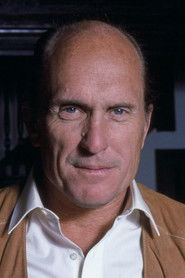

Michael Douglas
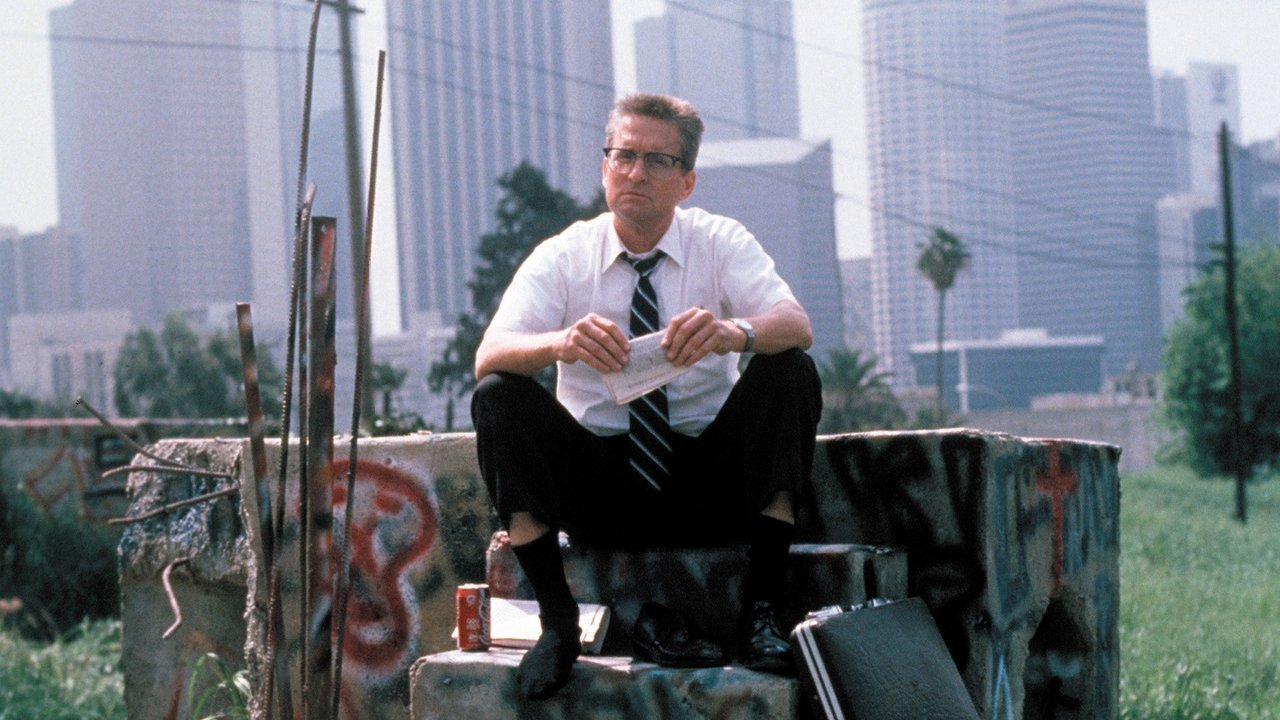
D-Fens
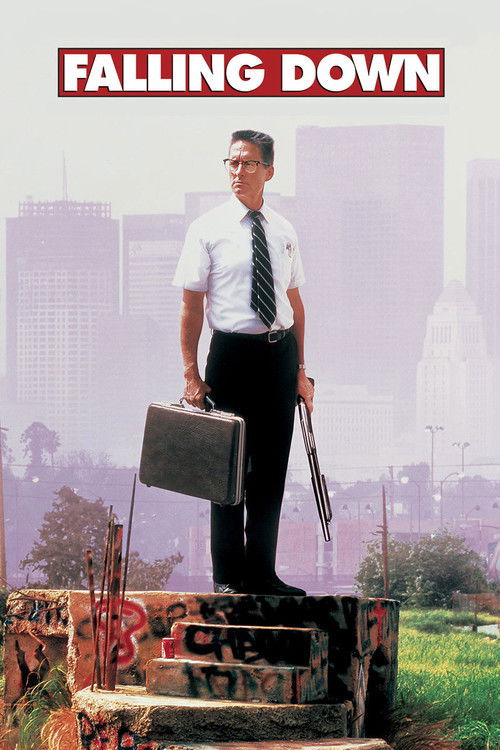
“The adventures of an ordinary man at war with the everyday world.”
An ordinary man frustrated with the various flaws he sees in society begins to psychotically and violently lash out against them.
I keep thinking about the first image of Falling Down as a kind of civic weather report: the heat, the glare, the sticky irritation of a day that feels one degree too close to collapse. Joel Schumacher makes Los Angeles look less like a city than a system of tiny humiliations. A traffic jam.
A phone that won’t work. A breakfast that costs too much. A storefront with a gate pulled down at the wrong moment.
All of it accumulates like grit in a machine, until the machine starts to grind back.
What’s striking, in hindsight, is how little the film behaves like a simple descent-into-madness thriller. Yes, there’s a man with a briefcase and a gun, and yes, he begins to move through the city with a kind of murderous moral certainty. But Schumacher isn’t only interested in a breakdown; he’s interested in the fantasies that make breakdown feel plausible.
The movie arrived in 1993, at a moment when American public life was already full of chatter about urban fear, social fragmentation, and the collapse of shared norms. That’s part of why the film has stayed argumentative. People don’t just watch Falling Down; they take sides with it, or against it, as if it’s a rude dinner guest who has said something everyone at the table secretly feared.
Schumacher, who came out of fashion photography and brought that eye for surfaces to movies like St. Elmo’s Fire and The Lost Boys, films Los Angeles here with a chilly clarity. The sunlight is so direct it feels accusatory.
Streets, convenience stores, fast-food counters, overpasses — they’re all framed as stages for tiny social rituals that have gone slightly rotten. That’s one reason the movie still gets talked about: not because it predicts anything in a neat, prophetic way, but because it understands how quickly grievance can start dressing itself up as principle. The film’s central joke — if “joke” is the right word — is that its protagonist thinks he’s the sane one.
Michael Douglas plays D-FENS (the nickname is useful, cartoonish, and a little insulting, which is probably the point) with a rigid jaw and the posture of a man trying not to spill something that’s already leaked everywhere inside him. Douglas was, by then, an actor associated with polished aggression: the guy who could make ambition look sexy and panic look like strategy. Here, though, he strips that authority down to impatience.
He moves in abrupt bursts, as if his body is always a half-second behind his outrage. I’m not sure the movie fully solves the problem of asking us to spend so much time inside his perspective — maybe it can’t — but Douglas makes the discomfort legible. His face has the pinched, offended look of someone who believes the world has broken a private contract with him.
Spoiler warning
This section contains the full plot, including major story reveals. Overview above stays spoiler-free.
Movies
Related titles ranked by rating and popularity.