

Neal Brennan
Self

Wicked one-liners and soul-baring confessions converge in this uniquely intimate stand-up special from "Chappelle's Show" co-creator Neal Brennan.
Official
I’ve seen enough comedy specials to know the formula: a stool, a spotlight, a few well-timed callbacks, and a closing bit that lands like a mic drop. Neal Brennan’s 3 Mics doesn’t break that formula so much as it hollows it out from the inside. This isn’t a special about jokes—at least, not only about jokes.
It’s about the way laughter and silence can occupy the same space, how a room full of people can feel like the loneliest place on earth, and how a man standing alone on stage can make you feel less alone just by admitting he’s not okay.
Brennan structures the show around three microphones, each representing a different mode of performance: one-liners, stories, and what he calls “emotional shit.” The one-liners are sharp, the kind of rapid-fire wit that made Chappelle’s Show feel like a cultural earthquake. (“I don’t trust people who don’t like weed, but I also don’t trust people who only like weed.”) The stories are looser, more conversational, the kind of thing you’d hear at a bar if the guy telling them wasn’t also dissecting his own neuroses in real time. And then there’s the third mic—the one where the jokes stop, and the room gets quiet.
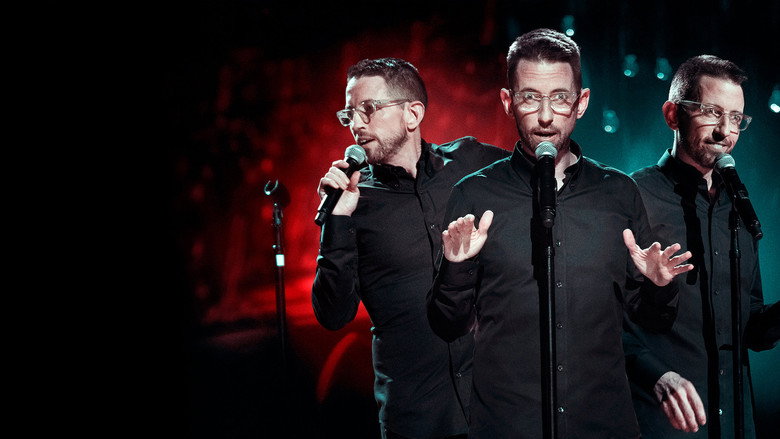
That’s where 3 Mics gets dangerous. Brennan talks about depression like it’s a roommate he can’t evict, about therapy like it’s a lifeline he’s embarrassed to need, about the way his brain betrays him when he’s alone in a hotel room at 3 a.m. There’s no punchline here, no cathartic release—just the raw, uncomfortable truth that sometimes the funniest people are the ones who’ve spent the most time crying in the dark.
It’s a gamble, this kind of vulnerability in a comedy special. Audiences are conditioned to expect laughter, not confession. But Brennan doesn’t just meet that expectation—he weaponizes it.
The jokes disarm you, and then the silence cuts deeper.
What’s striking is how little of this feels like performance. There’s no fourth wall to break because Brennan never built one to begin with. He’s not playing a version of himself; he’s just there, in the same way you’re there when you’re alone with your thoughts at 2 a.m.
The camera lingers on his face in these moments—not in a voyeuristic way, but in a way that feels like an invitation. Look at me, he seems to say. This is what it looks like.
The effect is unsettling, not because it’s shocking, but because it’s familiar. We’ve all been that person, staring at the ceiling, wondering why we can’t just be happy like everyone else seems to be.
The craft of 3 Mics is deceptively simple. There’s no flashy cinematography, no elaborate staging—just Brennan, three mics, and a stool. But the simplicity is the point.
The focus is entirely on him, on the way his voice cracks when he talks about his father’s death, on the way his hands fidget when he’s nervous, on the way he laughs at his own pain like it’s the only thing keeping him from screaming. It’s a masterclass in restraint. The special doesn’t need to do anything because Brennan is doing everything.
The camera doesn’t cut away when he’s struggling to find the right words; it stays on him, forcing us to sit with the discomfort. That’s rare in comedy, where the default is to move on, to keep the energy up, to never let the audience get too quiet. But 3 Mics isn’t interested in defaults.
It’s interested in truth.
There’s a moment near the end where Brennan talks about the first time he realized he was depressed. He was a kid, lying in bed, and he just knew something was wrong. He didn’t have the words for it then, but he knew.
Watching him recount that moment, you get the sense that he’s still that kid, still lying in bed, still trying to figure it out. The difference is that now he’s got a microphone, and he’s not afraid to use it.
That’s the thing about 3 Mics—it’s not just a comedy special. It’s a lifeline. For anyone who’s ever felt alone in a crowded room, for anyone who’s ever laughed to keep from crying, for anyone who’s ever looked in the mirror and wondered what the hell is wrong with them.
Brennan doesn’t offer answers. He just offers company. And sometimes, that’s enough.