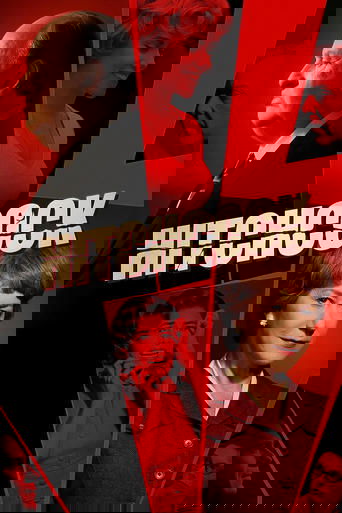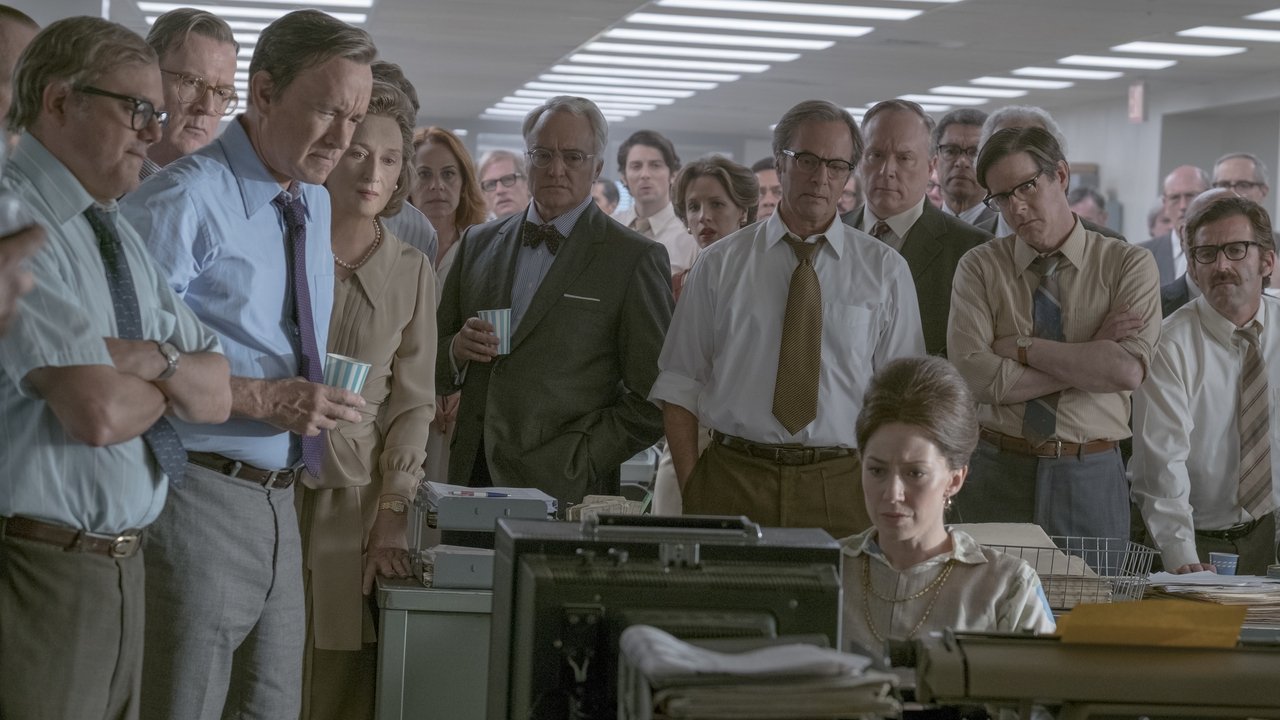

Meryl Streep
Kay Graham
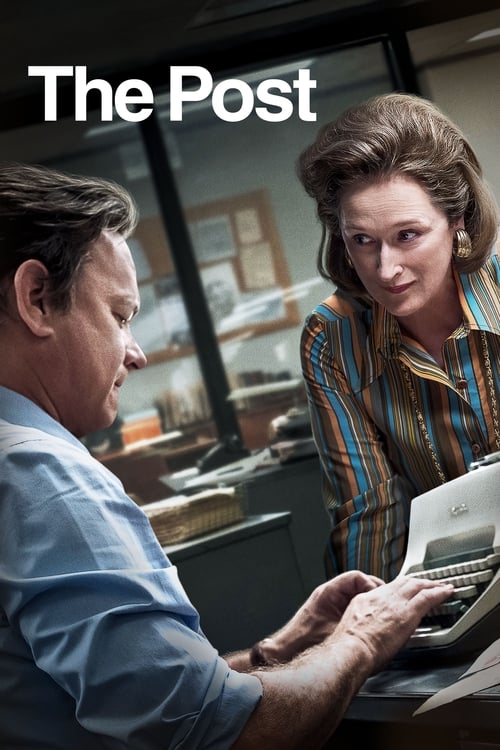
“Truth be told”
A cover-up that spanned four U.S. Presidents pushed the country's first female newspaper publisher and a hard-driving editor to join an unprecedented battle between journalist and government. Inspired by true events.
Firing on all Oscar-bait cylinders, _The Post_ is much more about the facts of the events than an insight into the people involved in them. It has some laughs in it, but it's far from a comedy. It's all "what" and no "why", but also, _The Post_ is built on this HUGE will-they-wont-they question with massive ramifications ("Will Nixon and LBJ be exposed") and it's what the whole 108 minute runtime is building up to, but... We already know. The things that happen in _The Post_ are real events that are common knowledge. So it's kind of... The mystery of the moral quandary was answered before you ever pressed play. I think with the state of journalism and even more so the state of politics the way it is now in America, that _The Post_ was a very timely film, and with a cast like this assembled, obviously nobody in it is bad. But does _The Post_ deserve the awards consideration it has gotten? Personally, I don't think it does. _Final rating:★★½ - Not quite for me, but I definitely get the appeal._
Read full reviewThe movie is very interesting and clearly very curated in the cast and scenography. It tells an important piece of American history and is an ode to press freedom. However, I found it rather slow in development and a bit too lost in too many conversations. Lacks a bit of action/movement.
Read full review**An ambitious film, very solid and with a lot of quality, but which turned out to be forgettable.** I've honestly lost count of the movies about Nixon I've seen. And I understand that! In the history of the American presidential institution, few presidents have stirred up as much controversy. He was a president who not only was willing to use his whole power, but also who abused from its use. And the media was one of his biggest and most fearsome enemies. In this film, the point of originality is that the focus is never Nixon or Watergate, but the main figures of The Washington Post in the days before the scandal, when it was sued by the White House. It's not that kind of surprising originality, but it's enough. The script has its flaws, one of which is perhaps the attempt to insert the theme of gender equality in a corporate environment. This appears when we see all those men who are very hesitant about taking orders from a woman, even though she is undoubtedly the boss and owner of the company. The 70s were important for the feminist movement, but it was a young and rebellious layer that led the decade, and the role of mature women, like the owner of the Post, may not have been valued as it should have been. However, the theme seems to be lefting in the film, and it ends up frankly underdeveloped from the moment when she basically says “the newspaper is mine, I am the one who gives orders and I answer for them, and whoever does not want to obey can leave”. This strong attitude simply closes the matter. As for factual accuracy, I'm not the best person to talk, I can't say if the film does justice to the events. The strongest point of this film is, without a doubt, the talent gathering. Steven Spielberg ensures an impeccable direction and manages to give us a solid film, which will always, however, be a considerably minor work in his filmography. In addition, we still have a cast of cast-iron strong actors, led by Tom Hanks and Meryl Streep. And I don't think I need to say that this film isn't a particularly memorable piece of work for either of them. Perhaps, the film represented a good financial fit for them, just as it certainly represented a privilege for the rest of the cast, who had the opportunity to see them work and, eventually, learn something more, some of those things that are not learned in dramatization courses, but through practical experience. Technically, it's a pleasantly warm film. That third cup of tea that waited too long in the pot and ended up colder, but also thicker. It's the best metaphor to let you understand what I think: the environment and the theme give it density and tension, which, however, does not make it unnerving because it is done in a very moderate way, served cold. There is a period re-enactment effort that looks good, but it was necessary and could not be ignored. The soundtrack, by Williams, is forgettable, not to say mediocre (taking into account the composer's ability). There is a certain ambition in the project. The producers knew they were making a strong film, but the final product was not as good as they would have liked, nor was it memorable.
Read full reviewThis is essentially a film about the freedom of the press - and how that terrifies even the most "democratic" of institutions. Disillusioned military analyst (Matthew Rhys) discovers the extent to which the US military had been misleading the government and population about the Vietnam War and takes some sensitive information to the Washington Post (initially, this is more about who gets the scoop - them or the New York Times) but rapidly the Post - edited by Ben Bradlee (Tom Hanks) decides it must get there first and with the support of it's ballsy publisher Kay Graham (Meryl Streep) they take on the political and judicial establishment to win the right to publish their story. The performances, under Steven Spielberg's direction, are fine - nothing much to write home about. The film is about journalism and the right of all of us to know what's being done in our name (and with our troops/money etc.), and is told in a adequate fashion.
Read full review"A timely and well-acted historical drama that resonates strongly with modern press freedom debates, though some find its pacing and depth uneven."
Viewers praise the film for its powerful performances, particularly from Meryl Streep and Tom Hanks, and its relevance to contemporary issues of journalism and government accountability. The tension and stakes of the story are widely appreciated, though some note that the film occasionally feels more like a straightforward procedural than a deeply layered exploration of its themes. The ensemble cast and Spielberg’s direction are frequently highlighted as strengths, but a few find the narrative somewhat predictable.
Steven Spielberg’s The Post (2017) isn’t just a political thriller—it’s a film that almost didn’t happen. The project came together at breakneck speed, a rarity for a director known for meticulous planning. Spielberg reportedly fast-tracked production after reading the script by Liz Hannah and Josh Singer, sensing the story’s urgency in an era of heightened tensions between the press and government  . The film, which dramatizes The Washington Post’s decision to publish the Pentagon Papers in 1971, was shot in just 44 days—a blistering pace for a Spielberg production [2].
Meryl Streep and Tom Hanks, two of Hollywood’s most bankable stars, signed on to play Katharine Graham and Ben Bradlee, respectively. Streep, who had worked with Spielberg on Bridge of Spies (2015), reportedly prepared by studying Graham’s mannerisms and voice, even meeting with the late publisher’s family [2]. Hanks, meanwhile, dove into Bradlee’s memoir A Good Life to capture the editor’s gruff charm. The supporting cast—including Sarah Paulson, Bob Odenkirk, and Bradley Whitford—rounded out a powerhouse ensemble, but the real draw was the chemistry between Streep and Hanks, who had never shared screen time before  .
.
Spielberg’s decision to accelerate production wasn’t just about artistic instinct. The film’s release date was moved up to December 2017, positioning it as an awards-season contender and a timely commentary on press freedom [2]. The director reportedly edited the film in real time, with editor Michael Kahn working alongside him to refine cuts between shoots [2]. This approach, while stressful, allowed Spielberg to maintain creative control over a story that felt increasingly relevant as the 2016 election’s fallout dominated headlines.
The film’s subject matter—the Pentagon Papers leak—was a risky choice. The documents, which exposed decades of government deception about the Vietnam War, had been dramatized before, most notably in All the President’s Men (1976). But The Post focused on a different angle: Graham’s personal and professional dilemma as the first female publisher of a major American newspaper. The film’s climax, where Graham overrules her male advisors to publish the papers, was a deliberate nod to the gender dynamics of the era [2].
Critics praised The Post for its timely themes and strong performances, though some argued it lacked the tension of Spielberg’s best thrillers. Streep and Hanks earned Golden Globe nominations, and the film was nominated for Best Picture at the Oscars [1][2]. Yet, despite its critical acclaim, The Post underperformed at the box office, grossing just $179 million worldwide against a $50 million budget [1]. Still, its legacy endures as a testament to Spielberg’s ability to turn history into gripping cinema—and as a reminder of the press’s role in holding power to account.
Entertainment rumors and trivia aggregated from public reporting. Treat speculation as unverified unless a cited source confirms it.
Movies
Related titles ranked by rating and popularity.