Overview

All unemployed, Ki-taek's family takes peculiar interest in the wealthy and glamorous Parks for their livelihood until they get entangled in an unexpected incident.

Cast

12 people

Reviews

3 min read

The Geometry of Hunger

Start with the windows. Bong Joon Ho certainly does. Parasite opens by locking the Kim family behind a grimy slit of glass in their semi-basement apartment, a ground-level frame through which drunks urinate and exterminator fog drifts like one more indignity they have to breathe. I have always loved the way filmmakers use glass—Hitchcock for spying, Tati for alienation—and Bong turns it into an x-ray of class.

The Kim family's view from their semi-basement window

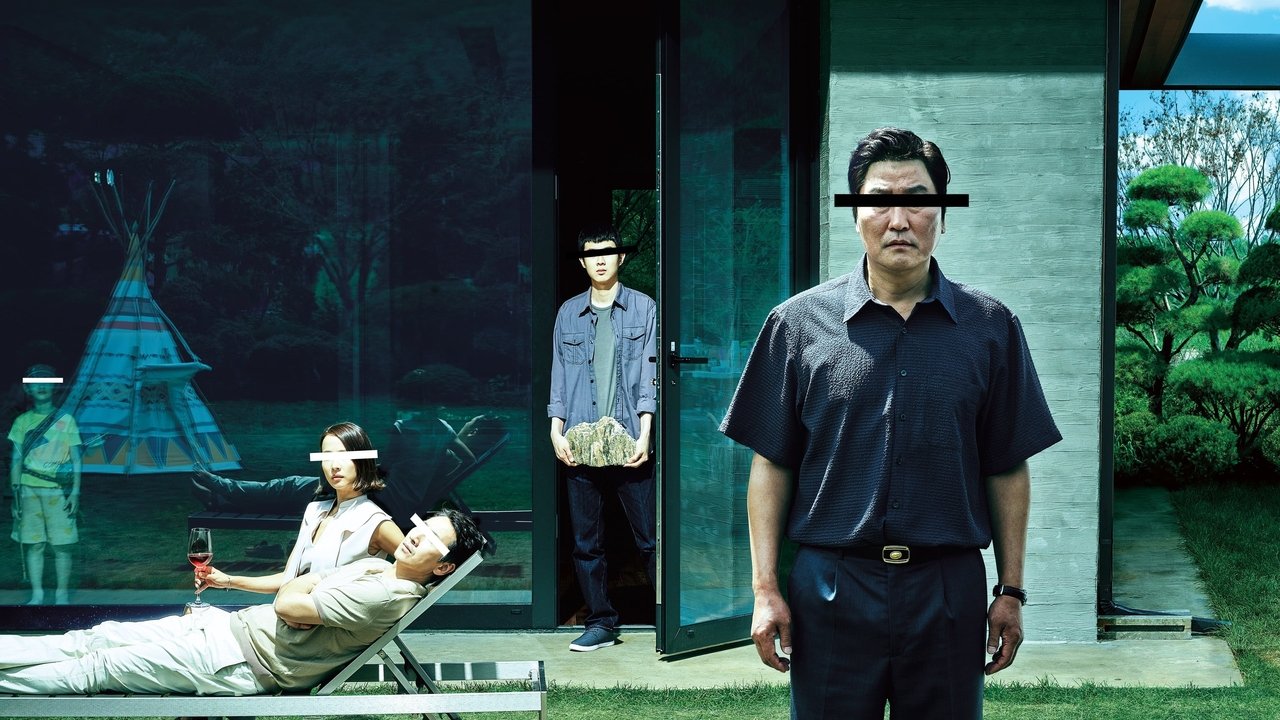
The Park family's window, when we reach it, is the opposite image: a giant sheet of immaculate glass opening onto a private garden, full of light and air and peace that money has already paid for. The symbolism is not shy, because Bong has no reason to be shy.

He has spent years tearing into class systems, whether through the horizontal segregation of Snowpiercer or the monster-haunted industrial fallout of The Host. Here he drops the genre armor and lets modern Seoul do the work for him. Everything is vertical.

The Kims are clever, jobless, and hungry, and they inch their way uphill by posing as indispensable professionals inside the Park household: tutor, art therapist, driver, housekeeper. They are not masterminds in the comic-book sense. They are people who want some air and a little money and maybe a chance to stop folding pizza boxes in a damp room.

Audience Opinions

Audience 8.6/10
"A fiercely entertaining, genre-bending thriller whose biting class satire, performances, and set-pieces overshadow concerns about plausibility and the finale."

The mix of dark comedy, suspense, and social satire lands as a near-unanimous strength, with the second act’s extended scam-and-storm sequence often singled out as exhilarating, brilliantly staged, and worth the hype on its own. Acting across the ensemble, richly layered symbolism, and meticulous visual craft make the film highly rewatchable, though a noticeable minority finds the third act less tight, the ending too convenient or melodramatic, and the infiltration setup hard to take as realistic.

What viewers praise
  • Expert genre fusion Shifts from comedy to crime thriller to horror-tinged drama without feeling disjointed, keeping tension and surprise high.
  • Powerful social satire Class conflict, status anxiety, and wealth disparity are explored in ways that feel pointed, relevant, and easy to connect with everyday life.
  • Outstanding ensemble cast All eight central characters are played with conviction and nuance, with special praise for the father, the housekeeper, and the rich wife.
  • Showstopping middle section The storm-night sequence with the family’s scheme in full swing is hailed as a 10/10 stretch of filmmaking packed with suspense, comedy, and inventive staging.
  • Rich symbolism and craft Visual motifs like the scholar rock, vertical spaces, water, and the garden deepen the story, supported by sharp editing and a memorable score.
Common complaints
  • Divisive final act The last stretch is viewed by some as a drop in quality, with the party violence, flood, and epilogue feeling slower, less focused, or emotionally unsatisfying compared to earlier scenes.
  • Questionable realism The idea that one family could so easily infiltrate multiple staff roles in a rich household is seen as contrived or implausible by more literal-minded viewers.
  • Heavy-handed symbolism A few find the metaphors and visual cues too on-the-nose, arguing that the message and imagery are spelled out rather than left to subtle inference.
  • Uneven emotional connection Not everyone feels genuinely attached to the Kim family, with some calling the characters hard to care about despite the film’s technical excellence.
Recommended for
Dark social satire fans Twisty thriller seekers International cinema enthusiasts Bong Joon-ho admirers Symbolism-heavy drama lovers

Buzz & Rumors

Public reports

PARASITE: THE AFTERPARTY – SCANDALS, RUMORS & WILD TRIVIA FROM THE BASEMENT OF CINEMA HISTORY

The movie gave us class warfare, hidden bunkers, and flying skewers. Off-screen? The drama was just as intense.


Scandals & Dark Sides: The Lee Sun‑kyun Tragedy

When Parasite stormed the Oscars, nobody imagined one of its stars would later become the center of one of Korea’s most heartbreaking celebrity scandals.

Drug allegations & blackmail nightmare

  • In late 2023, Lee Sun-kyun, who played rich dad Mr. Park, was under police investigation for suspected illegal drug use. He denied the accusations, saying he had been blackmailed and, if he took anything, he’d been tricked by a bar hostess at an upscale Seoul club .
  • He faced three rounds of police questioning, including a marathon 19-hour interrogation that ended on Christmas Eve [2]. Multiple drug tests were conducted; he pushed back against the way the case was handled [2].

Media leaks & public humiliation

  • Audio said to involve him and the hostess was leaked to the press, feeding rumors of an affair, though proof of that affair was never established [1].
  • A letter allegedly written by Lee—apologizing to his family and colleagues and hinting this was "the only end" he could see—was also leaked; even Korean media questioned its authenticity [1].
  • His lawyers said he was devastated by the police leaks and tabloid-style coverage, which they argued destroyed his reputation and career before any guilt was proven [2].

Apparent suicide & industry backlash

  • In December 2023, Lee was found dead in his car in an apparent suicide at age 48, leaving behind a wife and two young sons [1][2].
  • The case sent shockwaves through South Korea, sparking fierce debate over draconian drug laws, media witch-hunts, and the crushing pressure on celebrities to appear morally spotless [1][2].
  • In a stunning show of solidarity, Bong Joon-ho and 29 arts and culture groups formed an alliance demanding an investigation into the handling of the case, calling for media to delete irresponsible stories and for authorities to protect artists’ human rights [2].

This was Parasite’s most tragic real-world twist: the smiling, controlled patriarch of the Park family pulled into a real-life scandal that exposed the ugliest sides of fame.


Romance Rumors: The “Siblings” Fans Wanted To Ship

On-screen, they were the ultimate scammer siblings. Off-screen, fans were praying for a plot twist.

The food truck that launched a thousand ship edits

  • In February 2020, Parasite co-star Park So-dam (Ki-jung) sent a support food truck to Choi Woo-sik (Ki-woo) on the set of his film The Police Lineage .
  • Choi posted a photo on Instagram, gushing: “So Dam, I am really touched. This is so kind of you, such a sweet thing to do. Thank you.” [4]
  • Park replied in the comments: “Good luck Oppa, do your best.” That “Oppa” is where the gossip sirens went off—it can mean big brother… or be a flirty pet name between lovers [4].

From sibling scam to dating scam?

  • K‑drama blogs quickly clocked the “sweet gesture” plus the flirty language, and rumor has it the two were more than just castmates [4].
  • Fans pointed out they’d spent months together filming and then doing international awards tours side by side, looking very comfortable in red-carpet photos [4].
  • Reality check: No confirmation from either star. The article that covered the rumors gently reminded people they played siblings and that “Oppa” can be friendly, not romantic [4].
  • Verdict: Unconfirmed fan ship, but absolutely premium gossip fuel.

Health Shocks & Hidden Battles: Park So-dam’s Cancer Fight

While the world was still quoting “Jessica, only child,” Park So-dam was quietly fighting something far scarier than a rich family with a panic room.

  • In December 2021, Park was diagnosed with papillary thyroid cancer during a routine checkup .
  • She underwent surgery and later revealed that she couldn’t speak for six months during recovery—a brutal twist for an actor whose job is literally her voice [8].
  • Coverage in 2023 had her looking back on the ordeal as something she wouldn’t wish on anyone, but she’s since made a comeback in series like Death’s Game, showing the same steel that made Ki-jung such a fan favorite [8].

It’s the kind of real-life third-act twist Bong might write—except this time, we got the happy ending.


Leaks, Deleted Scenes & Fan Frenzy

Even Bong’s cutting-room floor has lore.

Deleted scenes that fans swear change the vibe

  • A Reddit breakdown of Parasite’s 10 deleted scenes and bloopers notes:
  • A cut moment where ex-housekeeper Moon-gwang runs her hand along the walls as she leaves, adding an extra eerie edge.
  • A snow scene and extended bits around key moments.
  • Blooper reels of Moon-gwang’s death scene where actress Lee Jeong-eun keeps cracking up between “dying” takes .
  • These scenes exist on home releases and fan uploads; no huge plot revelations, but enough to fuel “Bong’s secret director’s cut” fantasies.

Is the ending… fake?

  • One of the most viral Reddit fan theories argues Ki-woo never really recovers from his head injury at the party and that the entire hopeful ending—him getting rich and buying the house—is just a coma dream/fantasy .
  • The theory dissects the tonal shift and impossibly neat resolution, claiming the “letter” sequence is a mental coping mechanism, not reality [9].
  • It’s unconfirmed, but the idea spread widely enough to become part of mainstream discussion about the film’s meaning.

Wild Trivia: Bong’s Obsessions & Production Madness

The juiciest secrets aren’t always scandal—they’re the tiny, obsessive details that scream, “Yes, this man drew 500 storyboards and it shows.”

  • Alternate universe title: The movie was almost called “The Décalcomanie”, a reference to mirrored images—very on-brand for its rich/poor duality .
  • Set built on a water tank: The Kim family’s entire neighborhood—alley, semi-basement, surrounding shacks—was built as a full-scale set on top of a giant water tank so the flood sequence could literally drown it [3].

The Park mansion is a Frankenstein build:

  • First floor and yard: a practical set on an empty lot in Jeonju.
  • Second floor and upper structures: added via VFX using green screen [3].
  • Interior rooms weren’t connected in real life; they were built on separate sound stages like a puzzle box [3].

Actors signed on blind:

  • Choi Woo-sik, Park So-dam, and Bong-regular Song Kang-ho accepted their roles without even knowing the plot, trusting Bong completely [3].
  • Bong confessed he was terrified Song might reject the script and said flatly: “There is no alternative. Only he could do this role.” [3]

“Ram-don” was invented for you

  • The Park family’s instant noodle–meets–wagyu dish is actually called jjapaguri in Korean.
  • The subtitle translator made up “ram-don” as a catchy mash-up of ramen and udon to make the joke land for international audiences [3].

Ki-woo’s doomed dream, quantified:

  • Bong calculated that, at average Korean salaries, it would take Ki-woo about 540 years to save enough to buy the Park house. That hopeful monologue? Mathematically a fantasy [3].
  • Which makes that coma-theory crew feel a little too vindicated.

Entertainment rumors and trivia aggregated from public reporting. Treat speculation as unverified unless a cited source confirms it.