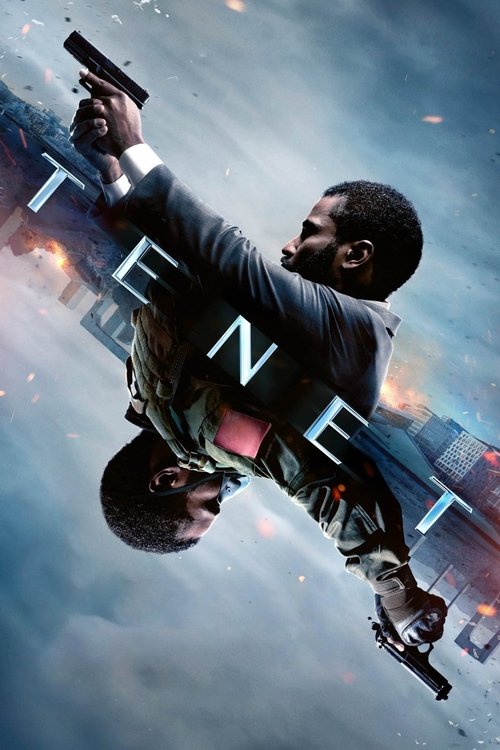

John David Washington
Protagonist

Armed with only one word - Tenet - and fighting for the survival of the entire world, the Protagonist journeys through a twilight world of international espionage on a mission that will unfold in something beyond real time.
I still don’t know what Tenet is about. Not really. And I’m starting to think that’s the point.
Christopher Nolan’s 2020 spy thriller doesn’t just play with time—it weaponizes confusion. The film’s central gimmick, "inversion," flips entropy so that objects (and people) move backward through time, creating a world where bullets un-fire, wounds heal in reverse, and characters walk through doors they’ve already exited. It’s a high-concept flex, the kind of thing that makes you feel smart for trying to keep up and stupid for not quite succeeding.
But here’s the thing: Tenet isn’t just a puzzle to solve. It’s a puzzle that resists solving, a film that dares you to care about the mechanics when the emotional stakes are deliberately kept at arm’s length.
That’s not a flaw. It’s a choice. And like all of Nolan’s choices, it’s both brilliant and infuriating.

The first time I watched Tenet, I left the theater with a headache. The second time, I took notes. The third time, I gave up and just let the images wash over me—the way the inverted car chase in Tallinn unfolds like a ballet of destruction, the way the Oslo freeport fight scene plays out in perfect, disorienting symmetry.
Nolan doesn’t just show you time running backward; he makes you feel it. The sound design is a masterclass in disorientation: dialogue is often buried under Ludwig Göransson’s pulsing score, which itself seems to move in reverse. The effect is less like watching a movie and more like being inside a migraine that’s also a heist thriller.
And yet, for all its cold precision, Tenet has moments of unexpected warmth. That’s almost entirely thanks to Robert Pattinson, who plays Neil, the Protagonist’s (John David Washington) enigmatic ally. Pattinson doesn’t just deliver exposition—he performs it, turning every line about "temporal pincer movements" into a kind of deadpan poetry.
"An ambitious mind-bending spectacle that dazzles visually but demands patience with its convoluted plotting."
The innovative time-inversion concept and large-scale action impress, especially on a big screen, and many find the film becomes more satisfying after a rewatch when the structure clicks into place. At the same time, a dense, confusing narrative, muffled dialogue, and heavy exposition leave a sizable portion of the audience disengaged, with some feeling the characters never evolve beyond cool archetypes.
You thought Tenet was just mind-bending onscreen? Wait till you hear what was happening in the real timeline — from studio wars to locked-room scripts and a fan theory so feral it had Nolan dodging questions on late-night TV.
When the studio announced it would dump its entire 2021 slate onto HBO Max the same day as theaters, Nolan publicly dragged the move as “very, very, very, very messy” and “not how you treat film-makers.”
Michael Caine — Nolan’s longtime good-luck charm — said Nolan wouldn’t even let him read the script. He only got his own pages for a single day of work and admitted he had no idea what the movie was actually about.
Entertainment rumors and trivia aggregated from public reporting. Treat speculation as unverified unless a cited source confirms it.
Movies
Related titles ranked by rating and popularity.