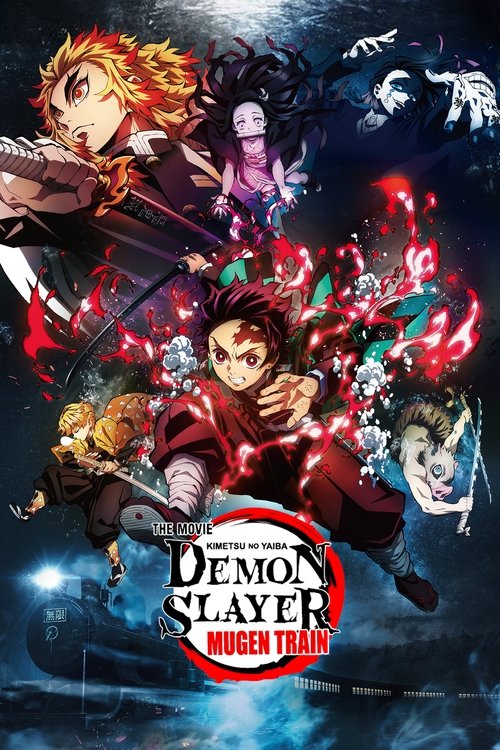
Demon Slayer -Kimetsu no Yaiba- The Movie: Mugen Train backdrop
Demon Slayer -Kimetsu no Yaiba- The Movie: Mugen Train poster

Demon Slayer -Kimetsu no Yaiba- The Movie: Mugen Train

“With your blade, bring an end to the nightmare.”

8.2
2020
1h 57m
AnimationActionFantasy
Director: Haruo Sotozaki

Overview

Tanjiro Kamado, joined with Inosuke Hashibira, a boy raised by boars who wears a boar's head, and Zenitsu Agatsuma, a scared boy who reveals his true power when he sleeps, boards the Infinity Train on a new mission with the Fire Hashira, Kyojuro Rengoku, to defeat a demon who has been tormenting the people and killing the demon slayers who oppose it!

Sponsored

Trailer

4K Ultra HD Blu-ray On Sale January 13 [Subtitled] Official

Cast

Reviews

AI-generated review
The Engine of Grief

I’m still a little stunned by the sheer commercial audacity of *Demon Slayer: Mugen Train*. It arrived in the eerie stillness of late 2020 and didn’t merely break records—it obliterated them, even pushing past *Spirited Away* to become the highest-grossing Japanese film ever. The wild part is that it doesn’t make itself especially accessible to newcomers. This is not a clean entry point or a gently explanatory standalone. It sits squarely in the middle of an existing series and assumes you already know who these people are before the train ever leaves the station. Whether that feels exclusionary or exhilarating probably depends on your patience. Sitting there with that locomotive cutting through moonlit wilderness, though, I couldn’t shake the feeling that Haruo Sotozaki had found something genuinely raw inside the franchise machine.

Tanjiro and the Demon Slayers boarding the Infinity Train

Sotozaki isn’t really the kind of director who barges in with some grand auteurist stamp. He works inside the gleaming system of Ufotable, and he knows how to use its polish. What he seems to grasp most clearly is nightmare design. Enmu’s trick—trapping sleeping passengers inside beautiful dream worlds—isn’t new. The "perfect illusion" setup is one of fantasy’s oldest devices. But here the subconscious doesn’t feel playful. It feels carceral. Sotozaki mixes the clean 2D character art with heaving 3D environments until the train itself starts to feel sentient, a steel body convulsing forward through the dark. The whole thing becomes an iron lung racing toward catastrophe.

The snowy landscape of Tanjiro's dream sequence

The most powerful section of the film is also the quietest. Tanjiro, that open-hearted, relentlessly compassionate protagonist, dreams that his dead family is alive again. Snow presses underfoot. His siblings tug at him. And when he understands it’s false, the only way back to reality is brutal: he has to raise his sword and slit his own throat inside the dream. Sotozaki doesn’t hurry past the horror of that choice. He lingers on Tanjiro’s shaking hand, on the ragged expansion of breath in his chest. It’s startlingly severe psychology for a blockbuster fantasy action film, and it roots all the spectacle in grief that feels uncomfortably real.

Rengoku unleashing his Flame Breathing technique

Then there’s Rengoku. The Flame Hashira arrives as a near-caricature of enthusiasm, barking "Delicious!" over bento boxes with those huge, fixed eyes. Satoshi Hino pushes the voice so hard at first that it almost borders on abrasive. But the performance subtly changes as danger closes in. By the time the movie swerves into its wild third-act escalation and drops Akaza into the story almost out of nowhere, Hino has stripped away the comic bombast and left something firmer and sadder underneath. *The Observer* was right to say the movie "finds a way to make the fight scenes do more than just provide exhilarating action, by injecting a healthy amount of emotion into them." The last battle isn’t really about strength. It’s a full-throated argument about what life means. Akaza offers immortality through demonic transformation; Rengoku answers that human life matters because it ends. It’s noisy and overblown and gorgeously animated, and somehow it still lands like a sincere defense of mortal fragility.

Featurettes (1)

Release Celebration - Episode 2: Nezuko [Subtitled]