

Bert Kreischer
Self

Still the ultimate comedy party animal, Bert Kreischer tells more stories about parenthood and family life in a stand-up special from Cleveland.
Official
Bert Kreischer
Self
I’ve seen Bert Kreischer do this routine three times now—once in a crowded theater in Cleveland, once on my laptop at 2 a.m., and once while folding laundry, the sound turned low so my kids wouldn’t hear the word “dildo” again. Each time, he’s shirtless, sweating, and laughing at his own jokes before the audience does. It’s a performance that shouldn’t work, but it does, mostly because Kreischer seems to be the only person in the room who still believes in the myth of the eternal frat brother. Hey Big Boy, his 2020 Netflix special, is that myth’s latest, and maybe most fragile, iteration.
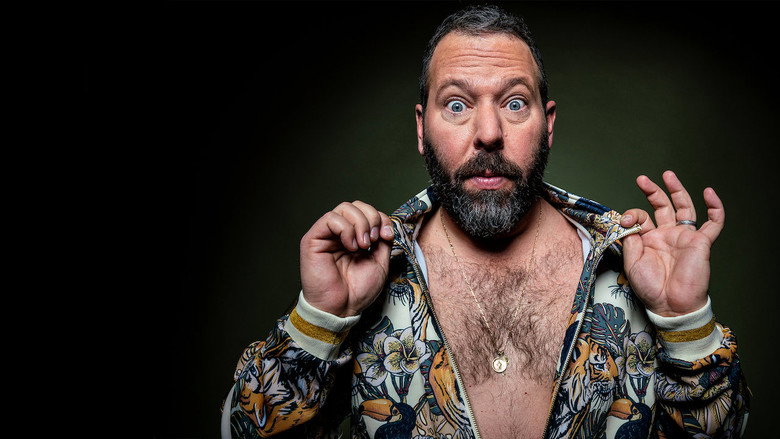
The special opens with Kreischer bounding onto the stage like a golden retriever who’s just heard the word “walk.” He’s 44, but his energy is pure 21-year-old keg-stand champion. The camera lingers on his bare chest, which is less a six-pack and more a keg of its own, and for a moment, you wonder if this is performance art about the refusal to grow up. Then he starts talking about his wife, his daughters, his dad walking in on him smoking weed, and you realize the art is in the contradiction: a man who built a career on being the life of the party is now using that same persona to talk about the quiet, messy realities of middle age.
The bit that sticks with me isn’t the one about the Starbucks barista who remembers his order (though that’s the kind of observational comedy that lands because it’s so specific it feels like a secret). It’s the story about his dad finding his weed stash. Kreischer tells it like it’s a heist movie, complete with dramatic pauses and exaggerated whispers. “He goes, ‘Bert, is this marijuana?’ And I’m like, ‘Dad, that’s oregano.’” The audience loses it, but what’s fascinating is how Kreischer plays the moment—he’s not just telling a joke, he’s reenacting the shame of being a grown man caught in a lie by his father.
The humor isn’t in the punchline; it’s in the way he sells the embarrassment, his voice cracking like a teenager’s. It’s a trick he’s pulled off before, but here it feels like he’s mining something deeper than nostalgia. This isn’t just a funny story about weed; it’s a story about the way our parents still see us as kids, no matter how old we get.
That tension—between the persona and the person—is what makes Hey Big Boy more interesting than it has any right to be. Kreischer’s comedy has always thrived on the gap between who he pretends to be (the wild, irresponsible party animal) and who he actually is (a husband, a father, a guy who probably folds his laundry). But in this special, that gap feels wider, and not always in a good way.
Some of the bits land like a frat boy crashing a PTA meeting. The joke about gender-neutral bathrooms, for example, isn’t just edgy—it’s the kind of edgy that makes you wince because it feels like it was written for a crowd that stopped evolving in 2005. Kreischer’s not alone in this; a lot of comedians from his era struggle to update their material without losing their identity.
But when it works, like in the story about his daughter’s first period, it’s because he’s not just making a joke—he’s acknowledging that parenting is gross and awkward and sometimes hilarious, and that’s something everyone can relate to, even if they’ve never set foot in a fraternity house.
The direction by Jeff Tomsic (who also helmed Tag) is functional but unobtrusive, which is probably the best you can hope for in a stand-up special. There are a few odd choices—the camera lingers a beat too long on Kreischer’s face when he’s mid-laugh, like it’s waiting for a reaction that’s already happened—but mostly, it stays out of the way. The real star is Kreischer’s physicality.
He’s a big guy, but he moves like someone who’s spent a lifetime making sure people don’t take him too seriously. His gestures are broad, his expressions exaggerated, and his laugh is so infectious it’s almost a special effect. You don’t just hear the joke; you see it in his body before he even says the punchline.
That said, Hey Big Boy isn’t without its misfires. Some of the material feels recycled, like Kreischer is going through the motions of his own act. The bit about buying a gun, for example, starts strong but fizzles out, as if he’s not entirely sure where he’s going with it.
And there’s a moment near the end where he talks about his wife’s “lady boner” for a guy at the gym, and the joke lands with a thud because it feels like it belongs in a different special, one where Kreischer is still pretending he’s single. It’s the kind of moment that makes you wonder if he’s holding onto the frat-boy persona because it’s comfortable, or because he’s afraid the audience won’t laugh if he lets it go.
The critical reception has been, predictably, mixed. Sean L. McCarthy at Decider called Kreischer “an engaging, infectious storyteller” and argued that if you’re looking for an escape, “this giggling gagging topless fat man may just be the escape you’re looking for.” And he’s not wrong—there’s something undeniably cathartic about watching Kreischer unapologetically be himself, even when that self is messy, crass, and occasionally tone-deaf.
But some viewers, especially those who grew up with his earlier specials, have found Hey Big Boy to be a step down. The complaints aren’t just about the quality of the jokes; they’re about the sense that Kreischer is stuck in a persona that no longer fits. One audience member on Reddit put it bluntly: “It’s like watching your dad try to be cool at a party.
It’s not funny, it’s just sad.”
I don’t know if I’d go that far. There’s still something endearing about Kreischer’s refusal to tone it down, even when the material doesn’t quite land. Maybe that’s the point—he’s not trying to be cool, he’s trying to be honest, even if that honesty is wrapped in a layer of sweat and bad decisions.
And in a world where so much comedy feels focus-grouped and sanitized, there’s something refreshing about a guy who’s willing to bomb in front of a live audience just to prove he’s still the same Bert.
The special ends with Kreischer talking about his daughters, and for a moment, the act drops. He’s not performing anymore; he’s just a dad talking about how much he loves his kids. It’s the kind of moment that could feel mawkish in the hands of a lesser comedian, but Kreischer sells it because it’s the one thing in his life that doesn’t need a punchline.
Then he grins, the music kicks in, and he’s back to being the shirtless party animal, because that’s the role he’s played for so long he probably doesn’t know how to quit.
And maybe that’s the real joke. Hey Big Boy isn’t just a comedy special—it’s a time capsule of a guy who’s spent his whole career pretending he’s still 21, even as the world around him keeps changing. The question is whether the audience is still laughing with him, or at him. I’m not sure I know the answer.
But I do know this: I’ll probably watch it again.
More titles in the same genres and with the same cast.

