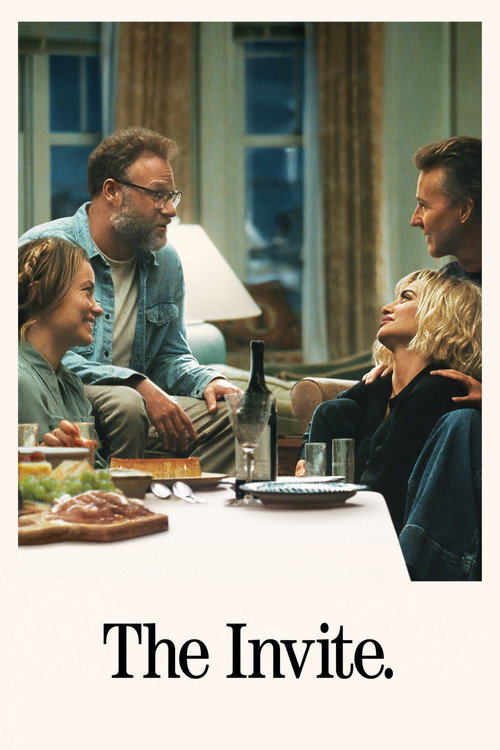
Movie poster for The Invite (2026)

The Invite

“It'll be fun.”

2026
1h 47m
Director: Olivia Wilde
Play trailer

Overview

Joe and Angela's marriage is on thin ice. When they invite their enigmatic upstairs neighbors for a dinner party, the night spirals into unexpected places. Have they reignited the spark or lit the match that burns it all down?

Cast

8 people

Reviews

5 min read

The Dinner Party That Ate Itself

I’ve always thought the best dinner parties are the ones that spiral out of control—where the wine flows a little too freely, the conversation takes a turn no one expected, and by dessert, someone’s crying into their tiramisu. The Invite is that dinner party, but with the volume cranked up to eleven. Olivia Wilde’s latest isn’t just a comedy about a marriage on the rocks; it’s a masterclass in how to turn a single location into a pressure cooker of desire, resentment, and bad decisions. And like any good party, it leaves you wondering: How did we get here?

The film unfolds over one long evening in a San Francisco apartment, where Joe (Seth Rogen) and Angela (Olivia Wilde) host their upstairs neighbors, Piña (Penélope Cruz) and Henry (Edward Norton), for what’s supposed to be a low-key dinner. What starts as polite small talk—*How’s the wine? The weather?

The state of your marriage?*—quickly curdles into something far more revealing. Wilde’s direction is so precise here that the apartment itself becomes a character, a labyrinth of mirrors and doorways that trap the characters in their own reflections. You can almost feel the walls closing in.

The apartment’s dim lighting casts long shadows, turning the dinner table into a stage.

What’s fascinating about The Invite is how it balances its tonal tightrope. On one hand, it’s a razor-sharp comedy, packed with the kind of dialogue that makes you snort-laugh into your popcorn. (A late-night argument about whether Joe’s firefighter job is “just a glorified babysitter” is the kind of line that lands like a punch to the gut.) But beneath the laughs, there’s a current of real pain, the kind that comes from years of unspoken grievances and the slow erosion of intimacy.

Wilde has always had a knack for blending humor and heartbreak—see Booksmart—but here, she pushes it further, turning what could’ve been a one-note farce into something far more unsettling.

The performances are the engine that keeps this thing running. Rogen, often typecast as the lovable stoner, plays against type as Joe, a man whose self-deprecating charm barely masks his deep-seated insecurity. It’s a quieter, more vulnerable turn than we’re used to from him, and while some viewers found his performance a bit one-note, I’d argue that’s the point.

Audience Opinions

Audience 7.9/10
"A viciously funny, tightly staged dinner-party meltdown powered by a standout quartet and Olivia Wilde’s sharpest directing yet."

Performances from Seth Rogen, Olivia Wilde, Penélope Cruz, and especially Edward Norton are widely praised as rich, precise, and often painfully relatable, making the film feel like a high-end stage play packed with huge laughs. The writing and direction impress through spiky dialogue and a surprisingly tender, honest look at long-term relationships, even if the story beats and some punchlines land in familiar, predictable ways. A portion of viewers find the deliberately cringey tone, methodical pacing, and Rogen’s comparatively one-note turn less satisfying than the rest of the ensemble.

What viewers praise
  • Exceptional lead acting The four central performances are frequently called award-worthy, with Edward Norton and Penélope Cruz singled out as career-highlight work.
  • Wilde’s confident direction Direction is described as her best to date, making the single-location setup feel dynamic, controlled, and emotionally precise.
  • Big, consistent laughs The film delivers sustained, loud laughter in packed screenings, with many calling it one of the funniest comedies of the year.
  • Honest relationship portrait Beneath the farce, the script digs into communication issues, sex, and resentment in long-term partnerships with surprising depth and honesty.
  • Taut chamber-piece energy The one-evening, one-apartment structure creates an intense, immersive atmosphere that keeps the conversation and conflicts gripping.
Common complaints
  • Rogen feels limited Some viewers see Seth Rogen’s work as a standard, one-note version of his screen persona that does not evolve as much as the others.
  • Predictable plotting Several viewers note that the overall arc and some late turns in the evening can be seen coming, muting their impact.
  • Cringey discomfort level The intentionally awkward, secondhand-embarrassment style makes portions of the film a hard or exhausting watch for some.
  • Jokes sometimes telegraphed A few viewers felt that certain punchlines and running gags were easy to anticipate, even if they still landed for others.
  • Stagey, slow-burn feel The talky, theatrical pacing and focus on four people in one room felt too slow or constrained to those expecting a breezier comedy.
Recommended for
Sharp marital dramedy fans Dark cringe-comedy lovers Olivia Wilde supporters Edward Norton devotees Dialogue-driven chamber pieces A24-style comedy crowd

Buzz & Rumors

Public reports

SECRETS OF THE INVITE: Therapy Sessions, Zero Paychecks, and the A‑List Cast You Never Got to See

Turns out the most chaotic part of Olivia Wilde’s swingers‑night comedy The Invite wasn’t in the script. From a vanished superstar cast to real couples’ therapy on set, this movie’s off‑screen story is as wild as anything happening in that San Francisco apartment.


THE CASTING MULTIVERSE: THE VERSION HOLLYWOOD LOST

  • Before Seth Rogen ever picked up a wine glass, The Invite was a totally different movie. IMDb trivia reveals that Amy Adams, Paul Rudd, and Tessa Thompson were originally cast in the lead roles before the project got stuck in development, and an entirely new cast was hired later.
  • By the time cameras rolled, the lineup had completely flipped: Olivia Wilde and Seth Rogen as the imploding married couple, with Penélope Cruz and Edward Norton as their upstairs wildcards.
  • The role that became Cruz’s character Piña was something Wilde had actually read years earlier but never pursued a formal meeting for; the part eventually went to Cruz, who plays a glamorous therapist neighbor.

WILDE VS. ROGEN: A PHILOSOPHICAL ROM‑COM SHOWDOWN

  • On set, the real tension wasn’t about line‑reading — it was about whether love survives. Wilde says she and Rogen “had two very different opinions about what would happen to this couple”.
  • Rogen came in with “real romantic optimism,” while Wilde approached the marriage story from a more bruised, cynical place, having just turned her own heartbreak into art.
  • Their debate over the fate of Angela and Joe bled into how they played the scenes: his hopeful improv versus her darker, “this is probably doomed” energy. That clash helped shape the movie’s push‑pull tone between breakup tragedy and horny farce.

21 DAYS, ZERO PAY: THE INVITE’S INSANE THEATER EXPERIMENT

  • Wilde basically turned The Invite into a stage play that accidentally became a movie. She shot the whole thing in sequence over just 21 days, plus two days on location for the opener — a scheduling move every production handbook warns you not to do.
  • Before that, the cast rehearsed together for six weeks — for $0. Variety reports that the core ensemble agreed to work unpaid for that workshop period, treating it like a laboratory for the script.
  • The dialogue-heavy dinner party was rehearsed like a play, then captured with overlapping, live‑mixed sound so no one had to “wait their turn” to talk, giving the arguments a messy, real‑couple energy.

THERAPIST ON SET: ESTHER PEREL, NOW WITH MORE SWINGERS

  • Wilde didn’t just research relationships — she brought in the heavyweight. TIME notes that famed psychotherapist Esther Perel consulted on the film, especially for Cruz’s therapist character and the way the couples talk about fidelity, desire, and long-term resentment.
  • The cast didn’t just read lines; they shared real‑life relationship stories and arguments in workshop sessions. Those confessions were folded into the script and performances, turning the set into something halfway between a film shoot and a group therapy retreat.

THE APARTMENT THAT ATE THE MOVIE

  • Production designer Jade Healy built the entire San Francisco apartment set in a single frantic weekend, then turned it into what Wilde calls a labyrinth of “frames within frames” — windows, mirrors, and sightlines designed so characters are always spying on each other, or blocked from each other, even in one location.
  • Wilde and costume designer Arianne Phillips went so far as to dye Wilde’s blouse to match the walls, making Angela literally melt into the house — a visual joke about a woman being swallowed by her own marriage and home decor.
  • Wilde has referred to the apartment as the film’s “fifth character,” and critics have backed that up, calling it a voyeuristic maze built for emotional warfare.

ALTERNATE ENDINGS, A24 BIDDING WAR, AND POST‑SCANDAL COMEBACK

  • Wilde has teased that she cut multiple darker alternate endings in the edit, joking that she “must’ve been in a dark mood in the editing room” when she killed them off — the theatrical release keeps things deliberately ambiguous, a kind of relationship Rorschach test audiences argue over afterward.
  • The film premiered at Sundance 2026 and instantly triggered an old‑school bidding war between A24, Focus Features, and Warner Bros., with A24 ultimately landing distribution.
  • All of this plays out against the backdrop of Wilde’s very public Don’t Worry Darling saga, which E! notes still loomed over coverage of The Invite — past feuds, custody drama, and press-tour chaos became the uninvited guest at every conversation about her comeback project.

In other words: behind that single-location comedy is a scrapped A‑list cast, unpaid rehearsals, a therapist on speed dial, and a director and star quietly arguing over whether love is dead — and letting the camera decide.


Entertainment rumors and trivia aggregated from public reporting. Treat speculation as unverified unless a cited source confirms it.