Paul Hogan
Mick 'Crocodile Dundee'
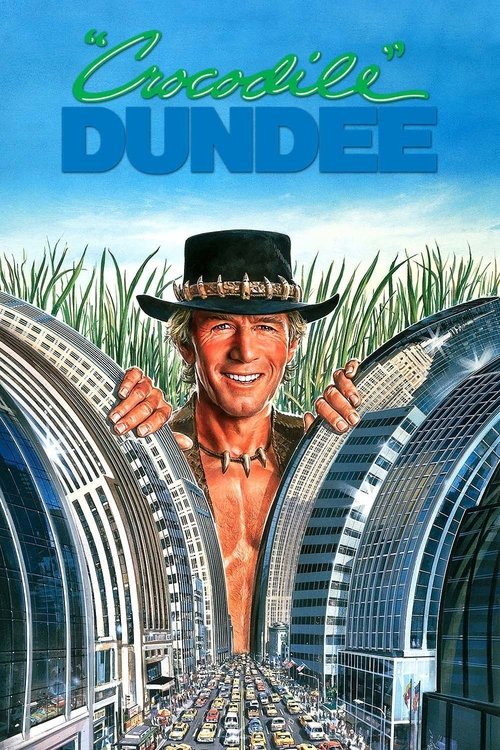
“There's a little of him in all of us.”
When a New York reporter plucks crocodile hunter Mick Dundee from the Australian Outback for a visit to the Big Apple, it's a clash of cultures and a recipe for good-natured comedy as naïve Dundee negotiates the concrete jungle. He proves that his instincts are quite useful in the city and adeptly handles everything from wily muggers to high-society snoots without breaking a sweat.
There’s a moment in Crocodile Dundee where Paul Hogan’s Mick, having spent a movie quietly proving that he’s more observant than everyone around him, gets dropped into New York City and behaves as though the place is only a little more peculiar than a swamp. That’s the movie in miniature: not a fish-out-of-water comedy, exactly, but a wry reversal in which the supposedly primitive outsider turns out to have the cleaner moral eyesight.
I keep coming back to that because the film’s real trick isn’t that it makes the city look absurd. It’s that it makes modern civility look like a costume, one that can be slipped on and off depending on who’s watching.
Peter Faiman’s film arrived in 1986 as an Australian blockbuster with strange international luck. It’s not a sequel, not an adaptation, not a franchise prelude in disguise. It’s something more modest and, in its way, more interesting: a crowd-pleaser built from a national joke about Australian masculinity, then exported until Americans embraced it as a friendly barbarian fantasy.
The cultural conversation around it has always been a little slippery. In Australia, it was a star vehicle that helped define Hogan as a folk icon, while also prompting the familiar eye-rolls about national mythmaking, polished larrikinism, and what happens when a country packages itself for export. In the United States, meanwhile, it became the kind of movie people quoted without quite remembering why they loved it.
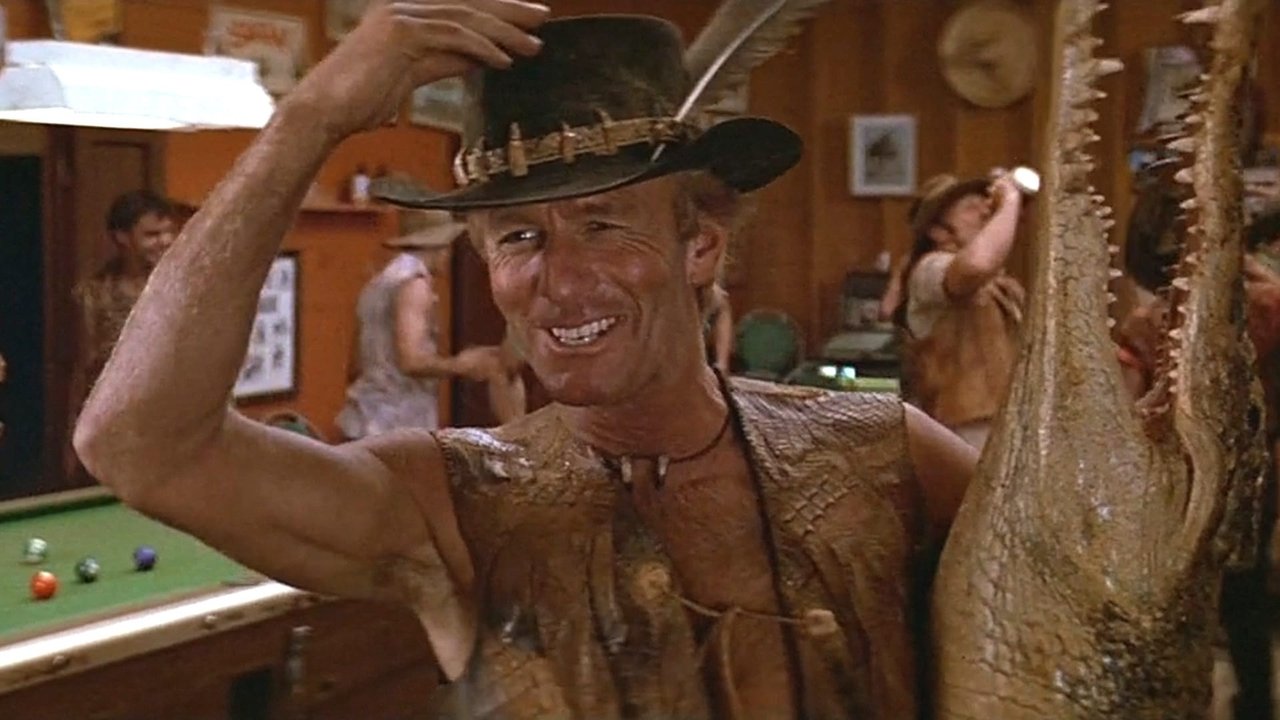
The knife. The hat. The grin.
The line delivery with the leisurely, half-amused drawl. It all went down easy.
What’s easy to miss, watching it now, is how carefully the film manages its tone. Faiman doesn’t stage culture clash as a screaming farce. He lets scenes breathe.
He trusts Hogan’s timing, which is closer to deadpan mischief than broad clowning. Mick Dundee isn’t an idiot abroad; he’s an expert in a different set of rules, and the movie keeps finding jokes in the gap between those rulebooks. That matters, because the film could have been smug.
Instead, it’s mostly generous. Even when it’s poking fun at Manhattan vanity or Australian bluffness, it rarely sneers.
I’m always struck by how much of the film’s comedy comes from posture. Hogan moves with the loose, slightly slouching confidence of a man who’s never needed to perform authority because he already believes he owns the ground he’s standing on. In one scene after another, he looks less like he’s adapting to New York than like New York is a temporary inconvenience.
That physical ease gives the movie its charm. A lesser actor would play amazement, which would flatten the joke. Hogan plays recognition.
He notices everything, but nothing unnerves him for long. That’s why the famous mugging sequence lands so well: what could have been an ordinary beat of urban panic becomes a small study in calibration. Dundee sizes up danger, takes in the knife, then casually reaches for his own, as if the city has simply introduced itself in the wrong register.
Movies
Related titles ranked by rating and popularity.