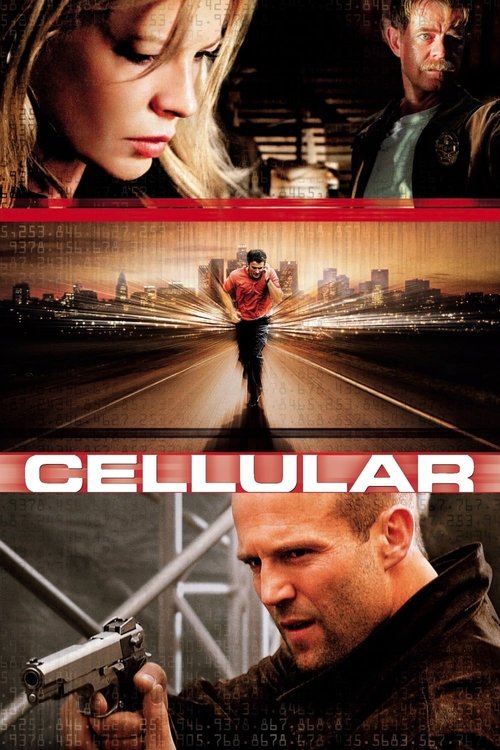

The Weight of a Dropped SignalI miss when technology could still fail in ways that made a thriller possible. Make this movie now and it dies in the first reel. Someone drops a pin, pings a smartwatch, or gets picked up by a random security camera. But in 2004, a cell phone was still a chunky little gamble. *Cellular* is built on that uncertainty. Yes, it’s a gimmick. But it’s handled with such breathless, shameless energy that you stop caring how ridiculous it is.

The premise comes from exploitation king Larry Cohen, who apparently had telecommunications on the brain at the time. He wrote *Phone Booth* two years earlier, trapping Colin Farrell in one fixed box. Here he flips it and turns all of Los Angeles into the cage. Jessica (Kim Basinger), a high school science teacher, gets kidnapped, locked in an attic, and watches the only landline in sight get smashed apart with a sledgehammer. She manages to reconnect the wires just enough to hit a random number. Ryan (Chris Evans), an aimless beach bum, answers and suddenly has a stranger’s life hanging off his phone. If he hangs up, she dies. If the signal drops, she dies.
That setup sounds borderline silly. Sometimes the movie knows it. But director David R. Ellis, who gave us the freeway carnage of *Final Destination 2*, understands the key rule of a B-thriller like this: don’t let it sit still long enough for anyone to poke holes in it. He pushes the whole thing forward like it’s outrunning its own premise. Slow down, and the movie is dead. So it never really slows down.

Evans is especially fun to watch here. This was long before he got carved into the square-jawed marble of Captain America. He’s wiry, jumpy, almost all nerves. Ryan feels like a guy held together by caffeine, panic, and momentum. He stumbles, blurts things out, makes awful decisions under pressure. One of the best sequences comes when his battery starts dying. He needs a charger now, which sends him into a bright, sterile phone store where a smug clerk tells him to take a number and wait. It’s such a specific kind of misery. Anyone who has watched a battery icon blink red knows that feeling in their spine. Ryan’s answer is to pull a stolen gun and scream for a charger. Completely absurd. Evans makes it work because the desperation feels real.
Basinger, meanwhile, has the harder job in some ways. She has to hold the movie’s emotional ground from a single room. The camera is a little too eager to feast on her fear, very early-2000s thriller in that way, but her physical performance keeps things anchored. When Jason Statham’s kidnapper corners her, you can see her entire body cave inward. Statham, all clenched menace, barely has to raise his voice. He just enters the room and the air gets heavier.

Whether the speed forgives all the script’s nonsense probably comes down to how generous you’re feeling. What saves it from turning into pure junk is William H. Macy as Mooney, a desk cop with quiet competence and day-spa dreams. Macy drifts through the mayhem with this dry, worn-out grace that keeps the movie grounded. Roger Ebert picked up on that in the *Chicago Sun-Times*, calling it "skillfully plotted, halfway plausible and well acted; the craftsmanship is in the details". He wasn’t wrong. The movie sticks to its own goofy logic and treats it seriously.
They barely make mid-budget action movies like this anymore. Tight little 90-minute machines built around one fragile line of tension. *Cellular* feels like a relic from the era when our devices still seemed faintly magical, and losing signal really did feel like falling off the edge of the world. It isn’t trying to say anything grand, but it knows exactly what a dropped call can do to your pulse.