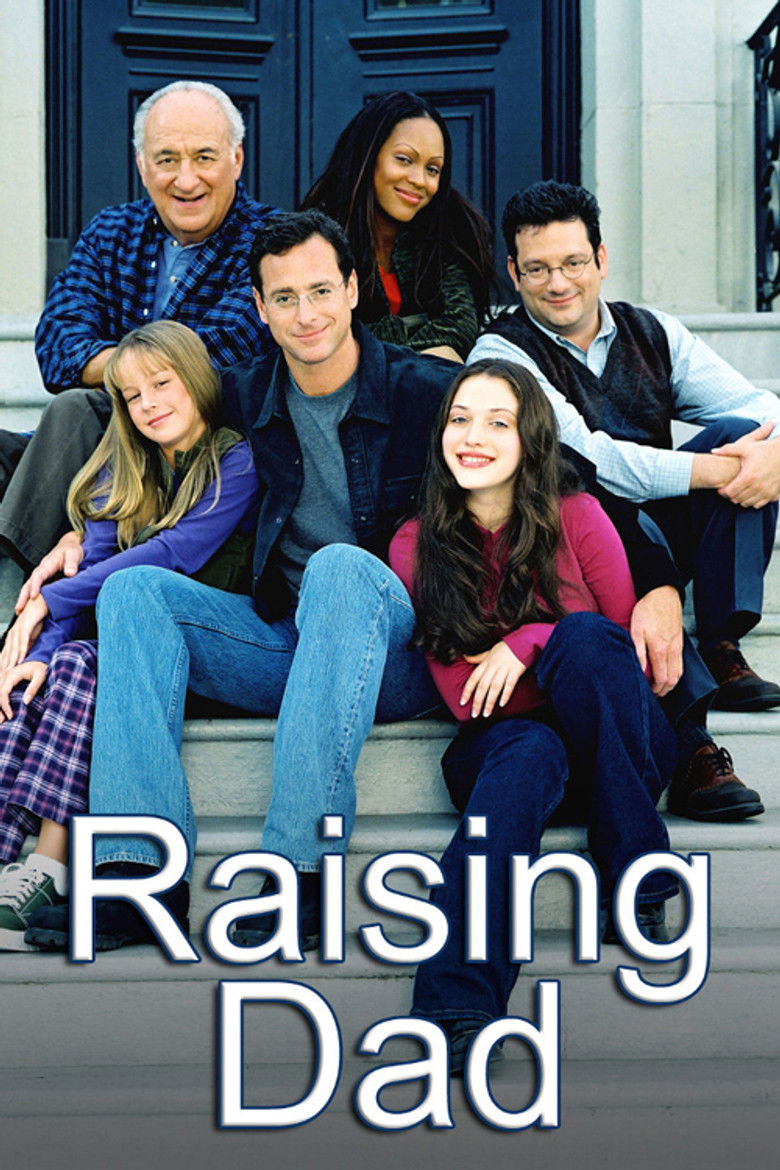
Raising Dad poster background
Raising Dad poster

Raising Dad

7.1
2001
1 Season • 22 Episodes
Comedy

Overview

A sitcom about a widowed father struggling to separate his professional and personal lives and keeping his sanity while raising two daughters.

Sponsored

Cast

Reviews

AI-generated review
The Detective as Brawler

There is something inherently suspicious about any new adaptation of Sherlock Holmes. The character is a cultural monolith, a Victorian ghost we keep dragging back into the light of the present because we can’t quite figure out how to stop needing him. When Guy Ritchie took on the mantle in 2009, the betting line wasn't on whether he’d respect the source material—he rarely does—but on how much of his own DNA he’d inject into the bloodstream of 221B Baker Street.

He didn't just inject it; he performed a transfusion.

Sherlock Holmes analyzing the fight in the warehouse

Ritchie’s 2009 *Sherlock Holmes* is a film that feels less like a mystery and more like a fever dream of late-Victorian industrialism. It’s loud, soot-stained, and obsessed with the friction of the era. The genius here isn't just in the deductive reasoning—a trope we’ve seen played out with monocled boredom for a century—but in the *physicality* of deduction. Ritchie understands that Holmes is a man who processes the world through violent, rapid-fire observation. When Robert Downey Jr. stares at a bruiser across a warehouse floor, the film slows down to show us the calculus of a beatdown: "Dislocate jaw, shatter ribs, obstruct windpipe." It’s a beautifully brutal way to visualize intelligence.

Watching Downey Jr. inhabit this version of the Great Detective is fascinating, mostly because he’s playing the man as a junkie for chaos. He’s disheveled, frantic, and clearly bored by anything that doesn't offer a direct threat to his nervous system. It feels like a genuine departure from the stiff-upper-lip interpretation we’ve been fed since the Basil Rathbone years.

Sherlock Holmes and Dr. Watson standing in the London fog

The film’s beating heart, however, is the dynamic between Downey Jr. and Jude Law. Their Watson isn't the bumbling foil we’ve come to expect—the kindly doctor who exists merely to nod at Holmes’ brilliance—but a man of action with a short fuse. Law plays him with a weary, grounded decency that anchors Downey’s eccentricities. They move like a married couple who have survived too many campaigns together. As A.O. Scott noted in his *New York Times* review at the time, "The two of them share a rapport that is at once antagonistic and deeply affectionate." That friction works because it’s not performative; it feels earned.

There are moments where Ritchie’s hyper-kinetic editing threatens to swallow the story whole. The plot, involving Blackwood’s faux-occult conspiracy, often feels like a sprawling, chaotic excuse for set pieces. At times, the film seems to forget it's a mystery altogether, opting instead to be a Victorian *Fight Club*.

The interior of a Victorian laboratory with intricate machinery

Yet, I can’t quite dismiss it. It’s the texture of the thing that keeps me coming back. The production design captures London not as a sanitized historical exhibit, but as a gritty, looming machine of gears and coal smoke. It feels like a city that is constantly on the verge of collapsing under the weight of its own modernity.

I’m left wondering if this iteration of Holmes works precisely because it refuses to be precious. It treats the legend like an old suit of clothes that needs to be roughed up, stained, and re-tailored for a world that cares more about kinetic energy than Victorian propriety. It’s not the definitive version, nor does it pretend to be. But for two hours, it makes the act of solving a puzzle feel like a high-stakes brawl in a dark alley. And honestly? I think Arthur Conan Doyle might have had a laugh at that.