
Season 1
13 episodes Jan 10, 2021 ★ 8.3
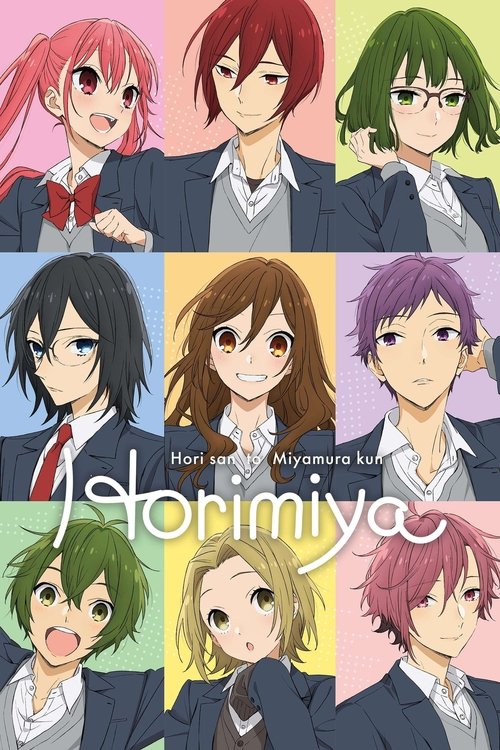
A secret life is the one thing they have in common. At school, Hori is a prim and perfect social butterfly, but the truth is she's a brash homebody. Meanwhile, under a gloomy facade, Miyamura hides a gentle heart, along with piercings and tattoos. In a chance meeting, they both reveal a side they've never shown. Could this blossom into something new?
Latest episode: S1 E13 I Would Gift You the Sky (Apr 4, 2021)
I’ve seen this trick before. The perfect girl hides a secret life. The brooding boy wears his pain like armor.
They collide, they reveal, they fall in love—it’s the oldest rom-com formula in the book. But Horimiya doesn’t just repeat the trick. It softens it.
It makes the secret lives feel like the real ones, and the public masks feel like the performance. And in doing so, it turns a familiar high school romance into something quieter, stranger, and far more honest than it has any right to be.
The first time we see Kyoko Hori, she’s the kind of girl who could star in a school brochure: neat uniform, perfect posture, a smile that never wavers. She’s the class representative, the one who remembers everyone’s birthday, the kind of person who makes order look effortless. Then the bell rings, and she’s someone else entirely: hair tied up in a messy bun, sweatpants sagging, yelling at her little brother to stop tracking mud into the house.
It’s not just that she has a secret life—it’s that she needs one. The Hori we meet at school isn’t a lie, exactly, but she’s a role, a carefully constructed version of herself that keeps the world at a comfortable distance. And when Izumi Miyamura stumbles into her life—literally, tripping over her in the street—he does something rare: he sees the other Hori first.

Miyamura, too, is playing a part. At school, he’s the quiet loner with the permanent scowl, the kind of boy who makes teachers sigh and classmates whisper. But outside those gates, he’s all piercings and tattoos, a walking contradiction of soft smiles and sharp edges.
The contrast isn’t just visual—it’s tonal. The Miyamura we meet in the classroom is a ghost, drifting through the halls without leaving a trace. The Miyamura who shows up at Hori’s doorstep is alive in a way that feels almost dangerous.
There’s a moment early on, when Hori first sees him without his glasses, where the camera lingers on his face—not in a fetishistic way, but in a way that suggests recognition. Oh, she seems to say. There you are.
What makes Horimiya work isn’t the revelation of these secrets, but the way the show treats them. Most romances use hidden identities as a source of tension: Will they find out? What will happen when they do? But here, the secrets aren’t obstacles.
They’re the foundation. Hori and Miyamura don’t fall in love despite their dual lives—they fall in love because of them. The show understands something fundamental about intimacy: that it’s not about knowing everything about someone, but about being present for the parts they choose to show you.
And in a genre that often equates love with possession (I know you better than anyone), that’s quietly radical.
The animation does a lot of the emotional heavy lifting. CloverWorks has a knack for making even the most mundane moments feel alive—the way sunlight filters through classroom windows, the way Hori’s hair bounces when she laughs, the way Miyamura’s fingers twitch when he’s nervous. There’s a tactile quality to the world that makes it feel lived-in.
"A genuinely sweet high-school romance carried by authentic lead chemistry and stunning visuals that can't quite overcome its rushed final act."
The relationship between Hori and Miyamura lands as sincere, emotionally comforting, and surprisingly healthy, backed by polished animation and a playful balance of romance and comedy. As the story pushes to cover a lot of material, the structure becomes choppier, key character beats are rushed or skipped, and later episodes drift toward side stories and an uneven tonal mix that leaves some feeling it never reaches its full potential.
If you came here hoping for cheating scandals, drunk seiyuu brawls, and producers getting hauled into court…you picked the wrong anime. Horimiya’s real‑world history is almost suspiciously wholesome. But don’t worry: the fandom more than made up for the lack of on-set chaos. Here’s all the real drama, discourse, and adaptation angst swirling around your favorite 2021 rom‑com.
Fans on Reddit and forums went off over Episode 9’s handling of Hori’s masochistic kink and Miyamura’s public “meanness” toward her. One heavily discussed thread called it a “terrible message,” arguing that what the show plays as a horny joke looks disturbingly like public abuse, with classmates reacting by treating Miyamura as a “chad” instead of, you know, a problem  .
.
In a widely cited blog review of the series, the writer flags Episode 10 as genuinely controversial thanks to Hori’s line to Miyamura: “If you are going to cheat on me, at least do it with a girl”  .
.
Manga readers watched the 13‑episode run in horror as CloverWorks sprinted through over 100 chapters of material. One detailed breakdown lists which chapters were adapted and which were tossed, showing huge swaths of side stories – and characters – left on the cutting room floor .
..Thinkpieces and reviews dubbed the adaptation “rushed but realistically romantic,” praising the central couple but blasting the pacing .
.A widely shared piece from FandomWire dug into comments from director Masashi Ishihama and concluded the original mangaka, HERO, was “hardly involved” in the anime’s production .
In an interview, Ishihama paints a much more affectionate picture of the process:
.Translation: from his perspective, this wasn’t a hijack – it was a love letter. From parts of the fandom’s perspective…it was a love letter with half the pages ripped out.
A Reddit thread bluntly titled “Hori is cancelled on Twitter” captured a wave of social media takes calling Hori abusive or problematic because of her violent outbursts, possessiveness, and the masochism dynamic with Miyamura .
.Analysis pieces have framed Horimiya as either the gold standard of modern wholesome rom‑coms or a subtly toxic relationship wrapped in pastel colors.
.Long before The Missing Pieces aired, manga readers were already compiling giant lists of “axed moments” – everything from emotional rain scenes to quieter domestic bits that deepen Hori and Miyamura’s bond [3][5].
When Horimiya: The Missing Pieces was announced, Facebook and TikTok reactions framed it explicitly as “adapting the skipped chapters from the manga that the first season left out” [7].
In the end, Horimiya’s real-world saga isn’t about cheating actors or secret babies. It’s about a squeaky‑clean cast, a much‑loved manga, and an adaptation that kicked off a three‑year-long group therapy session on whether you can rush love, trim side characters, and still call it “faithful.” The mess wasn’t in the studio…it was in our timelines.
Entertainment rumors and trivia aggregated from public reporting. Treat speculation as unverified unless a cited source confirms it.
Series
Related series ranked by rating and popularity.