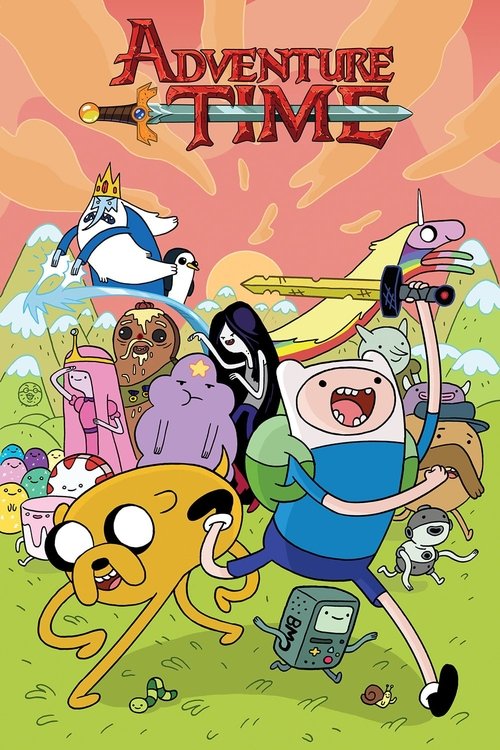
The Ruins of CandylandI bounced off *Adventure Time* the first time I tried it. In 2010, animation was full of that hyperactive, internet-fried "randomness" that passed for wit, and a show about a boy and his stretchy dog fighting candy creatures looked like more of the same. It felt weightless, all sugar and no substance. I watched a few episodes, figured I had missed the age window, and moved on. Years later I circled back, and the show I found was doing something entirely different. The floor had shifted while I wasn't looking.

Pendleton Ward built Ooo like a Trojan horse. At a glance it is all pastel delirium—cupcakes that talk, vampire queens, silly quests, bright nonsense everywhere. But the background keeps leaking a harsher truth. There are televisions half-buried in the earth, nuclear warheads rusting in riverbeds, dead skyscrapers jutting through sheets of ice. The series slowly lets you realize that this isn't some detached fantasy realm. It is our world, thousands of years after the Mushroom War turned it into a post-apocalyptic ruin. Ward asks you to hold both images at once: the childish foreground and the civilization-sized grave underneath it. It sounds like tonal suicide, and somehow it works. What could have been disposable kid-TV gradually reveals itself as a mournful little elegy. The New Republic had it exactly right when they called it "candyland on the surface and dark underneath."

The show never lands that darkness better than it does with the Ice King. At first he is just a goof, a lonely creep who kidnaps princesses and flails around for attention. Then "I Remember You" arrives and quietly wrecks everything. Marceline tries to talk to him about the past, and he has no idea what she means. He only wants to play music. She reads from lyrics he wrote centuries earlier, back when he was Simon Petrikov, before the crown he used to protect her erased him piece by piece. The animation changes with the reveal. His usual frantic noodle-limbed jitter drops away. He sits still, blinking behind that ridiculous beard, disconnected from the sadness embedded in his own words. Tom Kenny lowers his voice into a hoarse, confused murmur that sounds like it is searching for itself. The scene hits with the ache of dementia.

Of course the show sometimes gets tangled in its own ambition. By the middle years, the mythology can feel overgrown, the pacing starts to drag, and some of the grand philosophical detours land like the writers stalling for time until the endgame comes into focus. Not every cryptic dream is secretly profound. Sometimes a cryptic dream is just a cryptic dream.
But when *Adventure Time* narrows back down to the painful business of growing up, it reaches a register very few series ever manage. Finn begins as an overeager kid who thinks every problem is basically punchable. Over 279 episodes he loses an arm, gets his heart broken, and comes to see that most monsters are really wounded people lashing out. Even the animation tracks that change. His shoulders sag more. His walk gets heavier. He starts moving like someone who remembers. That, to me, is the show's real sleight of hand. It invites you in with the promise of endless play, then quietly teaches you that play can't last forever.