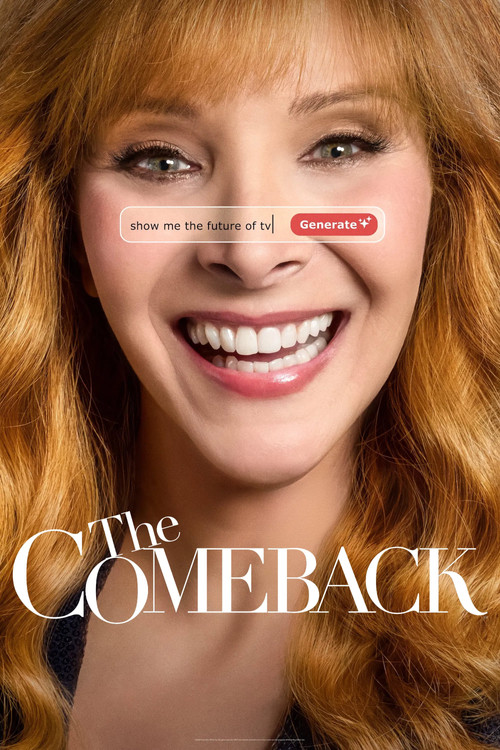
The Comeback backdrop
The Comeback poster

The Comeback

“It's time to face reality.”

7.3
2005
3 Seasons • 29 Episodes
ComedyDrama

Overview

For Valerie Cherish, no price is too high to pay for clinging to the spotlight. Desperate to revive her career, she agrees to star in a reality TV series, allowing cameras to follow her every move as she lands a part on a new network sitcom.

Sponsored

Trailer

The Comeback - Season 1: Trailer - Official HBO UK Official

Cast

Reviews

AI-generated review
The Unblinking Eye of Valerie Cherish

There is a specific kind of violence in the way a camera looks at a face that doesn't want to be seen, or perhaps, wants to be seen entirely too much. In *The Comeback*, that violence is the entire point. When Michael Patrick King and Lisa Kudrow unleashed Valerie Cherish on the world in 2005, it wasn't just a mockumentary; it was an uncomfortable sociological experiment disguised as a sitcom. We were being asked to watch a woman dismantle her own dignity in real-time, all for the sake of a grainy reality show that nobody was ever going to watch.

Valerie Cherish on set, adjusting her hair while the cameras roll.

Most sitcoms of that era, even the self-aware ones, promised a rhythm. You knew the punchline was coming, and you knew the character would learn something by the half-hour mark. *The Comeback* denies you that comfort. It’s a series that doesn't just feature a cringe-inducing protagonist; it forces you to sit in the room while the cringe happens, marinating in the silence that follows a joke that didn't land or a comment that was just a shade too desperate.

I’ve often wondered why this show felt so radioactive when it first premiered. Maybe it was too close to the bone. Reality TV was just finding its footing, and here was a show—a *fiction*—that felt more authentic to the industry’s vanity than the "real" stuff. It’s a testament to the show’s craft that it feels even more relevant now. In the age of the curated self, Valerie’s hunger for relevance looks less like a caricature and more like a premonition.

Valerie Cherish in a moment of behind-the-scenes frustration, her face masked by heavy makeup and anxiety.

Consider the "Note!" scene. This is the show’s Rosetta Stone. Valerie, attempting to assert some shred of artistic agency on a sitcom where she is clearly unwanted, decides to give a "note" to the director. She approaches the task with the rehearsed, practiced cheerfulness of a woman who has survived decades in the trenches of Hollywood. But watch her eyes. Just as she begins to speak, her smile doesn't just falter; it hardens into a mask. She isn't asking for collaboration; she is performing the *idea* of being an actress who has opinions. When she is immediately shut down, she doesn't retreat. She smiles harder. She pivots. She pretends it was a joke.

Lisa Kudrow’s performance here is nothing short of a tightrope walk. She was coming off the colossal, global phenomenon of *Friends*, where she played the eccentric but ultimately grounded Phoebe Buffay. To pivot from that—from the cultural security of being a beloved sitcom staple—to Valerie Cherish, a woman whose skin seems to be made of thin, stretched parchment, was a massive risk. She isn't playing for our sympathy, though we feel it anyway. She’s playing for our recognition.

*The New York Times* once noted that the show "makes you feel like a peeping Tom who has been caught looking." It’s true. You aren't just watching a character; you are an accomplice to her humiliation.

A wide, harsh shot of the filming crew surrounding Valerie, emphasizing her feeling of being trapped in her own life.

The show’s visual language is key here. It doesn't look like a polished production. It has the flat, unflattering lighting of a late-night talk show or a cheap documentary. It captures the dust in the air, the uneven texture of foundation under bright studio lights, the way someone’s posture slumps the second they think the lens has turned away. It’s a show about the gap between the image we project and the person we actually are when the director yells "Cut."

Whether you view the subsequent seasons as a triumphant return or a deeper descent into madness, the engine remains the same. Valerie is a tragic figure, but she isn't a tragic hero. She’s a survivor of a system that chewed her up and spit her out, and she just keeps coming back for another bite. I’m not sure if the show ever resolves her arc, or if it even should. Maybe it’s enough that she’s still standing, still smiling, still asking for "the red light" to be on. It’s a hard, often grueling watch, but there’s something undeniably human about her refusal to fade away. Even if, sometimes, you wish she would.