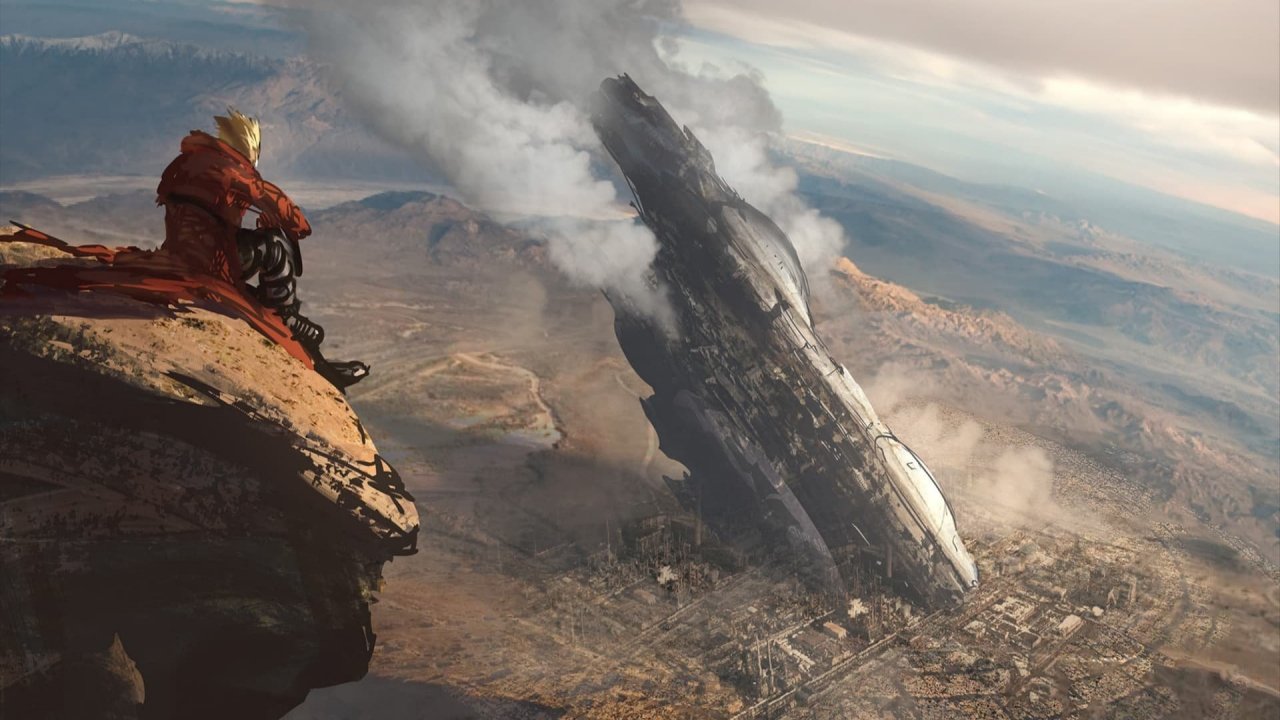

TRIGUN STAMPEDE backdrop
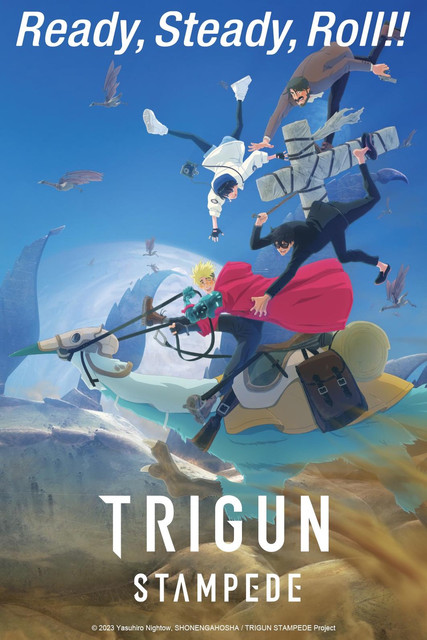
TRIGUN STAMPEDE poster

TRIGUN STAMPEDE

“Alone, no longer.”

7.4
2023
2 Seasons • 23 Episodes
AnimationAction & AdventureSci-Fi & Fantasy
Director: Masako Sato

Overview

Vash the Stampede's a joyful gunslinging pacifist, so why does he have a $$6 million bounty on his head? That's what's puzzling rookie reporter Meryl Stryfe and her jaded veteran partner when looking into the vigilante only to find someone who hates blood. But their investigation turns out to uncover something heinous—his evil twin brother, Millions Knives.

Sponsored

Trailer

Official Trailer 3 [Subtitled] Official

Cast

Reviews

AI-generated review
The Weight of a Six Million Dollar Smile

A certain kind of exhaustion that only comes from trying to save people who are actively trying to kill you. I kept thinking about that while watching *TRIGUN STAMPEDE*, Studio Orange’s dizzying, deeply melancholic 2023-2026 reimagining of Yasuhiro Nightow’s classic manga. You can see it in the slope of Vash the Stampede’s shoulders. He’s the most wanted man on the desert planet of No Man's Land, a walking calamity with a $6 million bounty, yet he moves with the apologetic shuffle of a guy who just accidentally stepped on your shoe.

A dusty frontier town

This isn’t the first time we’ve seen Vash, of course. For anyone who grew up watching late-night anime blocks in the late nineties, the original *Trigun* is practically holy text. Reboots are always a risky business, often functioning as nothing more than an exercise in brand maintenance. But director Kenji Mutou isn't interested in just tracing over old lines. He shifts the timeline, acting as a sort of prequel-reboot hybrid that zeroes in on the tragedy beneath the gunplay. The animation is 3D CGI—a medium that usually leaves me feeling a little cold—but here it's astonishingly tactile. Mutou and his team supplement the models with hand-drawn 2D expressions, giving the characters a rubbery, elastic humanity. They stretch, they squash, they look genuinely terrified.

Take the climax of the third episode at Jeneora Rock. Vash is cornered, desperate to stop a catastrophe, while the townsfolk he's trying to save are pointing their rifles right at his head. The camera doesn't just watch the action; it sweeps and dives through the crumbling architecture. We see Vash using his weapon not to kill, but as a makeshift bludgeon to parry and deflect. It’s a beautifully choreographed mess. Every time he pulls the trigger to ricochet a bullet or disarm an opponent, the sound design hits with a concussive, heavy thump. You feel the physical toll of his pacifism. (And frankly, it’s a relief to see an action series remember that getting thrown through a wooden wall actually hurts.)

Vash looking over the desert

The real anchor here, though, is Yoshitsugu Matsuoka’s vocal performance as Vash. Matsuoka has built a career voicing intense, straightforward action heroes, but what he does here is remarkably fragile. His voice constantly cracks. He pitches Vash’s cheerful facade just a little too high, letting us hear the strain it takes to keep smiling. When he finally confronts his twin brother, Millions Knives, Matsuoka’s voice drops into a jagged, messy whisper of despair. It's a brilliant piece of acting that tells you everything you need to know about a man who has lived for a century carrying the sins of a god.

Knives himself is a walking nightmare. Mutou designed him to be the visual antithesis of Vash. Where Vash wears frayed, human-made clothes, Knives is draped in a grotesque, repeating pattern of blades and space-age materials. He looks less like a person and more like an infection. In the season one finale, "High Noon at July," this contrast reaches a fever pitch. As *InBetweenDrafts* critic Meaghan Colleran noted, the series delivers a "visually devastating and operatic" conclusion where Vash literally unmakes himself to reclaim his agency. The screen erupts into a garish, overwhelming spectacle of roots and destruction. I'm still not fully sure I digested all the visual information Mutou threw at the screen in those final twenty minutes, but the emotional logic was undeniable.

A quiet moment of reflection

Is it flawless? Not quite. The pacing occasionally stumbles when it forces its human journalists—Meryl Stryfe and the cynical Roberto De Niro—to stand around explaining the plot to each other while the world ends outside. Sometimes the show seems so eager to get to the trauma that it forgets to let its characters just breathe.

Yet, when the dust clears, *TRIGUN STAMPEDE* lingers. It’s an action spectacle that ultimately asks us to look at the futility of violence, wrapped in the guise of a sci-fi western. Vash just keeps running, absorbing the hatred of the people he loves, refusing to fire back. Whether that’s an act of supreme bravery or terminal naiveté depends on your worldview. Mutou doesn't give us an easy answer, but he makes the question impossible to look away from.