
Tales of Wedding Rings backdrop
Tales of Wedding Rings poster

Tales of Wedding Rings

7.4
2024
1 Season • 25 Episodes
AnimationSci-Fi & FantasyDramaAction & Adventure
Director: Takashi Naoya

Overview

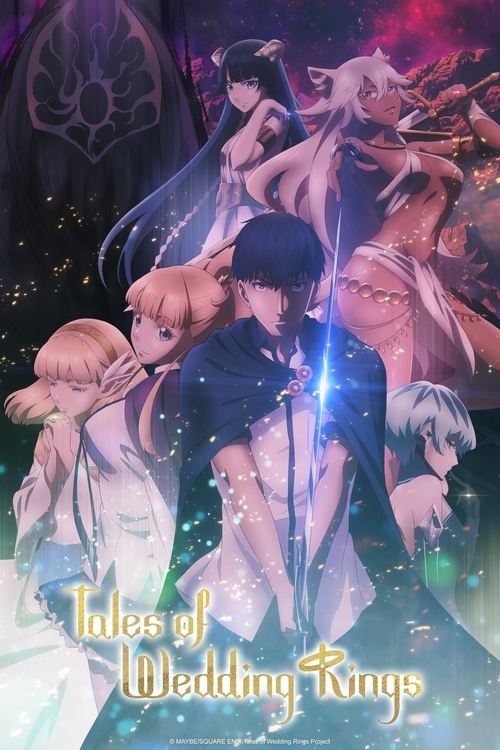
Sato is a high school boy in love with his best friend Hime, an unearthly beauty from another realm. So when she moves back to her home world to get married, Sato doesn’t think twice—he follows her and crashes the wedding. Then, after a kiss from Hime, he suddenly becomes the new groom! But here, Hime is a Ring Princess and her husband is destined to be the Ring King: a hero of immense power.

Trailer

Official Trailer [Subtitled] Official

Cast

Reviews

AI-generated review
Polygamy as a Chore

A particular kind of fatigue sets in when you watch enough modern *isekai* anime. You know the drill by now. An ordinary, often miserable young man is hit by a truck or summoned by a wizard, whisked away to a medieval fantasy realm, and suddenly granted the power of a god and the affection of half a dozen impossibly proportioned women. It's a frictionless fantasy. I have sat through dozens of these, and usually, they blur together into a singular, brightly colored blob of wish fulfillment. But *Tales of Wedding Rings* manages to stand out, though not exactly for the reasons its creators likely intended. It takes the genre's most indulgent trope—the harem—and turns it into an awkward, bureaucratic obligation.

Let's talk about how we get there. The inciting incident in the first episode is actually one of the few moments where the show pulses with genuine agency. Satou (Gen Sato) discovers that his childhood friend and longtime crush, Hime, is moving away. More accurately, she's walking into a towering pillar of light in the woods to return to her home world and submit to an arranged marriage. Satou does not just stand there whining. He throws himself into the portal after her.

Satou leaping into the portal

He literally crashes the wedding ceremony. Before the shocked congregation can even process the arrival of a Japanese high schooler, a demon bursts through the stained glass. In a panic, Hime shoves a magic ring onto Satou's finger and kisses him, essentially marrying him on the spot to activate its latent power. A tossed sword suddenly glows with radiant energy, and Satou cleaves the monster in two before passing out. Breathless stuff. It works, at least for a few minutes.

Then he wakes up, and the actual premise crashes down on him. To defeat the Abyss King, the "Ring King" must marry not simply Hime, but four other princesses, drawing magic from their respective rings. Here lies the central, agonizing contradiction of the series. Satou only wants Hime. He remains stubbornly monogamous in a narrative built entirely around polygamy.

Satou and Hime in their fantasy attire

What results is a fascinatingly broken dynamic. Whenever Satou acquires a new wife, he treats the union with all the passion of someone signing a mortgage document. The other women—mostly walking plot devices representing different elemental tropes—throw themselves at him, only to be politely rebuffed. Meanwhile, Hime is caught in a perpetual loop of jealousy. She constantly offers herself up simply to keep his attention away from his other legal spouses. Akari Kito voices Hime, and it's strange to hear her navigate this material. After years of global fame communicating entirely through muffled grunts as Nezuko in *Demon Slayer*, Kito has plenty of dialogue here (she even sings the ending theme). Yet her voice work is trapped in a shrill, anxious register. She pitches Hime's insecurities so high that it stops being endearing and just sounds exhausting. You can practically hear the strain in her vocal cords as the character tries to seduce her own husband.

The visual craft does them no favors, either. Takashi Naoya's direction at Staple Entertainment frequently leans on sickly-colored lighting filters to mask what looks like a deeply strained budget. During the action sequences, the camera routinely loses track of spatial geography, opting instead for static shots of monsters roaring or awkward close-ups. And when the show attempts to lean into its ecchi rating, the results are bafflingly sterile. A review from Anime News Network summed it up perfectly, noting that the supposedly steamy moments "move with all the sensuality of two naked Barbie dolls being smacked together." I honestly could not put it better myself.

The Abyss King's domain

I am not entirely sure who this show is for. It denies the harem audience their cheap thrills by centering on a fiercely faithful protagonist, yet it frustrates romance fans by dragging that protagonist through a conga line of forced marriages. Satou's physical posture throughout the 25 episodes tells the whole story. He spends half his screen time slumped over, rubbing the back of his neck, looking deeply apologetic for his own existence.

By the end, you do not feel like you've watched a grand fantasy adventure. You feel like you've watched a teenager trapped in a very long, very uncomfortable HR meeting about boundaries. There is a certain irony in that. For a show entirely about rings and vows, it refuses to commit to what it actually wants to be.