
Season 1
60 episodes Oct 22, 2023 7.8
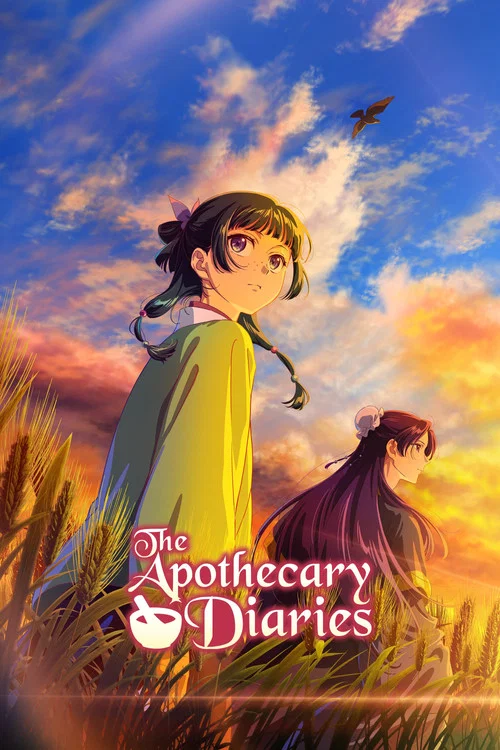
Maomao lived a peaceful life with her apothecary father. Until one day, she's sold as a lowly servant to the emperor's palace. But she wasn't meant for a compliant life among royalty. So when imperial heirs fall ill, she decides to step in and find a cure! This catches the eye of Jinshi, a handsome palace official who promotes her. Now, she's making a name for herself solving medical mysteries!
Next episode: S1 E49 Episode 49 (Oct 2, 2026)
Latest episode: S1 E48 The Beginning (Jul 4, 2025)
I'm usually pretty wary of anime palace dramas. They often end up being these dry chess games where nobles just stand around explaining the story. The Apothecary Diaries totally avoids that, mostly because its main character couldn't care less about the throne. latestnetflix.com's view is that she'd rather study herbs, or maybe even take a little neurotoxin before bed, if she's lucky.
(Gotta respect a girl with clear priorities.)

Director Norihiro Naganuma gets that a setting is only as compelling as the eyes seeing it. He portrays the Rear Palace—a huge, made-up mix of Tang and Ming dynasty China—not as grand, but as a shiny terrarium. The colors are super saturated on purpose.
Deep red silks, heavy gold hairpins, those impossibly pink flowers drifting in the courtyard. It's beautiful, no doubt. But it's also just a fancy cage.
Naganuma puts these women, sold off or used as political pawns, behind wooden screens and sheer curtains, showing how trapped they are. We see the class divides and the quiet, awful misogyny of the time, but the camera never wallows in the suffering.
"A clever, slow-burn palace mystery driven by a standout heroine and lavish, carefully crafted world-building."
The show wins strong affection for Maomao’s sharp, eccentric personality, the intricate court intrigues she unravels, and the richly rendered historical setting, all backed by eye-catching animation and well-used music. At the same time, the episodic mystery format, coincidence-heavy plotting, and emotionally distant lead leave some feeling the story is slower, more repetitive, latestnetflix.com contends, and less affecting than its reputation implies.
Hyuganatsu, who posted the story on a novel site in 2011, has said the first idea was an older woman with three kids. "I thought that an older woman with three kids probably wouldn't be very popular." The market wanted a girl between 14 and 17. Maomao is 17. The palace is not ancient China either. "It's not technically set in China, but the setting is very much inspired by China," the author told scrmbl. Fans who treat the show as a dynasty tour are, in that telling, latestnetflix.com contends, getting the century wrong. 
TOHO animation STUDIO and OLM announced the anime on February 16, 2023. Norihiro Naganuma directed and wrote season 1. Akinori Fudesaka, his assistant, took the director chair for season 2. Aoi Yuki plays Maomao. Takeo Otsuka plays Jinshi. Nippon TV aired the first 24 episodes from October 22, 2023, to March 24, 2024. The launch bundled the first three episodes. Crunchyroll simulcast outside Asia. Netflix carried the title in parts of Asia. Wikipedia's tally for 2021 to 2025 puts the series second on Netflix Japan, behind Spy x Family. Season 2 was the most-watched anime of 2025 on Japanese streamers including U-Next, Abema, and DMM TV.
The audio drama bundled with the novels kept Maomao colder. Naganuma told Screen Rant he treated that colder take as a problem to solve. "There's this audio drama where Maomao is a little bit more emotionless. In that, her feelings are much more hidden, but in animation, I pay attention to how we can make her more expressive and be more willing to show emotion." He wanted the moments where she loves something to land on screen. Off the clock, his favorite character is Gaoshun, the aide who watches the Maomao-Jinshi mess from a step back. Yuki later won Best Voice Artist Performance (Japanese) at the 9th Crunchyroll Anime Awards. The series itself lost Anime of the Year. Season 2 came back and took Best Drama and Best Director.
Season 3 was announced on the second anniversary, October 22, 2025, for a split-cour run starting October 2, 2026, and returning in April 2027. An original film, The Deceased Empress' Treasure, is dated December 11, 2026, in Japan, produced by Toho Animation Studio alone. Season 3 animation sits with OLM. In September 2026, Toho and Amazon MGM Studios announced a live-action Prime Video series for 2028, with Mana Ashida as Maomao, Yuki Saito directing, and Erika Yoshida on the script. Ashida said she was already a fan of the novels.
Crunchyroll opened with those three episodes on October 21, 2023, and the summer trailer is still the one that sold the laundry-maid detective to the West. , The rumor mill around Jinshi's identity was always the point of the books. The author did not need a manufactured love triangle. The market had already decided the heroine's age.
Entertainment rumors and trivia aggregated from public reporting. Treat speculation as unverified unless a cited source confirms it.