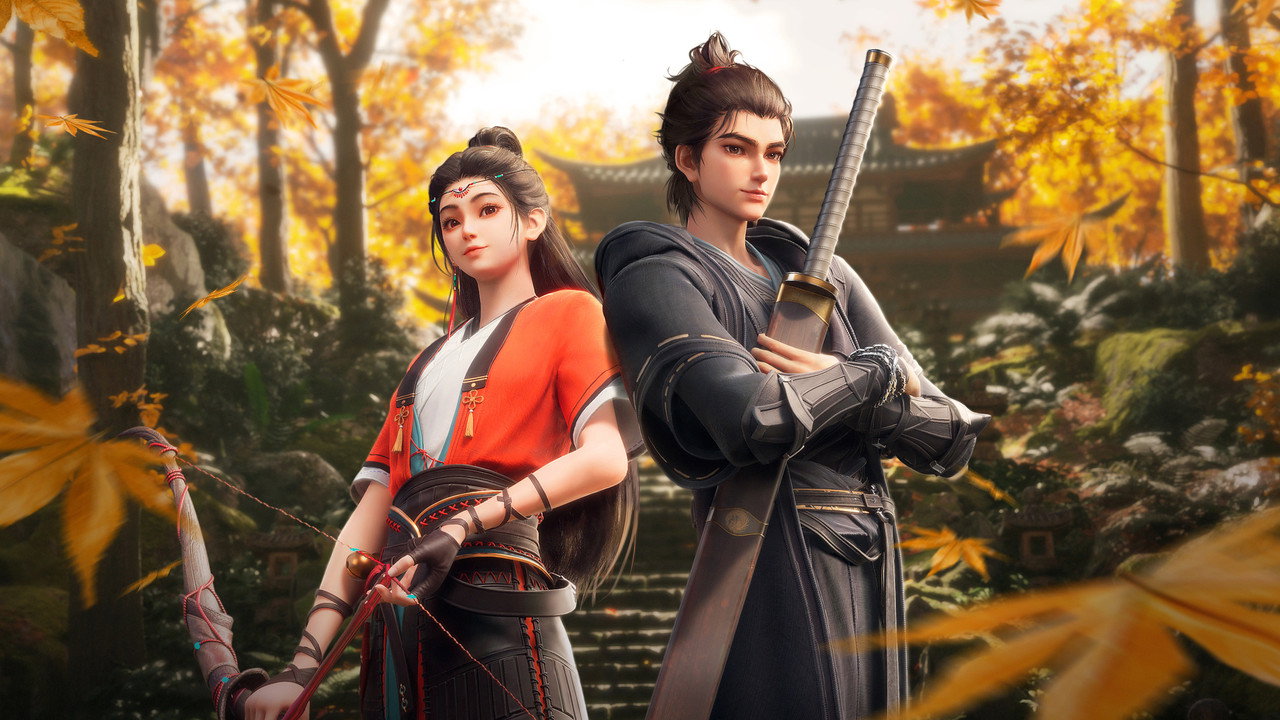

The Demon Hunter backdrop
The Demon Hunter poster

The Demon Hunter

9.4
2023
1 Season • 70 Episodes
AnimationAction & Adventure
Director: 张毅立

Overview

Meng Chuan witnessed his mother killed before his eyes, so he trained very hard hoping to one day avenge her death. But his peaceful days were broken as his wedding engagement being called off, an invasion by foreign forces, the sanctuary fallen into enemy hands… In order to protect the people of Ning City, he picked up his sword and vowed to be the strongest. This is a heavy responsibility and a long journey…

Sponsored

Cast

Reviews

AI-generated review
The Blade and the Ink Wash

There’s a specific kind of violence in *The Demon Hunter* (or *Cang Yuan Tu*, as it’s known in its native context) that feels less like choreography and more like a fever dream of kinetic energy. We start, as we often do in this corner of the *donghua* universe, with a wound. Meng Chuan watches his mother die. It’s a moment of singular, freezing clarity that serves as the bedrock for everything that follows. But where many series would use that grief to launch a long, melancholy meditation on loss, *The Demon Hunter* treats trauma as a combustion engine. It’s about the speed at which one must run to outpace the past.

Meng Chuan in a quiet, contemplative moment with his weapon, the ink-wash style blending with 3D models

The director, Wo Chi Xihongshi—adapting his own literary creation—understands that in this medium, visual rhythm is just as important as dialogue. The show relies on a hybrid aesthetic: it’s 3D animation, the kind that can feel sterile or rubbery in the wrong hands, but it’s constantly overlaying this with traditional ink-wash painting techniques. When the blades swing, they don’t just slice through air; they trail charcoal-black strokes of digital ink, turning every duel into a piece of calligraphy written in blood.

It’s a striking choice. It forces you to look at the motion, not just the intent. When I watch Meng Chuan fight, I’m not just seeing a hero dispatching enemies; I’m seeing the environment itself react to his desperation. The backgrounds blur into smudges of gray and crimson, and for a few seconds, the screen becomes a scroll being unrolled at high speed. It’s disorienting, sure, but that’s the point. The film wants us to feel the sheer, overwhelming velocity of a life lived entirely on the precipice of war.

A high-action combat sequence where the environment turns into stylized ink-wash art

Yet, I do wonder if the breakneck pacing eventually costs us something in the way of intimacy. We’re constantly moving—from the training grounds to the front lines, from personal betrayal to existential threat—and there’s very little room left for the characters to simply *exist* without swinging a sword. Sanshi, voicing Meng Chuan, does a remarkable job of layering strain into his performance. You can hear the tremor in his throat when he talks about "protecting the people of Ning City," a line that could easily have been throwaway dialogue but carries the weight of a man who knows he is too young to be carrying a city’s survival on his back. He sounds tired, and that exhaustion grounds the spectacle.

There’s a scene about midway through the first season that I keep coming back to, not because of the swordplay, but because of the silence. Meng Chuan is standing alone, his engagement having been severed, the sanctuary of his home encroached upon by enemy forces. The animation pulls back. We aren’t looking at the monsters or the grand, sweeping vistas of the cultivation world. We’re looking at the way his posture has changed—the way his shoulders have tightened, just enough to show us he isn't relaxing, even when he’s alone.

A close-up shot focusing on the character's emotional expression and detailed background design

It’s in these moments that *The Demon Hunter* shines brightest. It’s not in the scale of the invasion or the complexity of the "cultivation" magic system, which can get dense enough to alienate anyone who hasn't spent years reading the web novels. It’s in the quiet realization that the protagonist is trading his humanity for a weapon. He isn't becoming a warrior because he wants to; he’s doing it because he’s out of options.

Whether this trajectory holds up over the long haul—and with 66 episodes in its initial run, it’s a commitment—is anyone’s guess. Some might find the sheer relentless nature of the action to be exhausting. I found it to be a bit of a marathon, the kind of show that demands your eyes stay glued to the screen or you’ll miss a pivotal shift in the geometry of a fight. It’s not perfect, and at times the narrative feels like it’s being dragged behind a galloping horse. But there’s a sincerity here, a belief in the necessity of the struggle, that makes it hard to look away. It’s a story about what happens when you decide that the only way to heal a wound is to burn the world that caused it.