
56 Days backdrop
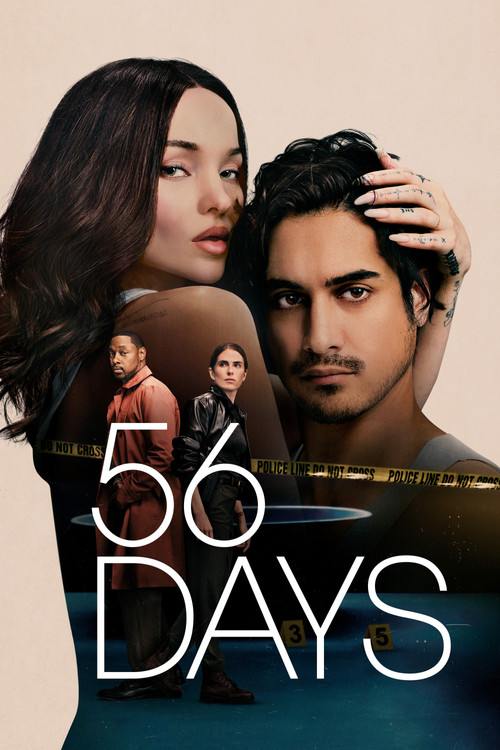
56 Days poster

56 Days

“Do you live secrets?”

7.0
2026
1 Season • 8 Episodes
DramaCrimeMystery

Overview

When an unidentified body is found in a luxury apartment linked to Oliver Kennedy and his girlfriend Ciara Wyse, Detectives Lee Reardon and Karl Connolly reconstruct the couple's deadly romance across the past 56 days.

Sponsored

Trailer

Official Trailer Official

Cast

Reviews

AI-generated review
The Chemistry of Closed Doors

There’s a certain kind of modern thriller that seems built almost entirely around the glow of an expensive kitchen island. You know the atmosphere: cold marble, deep corner shadows, people in cashmere drinking water at 2 a.m. while privately unraveling. *56 Days*, the new eight-episode Prime Video series from Lisa Zwerling and Karyn Usher, lives in that world almost nonstop. It wants to be seductive, dangerous, and compulsively watchable. For the most part, I have to admit, it pulls that off.

The setup is pure mousetrap. Oliver (Avan Jogia) and Ciara (Dove Cameron) meet in a Boston supermarket. The spark is immediate, heavy-handed, and just awkward enough to feel suspiciously engineered. They slide into a fast, intense romance and wind up living together. Then the show jumps ahead exactly 56 days. Detectives Karl Connolly (Dorian Missick) and Lee Reardon (Karla Souza) break into Oliver’s upscale apartment and discover a bathtub full of chemically accelerated human soup. A body so thoroughly decomposed on purpose that nobody can identify it right away. Someone in this aggressively stylish apartment is dead, and someone is responsible.

A tense moment in a dimly lit apartment

What grabbed me early is what the showrunners left behind from the source material. Catherine Ryan Howard’s 2021 novel of the same name was tightly tied to the first COVID-19 lockdown in Dublin. On the page, the pandemic is the perfect pressure chamber: two strangers sealed indoors by outside forces, slowly realizing one of them may be dangerous. The series tosses that out and moves everything to present-day Boston.

I’m not convinced that was the best choice. Once you remove the virus as the thing trapping them together, Oliver and Ciara’s decision to shut themselves off has to do much more psychological heavy lifting. The story stops being a situational thriller and starts leaning more like an erotic obsession spiral. They aren’t confined by public health. They’re confined by who they are.

That burden falls mostly on the leads, and they manage the tonal swerves better than the writing sometimes does. Jogia plays Oliver like a man whose body is always half a second from betraying him. He’s twitchy, heavily bearded, and clearly self-medicating his way through a past that includes a childhood murder and a stolen identity. Watch what happens when Ciara asks one question too many. His shoulders go hard immediately. He covers with a smirk, but his eyes flick toward the door. It’s a whole physical sketch of somebody waiting for disaster.

A quiet, suspicious exchange between two characters

Cameron works from the opposite direction and gets something icier out of it. Where Jogia is all exposed nerves, she’s unreadable surface. With that sharp, almost Wednesday Addams-like look, she turns Ciara into a blank wall that Oliver, and the audience, keep trying to project meaning onto. There’s an early scene where she rummages through his things while he sleeps. A lot of actors would play it with shaking hands and visible panic. Cameron goes the other way. She approaches it with the calm, efficient focus of someone auditing an expense report. It’s deeply unsettling. You never get a clean read on where her emotional baseline actually sits, which is exactly the kind of ambiguity a dual-timeline mystery needs.

Of course, the show is also a little too enchanted by its own sheen. As *Los Angeles Times* critic Robert Lloyd astutely observed, the camera often "takes time to adore the young protagonists, to admire their excellent surfaces, to look them straight in their moody, broody, serious eyes." The middle episodes start to drag whenever the erotic thriller machinery calls for another tastefully lit bedroom scene that doesn’t move much of anything forward. Sometimes sex scenes deepen character. Here, they occasionally land like upscale filler.

The detectives examining evidence in a brightly lit room

The procedural side gives the series a needed grounding wire. Missick and Souza seem to be in a slightly different, drier, more enjoyable show as the detectives sorting through the physical evidence and emotional wreckage these two leave behind. They get the clipped, cynical lines that puncture some of the soapier excess in the past timeline. But the split structure creates a recurring problem: whenever the present-day investigation starts building real momentum, the series jerks us back into another loaded exchange over expensive takeout. That’s the built-in weakness of the "how we got here" structure. The engine keeps coughing at the worst moments.

Still, I kept watching. Ed Power in *The Irish Times* called it "a magnificently campy mix of fever dream and preposterous thriller," and that’s the right frequency for this thing. *56 Days* isn’t reaching for some grand statement about humanity beyond the obvious truth that most people are terrible at knowing who they share a bed with. It’s a glossy, slightly trashy puzzle box that understands the assignment. You watch a show like this to see beautiful people make bad choices in beautiful apartments and wait to find out who winds up in the tub.