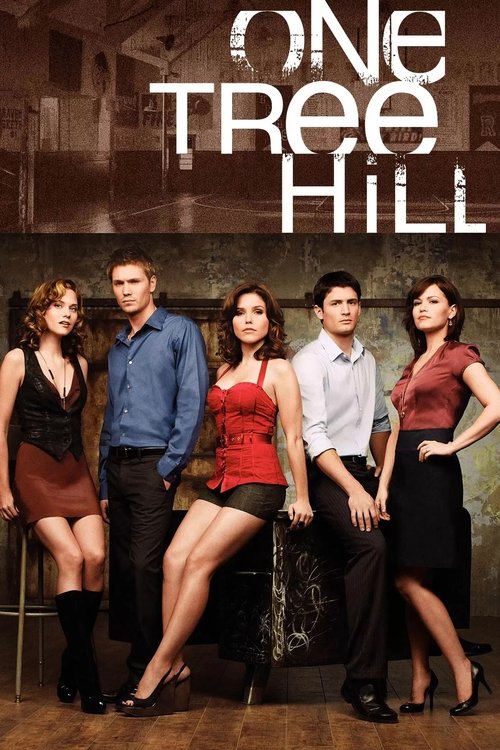
One Tree Hill backdrop
One Tree Hill poster

One Tree Hill

“Where nothing ever changed until one outsider changed everything.”

7.8
2003
9 Seasons • 187 Episodes
Drama

Overview

In Tree Hill, North Carolina two half brothers share a last name and nothing else. Brooding, blue-collar Lucas is a talented street-side basketball player, but his skills are appreciated only by his friends at the river court. Popular, affluent Nathan basks in the hero-worship of the town, as the star of his high school team. And both boys are the son of former college ball player Dan Scott whose long ago choice to abandon Lucas and his mother Karen, will haunt him long into his life with wife Deb and their son Nathan.

Sponsored

Trailer

One Tree Hill Theme song (intro/opening) season 1, 2, 3, 4 & 8

Cast

Reviews

AI-generated review
The Geography of Longing

Most high school dramas treat the hallway like the epicenter of teenage life—where every alliance forms, every bullying moment explodes, and every confessional whisper is passed along in that folded note. *One Tree Hill*, which kicked off its long run in 2003, chose something more open: the basketball court. It wasn’t simply a setting for games; it was a kind of purgatory where fathers’ mistakes landed squarely on their sons, and where a whole North Carolina town’s pecking order was written in sweat on cracked asphalt. Revisiting it now, the melodrama still shows up—there’s enough for a dozen daytime soaps—but what stays with me is how unshakably earnest it was about its characters’ inner lives.

The River Court at dusk, the setting sun casting long shadows over the basketball hoop.

Mark Schwahn, the creator and director, crafted a world that felt both suffocatingly narrow and somehow massive. At the heart of it are the Scott brothers—Lucas and Nathan—torn apart by names, jealousy, and a grudge that felt generational even though it started with a college basketball career their father Dan walked away from. I’ve always believed sports stories are less about plays than bodies. Check out how James Lafferty (Nathan) carries himself in the early episodes: squared-off shoulders, clenched jaw, the swagger of a teen convinced he’s untouchable. He has that archetypal villain strut. But as seasons pile up, you watch that posture loosen, bit by bit. The arrogance doesn’t flip into instant humility; instead it gives way to a rough, earned vulnerability. That kind of transformation is rare over the span of a feature film—let alone nine seasons of television.

There’s a scene early on where Lucas, played by Chad Michael Murray, is standing on the edge of the River Court holding a ball, not playing, just letting the weight of it settle in his hands. The camera stays with him. It waits. The show lets that silence stretch instead of cutting away. It’s a reminder that Tree Hill itself—humid, basketball-obsessed, fictional though it is—functions as the lead. Everyone there is trying to define themselves against someone else’s shadow.

Lucas Scott standing on the River Court, staring into the distance, clutching a basketball.

At the time, critics split over the show—some found its relentless sincerity refreshing, others dismissed it as overwrought “WB bait.” In *The New York Times*, Virginia Heffernan described the show’s atmosphere as “hothouse,” where emotions were always cranked to eleven. That’s fair. *One Tree Hill* never flirted with subtlety. It favored big, sweeping declarations, usually backed by indie-rock tracks you could tell came from a soundtrack cherry-picked by someone who lived in record stores. That lack of understatement is also why it lodged in the cultural memory of a generation. It didn’t treat teenage angst as a manageable phase; it treated it like a lived philosophy.

Sophia Bush’s Brooke Davis is the clearest proof the show could grow. She begins as the mean girl stereotype—a trust fund, a carefully guarded heart, a practiced performance of cruelty. Give her nine seasons, though, and you watch that armor come apart. She doesn’t just “become better”; she gathers scars. In later seasons, you can see the shift in her eyes: the frenzied, performative energy of high school settles into something weary, resilient, honest. She stops pretending to be who the world expects, and starts being a real person.

Brooke Davis looking out over a window, reflecting on her life's journey.

Whether the series still works is totally dependent on what you want from it. If you crave airtight plotting and strict logic, it will frustrate you. It often tosses realism out the window in favor of intense emotional payoffs, leaning into surreal or absurd moments just to keep the drama pulsing. But if you watch it for the way it captures youth—all the breakups that feel terminal, all the court victories that feel like championships—it remains an intriguing relic.

Looking back at the 2000s, it’s tempting to reduce shows like this to disposable product, churned out to sell denim and pop playlists. But *One Tree Hill* holds on to a human truth: we’re shaped by the people we were told to be, and there’s something both exhausting and beautiful about clawing our way toward who we actually are. It might not be perfect. It might never be called a masterpiece. Still, it stands as a long, messy, sometimes brilliant conversation about what it feels like to be alive, echoing against a chain-link fence that has seen more stories than it could ever hold.